
Metal Powder Market Expands Rapidly Amid Industrial Modernization
How rising investments in industrial modernization, automation technologies, and precision engineering are transforming production capabilities within the metal powder market

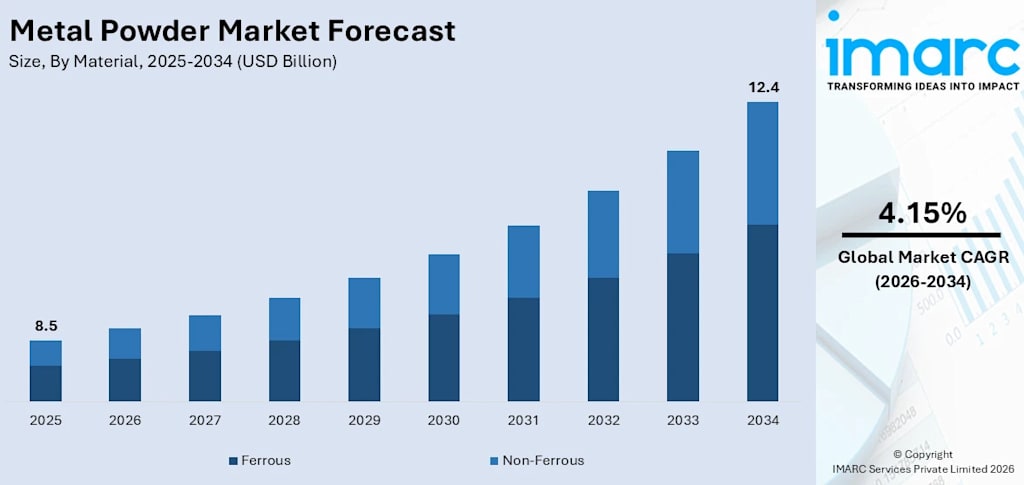
Accelerating industrial automation, structural automotive updates, and the expanding scope of localized digital production are driving global metal powder demand. This development is heavily backed by the rapid advancement of additive manufacturing, high-density component forging, and a widespread manufacturing shift toward minimizing raw material waste. According to IMARC Group’s latest data, the global metal powder market size was valued at USD 8.5 Billion in 2025. Looking forward, IMARC Group estimates the market to reach USD 12.4 Billion by 2034, exhibiting a CAGR of 4.15% from 2026-2034.
Metal powders now represent a highly engineered global asset class exceeding several billion dollars, marking a structural transition from traditional subtractive machining toward near-net-shape manufacturing. Industry growth is propelled by the rising necessity for lightweight automotive platforms, defense-grade high-temperature alloys, and ultra-fine formulations for high-density consumer electronics. Advanced processing techniques like gas and water atomization continue to scale, matching stricter corporate sustainability mandates through increased raw material recycling and a sharp reduction in secondary finishing steps.
Access Expert Analysis with the "Metal Powder Market" Sample PDF
Metal Powder Market Growth Drivers:
- Surge in Automotive Lightweighting Programs
Automotive manufacturers are actively replacing heavy cast components with lightweight, sintered metal powder parts to improve fuel efficiency and extend the driving range of modern vehicle fleets. This structural transition favors high-strength ferrous and aluminum powder formulations used to manufacture high-volume components like connecting rods, variable valve timing gears, and transmission hubs. The widespread integration of powder forging technology—which now accounts for approximately 30% of automotive connecting rods globally, enables the production of complex geometries with minimal post-machining waste.
- Rapid Industrialization of Additive Manufacturing
The rapid evolution of metal additive manufacturing (3D printing) from prototyping into full-scale industrial production is creating a massive demand for highly spherical, specialized metal feedstocks. Aerospace, defense, and medical equipment manufacturers utilize laser powder bed fusion and binder-jetting techniques to build complex, lightweight parts that are impossible to create via traditional casting. Commercial aircraft engine programs regularly incorporate thousands of pounds of high-performance superalloy powders to maximize component durability and shave off critical structural weight.
- Electronics Densification and Component Miniaturization
The consumer electronics and telecommunications infrastructure sectors are heavily driving the demand for ultra-fine, high-purity metal powders to manufacture next-generation micro-components. Techniques like metal injection molding (MIM) utilize micron-sized iron, stainless steel, and copper powders to produce intricate, high-density parts such as smartphone camera brackets, fiber-optic connectors, and wearable device internal hinges. As consumer hardware becomes increasingly compact, traditional machining techniques fail to deliver required dimensional tolerances economically.
Metal Powder Market Trends:
- Sustainability and Hydrogen-Based Production Routes
Metal powder producers are increasingly adopting eco-friendly production methods, including hydrogen-based direct reduced iron (DRI) processes and fluidized-bed electrolysis, to reduce carbon emissions and cut down the high energy footprints typically linked with standard atomization. This change is heavily supported by government-led net-zero initiatives and corporate supply chain sustainability mandates. Major industry players are shifting toward 100% recycled scrap metal as their primary feedstock, ensuring a highly circular material loop that eliminates primary ore processing extraction steps.
- Aerospace-Grade Hypersonic and Refractory Alloy Innovation
The aerospace and defense sectors are accelerating product testing and deployment of advanced refractory metal powders, such as titanium, tungsten, molybdenum, and tantalum, to support hypersonic flight and high-altitude space systems. These materials offer exceptional resistance to extreme thermal and corrosive conditions, making them vital for propulsion nozzles, heat shields, and specialized guidance components. Manufacturers are focusing heavily on particle size consistency and advanced vacuum processing to ensure that final components lack internal micro-porosity. Recent commercial milestones highlight aerospace suppliers executing large-scale distribution agreements to secure specialized stainless steel and titanium alloy powder grades for critical defensive applications.
- Medical Component Personalization via Biocompatible Powders
The medical device industry is undergoing a significant transformation by integrating additive manufacturing-grade titanium and cobalt-chromium powders to produce custom orthopedic implants, dental prosthetics, and personalized surgical instruments. These biocompatible metal powders allow for the engineering of porous, trabecular structures that mimic natural human bone architecture, significantly improving osseointegration and reducing the risk of implant rejection. Medical device manufacturers are moving away from standardized sizing, utilizing advanced scanning and 3D printing to create patient-specific solutions.
Recent News and Developments in Metal Powder Market
- May 2025: Outokumpu expanded its specialized additive manufacturing metal powder footprint into the global aerospace sector, successfully shipping its first commercial batch of a newly engineered, high-performance stainless steel powder grade tailored for complex 3D-printed aviation components.
- May 2025: Industrial manufacturing specialist Oerlikon Metco introduced its new "MetcoMed" brand, launching a dedicated portfolio of advanced metal powders engineered specifically for the additive manufacturing of high-precision medical components and patient implants.
- April 2025: Epson Atmix Corporation, a subsidiary of Seiko Epson Corporation, collaborated with Epson Europe Electronics GmbH to establish a new regional sales office in Munich, Germany, focusing on expanding its customized metal powder distribution network across European automotive hubs.
Note: If you require specific details, data, or insights that are not currently included in the scope of this report, we are happy to accommodate your request. As part of our customization service, we will gather and provide the additional information you need, tailored to your specific requirements. Please let us know your exact needs, and we will ensure the report is updated accordingly to meet your expectations.
About the Creator
Andrew Sullivan
Hello, I’m Andrew Sullivan. I have over 9+ years of experience as a market research specialist.
Enjoyed the story? Support the Creator.
Subscribe for free to receive all their stories in your feed.
Comments
There are no comments for this story
Be the first to respond and start the conversation.