
Metal Injection Molding Market Gains Momentum Through Innovation
How automotive electrification, miniaturized components, and advanced production technologies are accelerating innovation across the metal injection molding market

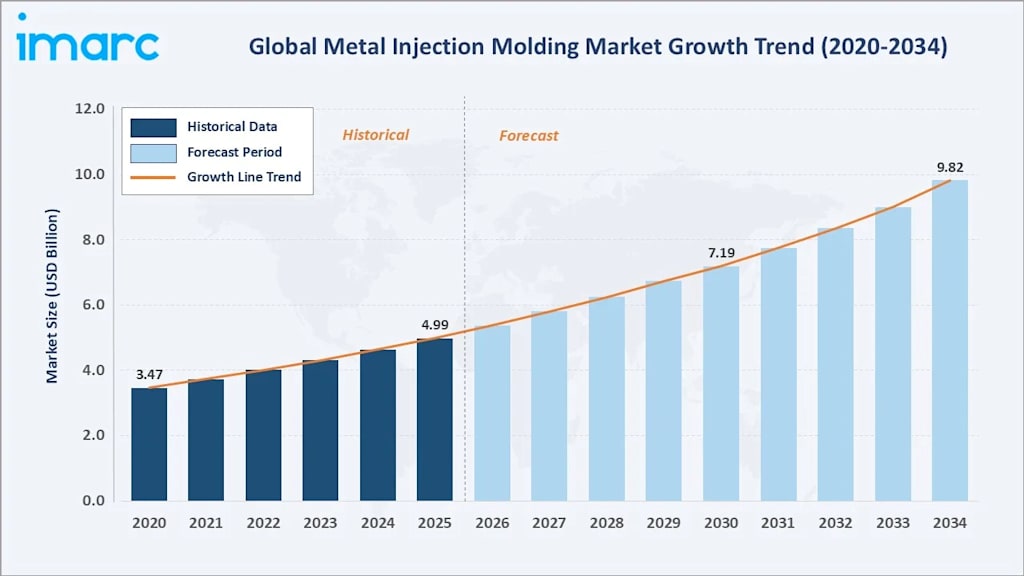
The growing requirement for complex, high-precision components across various sectors like automotive, consumer electronics, and medical devices is driving the metal injection molding demand, supported by the ongoing hardware miniaturization trend, advanced material usage, and growing adoption of smart manufacturing. According to IMARC Group’s latest data, the global metal injection molding market size was valued at USD 4.99 Billion in 2025. Looking forward, IMARC Group estimates the market to reach USD 9.82 Billion by 2034, exhibiting a CAGR of 7.57% from 2026-2034.
Metal injection molding now represents a multi-billion-dollar global industry exceeding a net valuation of USD 4.9 billion and exhibiting steady year-on-year expansion. Demand is driven by a rising manufacturing shift toward smaller, lighter, and more complex hardware that traditional machining cannot economically produce at scale. Industrial automation, the global transition to electric vehicles, and increased reliance on biocompatible metals are further accelerating uptake. Major segments include stainless steel, which holds a majority share of the market, alongside consumer products, medical devices, automotive, and defense sectors where contract manufacturers prioritize near-net-shape metallic parts, high density, and tight tolerances
Metal Injection Molding Market Growth Drivers:
- Growing Miniaturization Demand
The global trend toward smaller, lighter, and more complex hardware is accelerating the adoption of metal injection molding across high-tech industries. Devices such as smartwatches, wireless earbuds, and specialized IoT components increasingly rely on this manufacturing method to produce intricate internal geometries that traditional CNC machining cannot handle cost-effectively. Industry data shows that the global precision hardware sector relies heavily on this technology to keep pace with micro-engineering needs. Manufacturers are leveraging these dense, complex molds to pack more functionality into tighter physical spaces, ensuring modern consumer hardware remains ultra-compact yet highly durable.
- Medical Device Industry Expansion
The global medical device sector continues to expand rapidly, exceeding a valuation of USD 595 billion worldwide. This massive scale creates a continuous demand for surgical tools, orthodontic brackets, bone anchors, and drug delivery components that must meet strict quality standards. Metal injection molding provides the exact repeatable precision needed for these biocompatible parts. Healthcare equipment manufacturers use the technology to produce high-volume, intricate surgical instruments with exceptional surface finishes. The ability to utilize durable materials like stainless steel and titanium while maintaining absolute dimensional accuracy makes it an essential process for modern medical component manufacturing.
- Automotive Lightweighting and EV Transition
Automakers face immense pressure to reduce vehicle weight and enhance powertrain efficiency to meet modern environmental goals. Metal injection molding enables the mass production of complex gearbox components, fuel system parts, and electric vehicle motor actuators with design flexibility that traditional metalworking lacks. These molded components achieve mechanical properties and material densities that closely approach forged metal. By replacing heavy, multi-part assemblies with single, lightweight, net-shape components, automotive brands can streamline supply chains and improve overall energy efficiency.
Get Instant Access to the "Metal Injection Molding Market" Sample Report
Metal Injection Molding Market Trends:
- Defense and Firearms Modernization Programs
Global defense spending has scaled up significantly, pushing modernization programs to secure high-precision weapon and equipment components. Procurement teams are turning to metal injection molding for its unique capability to produce complex, high-strength parts like triggers, sears, and magazine catches at a much lower per-unit cost than traditional machining. The method ensures excellent consistency across massive production runs, which is a critical safety and operational requirement for defense hardware. This manufacturing shift allows defense contractors to maintain tight tolerances and strict quality controls while handling large-scale supply demands without bottlenecking operations.
- Material Innovations and Advanced Feedstocks
The ongoing development of specialized metal alloys, custom binder formulations, and ceramic-metal matrix feedstocks is opening new doors for component design. Modern manufacturing lines are no longer limited to basic steels; they now utilize custom formulations that offer enhanced thermal conductivity, magnetic performance, or extreme corrosion resistance. These material advancements allow engineers to specify exact physical properties for heavy-duty industrial appliances, aerospace brackets, and high-wear consumer hardware. By choosing advanced feedstock combinations, companies can eliminate post-molding heat treatments or secondary finishing steps, radically speeding up time-to-market for premium product lines.
- Integration of Smart Manufacturing and Hybrid Techniques
The convergence of metal injection molding with automated debinding systems, digital quality inspections, and hybrid additive manufacturing techniques is transforming production floors. Facilities are adopting real-time monitoring sensors to track pressure and temperature variances inside injection molds, minimizing defects and drastically lowering material waste. Furthermore, combining 3D-printed molds with traditional metal injection cycles allows for rapid prototyping and low-volume custom runs without the high upfront tooling costs. This smart integration optimizes energy consumption, keeps production lines nimble, and directly addresses the manufacturing sector's growing push for automated, resource-efficient operations.
Recent News and Developments in Metal Injection Molding Market
- August 2025: A prominent global powder metallurgy leader announced a strategic partnership with an automation specialist to integrate AI-driven quality inspection into their metal injection molding lines, drastically lowering component defect rates and speeding up delivery for consumer electronics clients.
- September 2025: A major medical component manufacturer completed a substantial facility expansion to house advanced vacuum sintering furnaces, doubling its capacity to produce high-volume titanium surgical components for the international healthcare market.
- January 2026: A tier-one defense contractor signed a long-term supply agreement with a specialized metal injection molding provider to secure high-volume, tight-tolerance components for its firearm and defense hardware modernization programs.
Note: If you require specific details, data, or insights that are not currently included in the scope of this report, we are happy to accommodate your request. As part of our customization service, we will gather and provide the additional information you need, tailored to your specific requirements. Please let us know your exact needs, and we will ensure the report is updated accordingly to meet your expectations.
About the Creator
Andrew Sullivan
Hello, I’m Andrew Sullivan. I have over 9+ years of experience as a market research specialist.
Enjoyed the story? Support the Creator.
Subscribe for free to receive all their stories in your feed.
Comments
There are no comments for this story
Be the first to respond and start the conversation.