
Metal Casting Market: Energy-Efficient Processes, Recycling Trends & Industry Growth
How sustainable foundry practices, recycled metal utilization, and energy-efficient production technologies are reshaping operational strategies and environmental performance in metal casting.

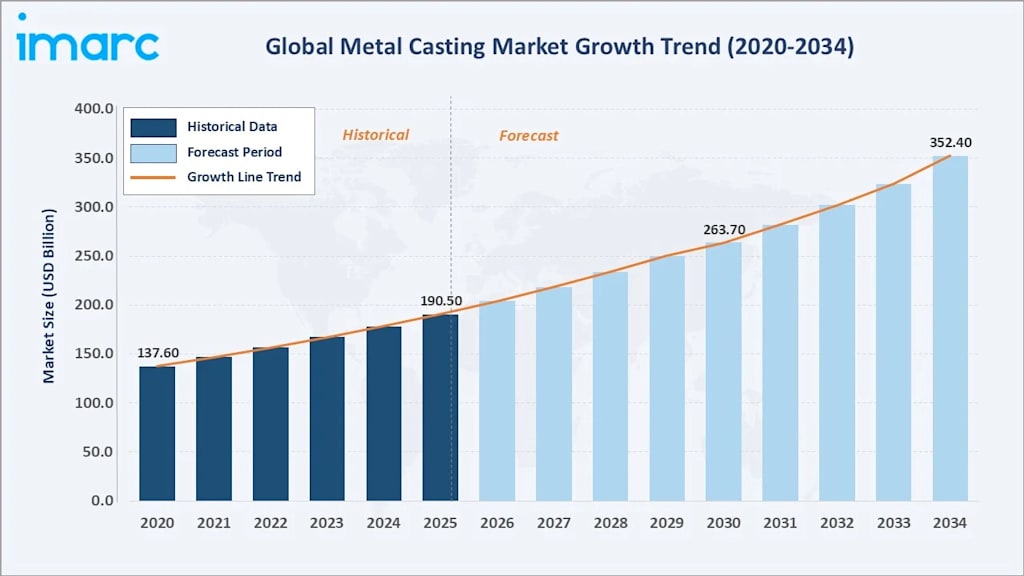
Rising demand from the automotive, construction, and heavy machinery sectors, alongside a shifting focus toward lightweight components, is driving the metal casting demand, supported by technological advancements, automated foundry systems, and expanding industrial infrastructure. According to IMARC Group’s latest data, The global metal casting market size was valued at USD 190.5 Billion in 2025. Looking forward, IMARC Group estimates the market to reach USD 352.4 Billion by 2034, exhibiting a CAGR of 6.70% from 2026-2034.
Metal casting represents a fundamental global manufacturing pillar, generating complex components across critical economic supply chains. Production activities are anchored heavily by sand casting methods and cast iron materials, which provide the high tensile strength, durability, and vibration-damping traits essential for heavy engineering. The rapid integration of robotic handling, digital simulation software, and 3D-printed molds has significantly accelerated lead times while decreasing material waste. Foundries are aligning operations with broader circular economy principles, reusing millions of tons of scrap metal annually to meet the dual demands of corporate sustainability goals and high-volume industrial outputs.
Metal Casting Market Growth Drivers:
- Accelerating Automotive Production and Electric Vehicle Integration
Automakers increasingly replace traditional heavy components with lightweight aluminum and magnesium castings to enhance vehicle efficiency and range. With global electric vehicle sales reaching tens of millions of units annually, the reliance on high-precision die casting has surged. Foundries now deliver complex components such as battery enclosures, motor housings, and structural chassis parts. This industrial pivot directly drives high-pressure manufacturing operations, ensuring vehicle platforms meet stringent structural safety guidelines while shaving critical pounds off the overall assembly to accommodate modern battery weights.
- Expanding Large-Scale Global Infrastructure Development
Massive public works investments in transport systems, water distribution pipelines, and structural building frameworks provide sustained momentum for industrial foundries. National logistics and urban development frameworks supply steady demand for durable cast products such as heavy-duty valves, structural joints, and pipes. Because metal casting offers distinct advantages in cost efficiency and component scalability, engineering firms consistently prioritize these components for large-scale construction machinery. This ongoing built-environment expansion ensures high-capacity manufacturing runs remain a core priority for industrial casting operations across emerging economies.
Unlock Free "Metal Casting Market" Data & Forecast Sample PDF
- Rapid Industrial Automation and Machinery Upgrades
Heavy machinery, mining equipment, and energy generation sectors depend heavily on precision-engineered castings to sustain intensive daily workloads. Modern manufacturing plants require specialized components capable of withstanding extreme thermal environments and high pressure. Foundries are expanding their technical capabilities to produce intricate, low-volume components through advanced investment casting processes. The continuous modernization of factory floors and global power generation facilities, including wind turbine assemblies, secures an active pipeline for high-strength steel and iron castings across diverse manufacturing corridors.
Metal Casting Market Trends:
- Widespread Adoption of Automation and Smart Foundry Solutions
Foundries are aggressively modernizing legacy production lines with automated robotic handling systems, smart melting furnaces, and artificial intelligence-enabled quality inspection platforms. This systematic shift minimizes human error, improves worker safety in high-temperature environments, and dramatically reduces scrap rates during large-scale manufacturing runs. Furthermore, operators utilize advanced digital simulation software to map molten metal flows before pouring. This predictive engineering approach allows companies to catch structural vulnerabilities early, optimize mold layouts, and maximize energy efficiency during intensive production cycles.
- Integration of 3D Printing and Digital Tooling
The deployment of additive manufacturing technologies for creating intricate sand molds and cores has transformed traditional tooling timelines. 3D printing allows engineers to bypass expensive, time-consuming hard tooling phases, enabling fast prototyping and the cost-effective creation of highly complex geometries. This application proves highly beneficial for defense, aerospace, and specialized industrial machinery where low-volume, customized parts are frequently required. By eliminating standard design constraints, foundries seamlessly deliver complex internal channels and optimized walls that traditional molding techniques simply cannot replicate.
- Strict Alignment with Circular Economy and Recycling Standards
Industrial casting facilities are maximizing their position as primary collectors and consumers of scrap metal, processing millions of tons of waste material back into premium-grade components each year. Foundries are actively deploying energy-efficient electric arc furnaces and advanced sand reclamation systems to recondition and reuse molding materials multiple times. Driven by corporate sustainability initiatives and rising input costs, these circular loops lower dependency on virgin raw materials. This operational strategy significantly decreases the manufacturing carbon footprint while protecting profit margins from unpredictable global supply chain disruptions.
Recent News and Developments in Metal Casting Market
- May 2024: The Government of India accelerated infrastructure allocations exceeding billions of dollars under the PM Gati Shakti national master plan, directly stimulating regional foundry orders for transport and construction equipment components.
- January 2025: Major global automakers, including Ford and General Motors, expanded their strategic utilization of advanced aluminum structural castings within their latest electric vehicle platforms to optimize battery space and chassis rigidity.
- November 2025: GE Aerospace implemented advanced precision investment casting systems across its production facilities to manufacture next-generation turbine blades designed to withstand higher operating temperatures and stress levels.
Note: If you require specific details, data, or insights that are not currently included in the scope of this report, we are happy to accommodate your request. As part of our customization service, we will gather and provide the additional information you need, tailored to your specific requirements. Please let us know your exact needs, and we will ensure the report is updated accordingly to meet your expectations.
About the Creator
Andrew Sullivan
Hello, I’m Andrew Sullivan. I have over 9+ years of experience as a market research specialist.
Enjoyed the story? Support the Creator.
Subscribe for free to receive all their stories in your feed.
Comments
There are no comments for this story
Be the first to respond and start the conversation.