
Metal Additive Manufacturing Market: How Printing Metal Parts Layer by Layer Became a USD 145 Billion Industrial Revolution
Boeing, GE Aviation, and Lockheed Martin are qualifying flight-critical parts built from digital files — the metal additive manufacturing market is growing at 23.8% annually and the aerospace sector is just the beginning

In 2016, GE Aviation flew the first commercial jet engine containing a fuel nozzle tip manufactured entirely by metal additive manufacturing. That single component — printed from a cobalt-chrome alloy in a powder bed fusion machine rather than assembled from twenty separate cast and machined parts — was 25% lighter, five times more durable, and geometrically impossible to produce any other way. Today, GE manufactures over 100,000 additive components annually across its aviation programs.
That fuel nozzle tip was the moment the aerospace industry understood what metal additive manufacturing could actually do. Not demonstrate. Not prototype. Actually do — in production, on certified flight hardware, at scale.
The global metal additive manufacturing market was valued at USD 17.24 billion in 2025 and is projected to reach USD 145.80 billion by 2035, growing at a CAGR of 23.8%. Aerospace, defense, and medical manufacturers are driving adoption as metal AM moves decisively from prototyping into serial production across the most demanding applications in the manufacturing world. The complete analytical breakdown — covering technologies, applications, materials, components, and regional forecasts through 2035 — is documented in the metal additive manufacturing market report from Evolvance Market Research.
Metal Additive Manufacturing Market Size and Growth
The Wohlers Report 2026 valued total additive manufacturing revenues at USD 24.2 billion in 2025 — with AM services representing 48% of total market value and growing 15.5% in 2025 alone. That services growth is significant because it signals a maturing market where buyers who cannot yet justify capital investment in their own systems are accessing production capability through service bureaus — building the business case for eventual in-house deployment.
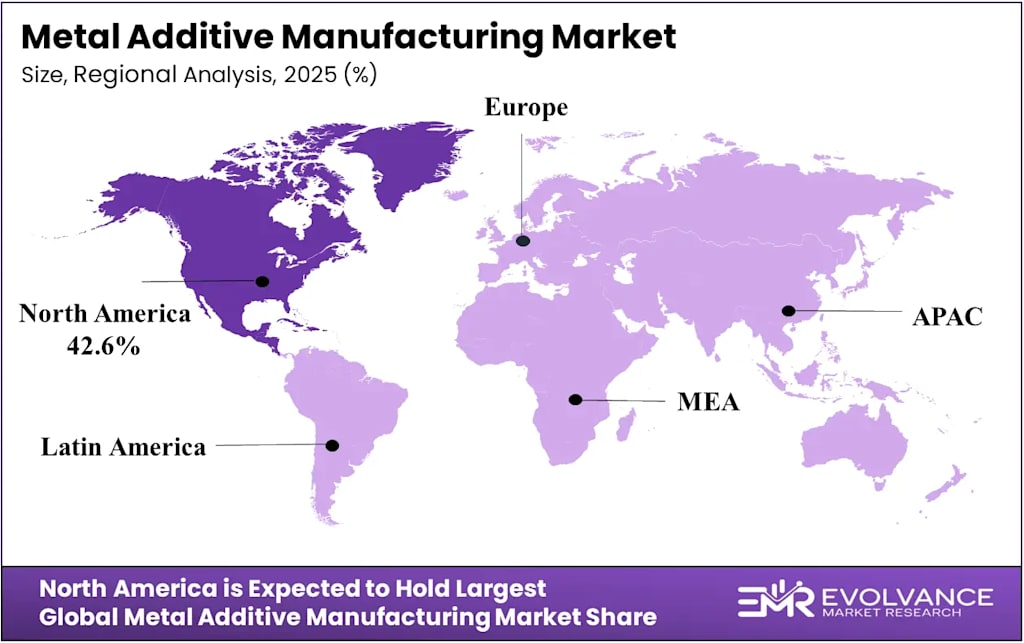
North America holds the largest regional share at 42.6%, valued at USD 7.32 billion in 2025. The United States alone accounts for approximately 94% of that figure — reaching USD 6.91 billion in 2025 and projected to grow to USD 27.67 billion by 2035 at a CAGR of 14.9%. The concentration of aerospace prime contractors, defense programs, and medical device manufacturers in the US creates a demand base for metal AM that no other country currently matches.
Asia Pacific is growing fastest — averaging 19.8% revenue growth in 2025 — driven by China's state-backed additive manufacturing programs targeting aerospace independence and automotive lightweighting, and by Japan and South Korea's precision manufacturing industries adapting metal AM for high-value component production. Global metal AM system shipments reached 3,793 units in 2023, a 24.4% increase from 2022 — confirming that capital investment in production capability is accelerating sharply.
Check Out This: Metal Additive Manufacturing Market Research PDF
Metal Additive Manufacturing Market Trends: Powder Bed Fusion Dominates
Powder Bed Fusion dominates the technology segment with a 49.3% market share — and the reason is straightforward. PBF processes — Selective Laser Melting and Electron Beam Melting — deliver the combination of geometric complexity, dimensional accuracy, and material property consistency that aerospace and medical certification programs require. When a component needs to meet FAA or FDA qualification standards, the process consistency and documentation capability of mature PBF systems provides the validation pathway that other metal AM technologies cannot yet reliably match.
Directed Energy Deposition is the technology showing the most interesting growth trajectory for a different reason — repair and remanufacturing. DED can deposit material onto existing components, rebuilding worn surfaces and repairing damaged geometries that would otherwise require complete part replacement. For aerospace maintenance operations and heavy industrial equipment repair, the economics of DED-based restoration versus part replacement are compelling in high-value component categories.
Binder Jetting is the technology that most directly targets high-volume production economics. Desktop Metal's Production System uses binder jetting to produce metal parts at costs competitive with die casting — without tooling investment — making it the first metal AM process whose economics work for mass production of relatively simple geometries. The automotive sector is watching this development closely as a potential supply chain disruption for cast metal components.
Metal Additive Manufacturing Market Segments: Aerospace Leads With 36.8%
Aerospace and defense leads the application segment with a 36.8% share — anchored by flight-critical part qualification programs at Boeing, GE Aviation, and Lockheed Martin that have invested years and significant capital in developing the process validation and material databases needed to certify additively manufactured components for flight use. That qualification investment creates a structural barrier to entry for new vendors and a durable competitive advantage for established aerospace AM service providers with certified material and process portfolios.
Medical and dental applications represent the second major pillar of metal AM demand — and the fastest-growing in value terms. Patient-specific implants manufactured from titanium alloy and cobalt-chrome — hip replacements, spinal fusion devices, dental prosthetics — are reaching patients who benefit from components designed specifically to their anatomy rather than selected from a standard size range. The combination of improved outcomes and premium pricing makes medical the highest-margin application category in the metal AM market.
Automotive is the application segment with the most contested growth narrative. Traditional automotive volumes — millions of units annually — appear incompatible with metal AM economics at first glance. The reality is more nuanced. Electric vehicle programs are creating new component categories where design freedom and performance optimization matter more than unit cost minimization. Formula 1 and motorsport have used metal AM for performance components for over a decade. Production applications are growing in low-volume, high-value vehicle programs where the tooling cost savings of additive manufacturing justify the higher per-part cost.
Metal Additive Manufacturing Materials: Titanium Commands Premium Pricing
Titanium alloys command the highest revenue share and the highest per-kilogram pricing among all metal AM materials — driven by aerospace demand for components that combine the highest strength-to-weight ratio with corrosion resistance in extreme environments. The combination of titanium's material properties and additive manufacturing's geometric freedom creates components that are simply impossible to manufacture any other way at acceptable cost.
Nickel superalloys — Inconel 625 and 718 in particular — serve the turbine engine segment where operating temperatures exceed the capability of titanium. The ability to print internal cooling channels directly into turbine components is one of the original value propositions of metal AM for jet engine manufacturers — a capability that delivers measurable performance improvements in fuel efficiency and component life.
Stainless steels and aluminum alloys serve the broader industrial and automotive markets where the material cost and processing requirements are more accessible. Cobalt-chrome is the dominant material for dental and orthopedic implants where biocompatibility and wear resistance are the primary selection criteria.
Key Players in the Metal Additive Manufacturing Market
EOS anchors the powder bed fusion market with industrial systems that have become the de facto standard in aerospace and medical production environments. GE Additive brings aerospace manufacturing credibility and integration with GE's own jet engine programs. Trumpf competes strongly in the European market with laser metal fusion and DED systems. Arcam — now part of GE Additive — leads in electron beam melting for titanium aerospace and medical implant applications.
Desktop Metal is pursuing the automotive and industrial mass production market with binder jetting technology. Markforged focuses on metal extrusion systems at lower capital cost for engineering and tooling applications. The competitive landscape is consolidating through strategic investment and acquisition as the market moves from technology demonstration toward production-scale operations that require the financial depth and application expertise of larger organizations.
GE Aviation's 100,000 annual additive components is not a ceiling. It is a baseline for what this market becomes over the next decade.
About the Creator
Suge kun
Research Analyst passionate about data & market insights. I turn complex information into clear, actionable strategies. Detail-driven & results-focused — helping businesses make smarter decisions. — Suge Kun
Enjoyed the story? Support the Creator.
Subscribe for free to receive all their stories in your feed.
Comments
There are no comments for this story
Be the first to respond and start the conversation.