
Men's Hair Care Market: The USD 75 Billion Industry Built on a Generation of Men Who Finally Started Reading the Label
From two-in-one shampoo to scalp serums and bond repair — the global men's hair care market is growing faster than almost anyone predicted

There is a generational shift happening in bathroom cabinets that nobody talks about enough. For decades, the men's hair care routine was simple to the point of being almost deliberately minimal — a bottle of two-in-one shampoo, maybe some gel, done. The idea that a man might own a separate shampoo, conditioner, scalp serum, and hair oil was either aspirational marketing that never quite landed or the exclusive territory of a small grooming-obsessed minority.
That world is changing fast. Gen Z men in particular have grown up watching skincare and hair care content on social media, absorbing ingredient education and routine advice that their fathers never had access to. The result is a generation of male consumers who know what sulfates do, who understand why scalp health matters, and who are willing to pay premium prices for products that genuinely work differently from the basic options.
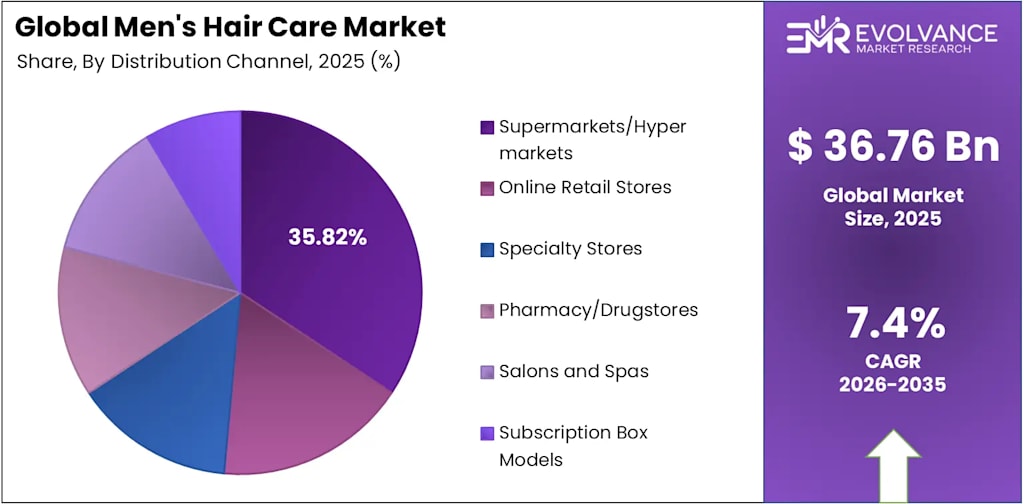
The global men's hair care market size was valued at USD 36.76 billion in 2025 and is projected to reach USD 75.06 billion by 2035, growing at a CAGR of 7.4%. Rising male grooming awareness, Gen Z adoption of multi-step hair routines, and clinical investment in scalp health are pushing category spend well beyond basic shampoo. For brand strategists, investors, and industry professionals who need the complete picture — covering product types, hair concerns, price segments, distribution channels, and regional forecasts through 2035 — the full research is available in the men's hair care market report from Evolvance Market Research.
Men's Hair Care Market Size and Growth
North America leads all regions with a 36.8% share valued at USD 13.50 billion in 2025 — driven by high per-capita grooming spend, mature retail infrastructure, and a DTC brand ecosystem that has made premium men's hair care genuinely accessible outside traditional retail channels.
The US market specifically reaches USD 9.2 billion in 2025, growing to USD 13.55 billion by 2035 at a 4.4% CAGR. That growth rate sits below the global average — reflecting a mature market where volume is established and growth depends on premiumization and clinical category expansion rather than new buyer acquisition. US hair care imports hit USD 1.41 billion across 208.3 million kilograms in 2024, confirming deep consumption at scale that supports both mass incumbents and specialty DTC entrants simultaneously.
China is the market showing the most dynamic growth within the men's hair care category — reaching USD 10.7 billion in 2025 and expanding to USD 18.70 billion by 2035 at a 6.4% CAGR. Rising disposable income among urban male consumers, rapid adoption of multi-step grooming routines, and strong import demand for international brands are all contributing to growth that outpaces the US and approaches the global average.
Men's Hair Care Market Trends: Clinical Grade Is the New Premium
The most important trend reshaping the men's hair care market right now is the migration of premium positioning from aesthetic to clinical. The old model of men's premium hair care was about fragrance, packaging, and brand prestige. The new model is about functional ingredients, dermatologist endorsement, and measurable results.
Hair loss is the fastest-growing concern segment in the entire men's hair care market, growing at a 6.11% CAGR. Clinical-grade treatment products from brands like Hims and Veradermics are accelerating consumer adoption of prescription-adjacent hair care — bringing minoxidil, finasteride, and biotin-complex formulations into a grooming category that was previously defined by styling products and basic cleansing.
This clinical shift is significant because it changes the pricing conversation entirely. A man who believes a product will genuinely slow or reverse hair thinning will pay significantly more for it than he would for a premium shampoo — the perceived value is incomparable. Brands that can credibly bridge clinical efficacy and accessible retail positioning are building pricing power that the men's hair care market has never historically supported.
Bond repair technology — originally developed for chemically treated and heat-damaged hair — is finding a growing men's market as color-treated hair becomes more mainstream among younger male consumers. The men's hair colorant segment, while still small relative to women's, is one of the fastest-growing product categories in the men's grooming space.
Men's Hair Care Market Segments: Mass Still Rules, Premium Is Gaining
Shampoo dominates by product type with a 34.25% revenue share — anchored by high purchase frequency and mass-market penetration across every geography. But the story within shampoo is premiumization. Men who have adopted scalp-first thinking are trading up from mass two-in-one formulations to dedicated scalp-care shampoos with active ingredient stories that justify meaningfully higher price points.
The mass price segment commands 78.10% of revenue — confirming that most men's hair care purchases are still made on value and convenience rather than ingredient sophistication. But premium and mid-range tiers are expanding faster than mass, as male consumers with established routines consistently trade up for functional benefits once they understand what those benefits deliver.
Styling products represent a large and stable segment — but the styling product the modern male consumer wants increasingly looks different from the gels and waxes that dominated a decade ago. Lightweight creams, defining oils, and texture sprays that work with natural hair movement rather than against it are taking share from traditional hold products whose stiff, heavy finishes have fallen out of favour with younger consumers.
Men's Hair Care Market Distribution: Online Discovery, Offline Purchase
Supermarkets and hypermarkets control 35.82% of distribution revenue — still the dominant channel where the majority of men make routine repurchase decisions quickly and efficiently. But online retail is the fastest-growing channel, and its role in the men's hair care market specifically goes beyond transaction volume.
Men who are exploring new categories — moving from basic shampoo to scalp treatment, or trying hair loss products for the first time — do significant research online before making their first purchase. Reviews, ingredient comparisons, before-and-after results, and dermatologist content all influence trial decisions in ways that in-store shelf positioning simply cannot replicate.
Subscription box models are an emerging distribution format with particular relevance to men's hair care — offering curated discovery experiences that expose male consumers to premium products they would not have independently sought out in a traditional retail environment. For brands targeting the trade-up journey from mass to premium, subscription models represent one of the most efficient trial acquisition channels available.
Key Players in the Men's Hair Care Market
Procter and Gamble's Head and Shoulders and Old Spice anchor the mass end. Unilever's Dove Men Plus Care has successfully extended the Dove trust platform into male grooming. American Crew maintains strong professional salon distribution and aspirational brand positioning in men's styling.
The most interesting competitive action is at the DTC clinical end — where Hims has built a genuinely differentiated business by combining prescription hair loss treatment with grooming product subscriptions in a single platform. That combination of clinical credibility and subscription economics is a model that legacy personal care companies are now actively trying to replicate or acquire.
The man who reads the label is a relatively new consumer. By 2035, there will be tens of millions more of him — and the USD 75 billion market being built around his preferences is only getting started.
About the Creator
Suge kun
Research Analyst passionate about data & market insights. I turn complex information into clear, actionable strategies. Detail-driven & results-focused — helping businesses make smarter decisions. — Suge Kun
Enjoyed the story? Support the Creator.
Subscribe for free to receive all their stories in your feed.
Comments
There are no comments for this story
Be the first to respond and start the conversation.