
Manga Market Trends: Anime Adaptations, Online Platforms & Forecast to 2034
How digital publishing platforms, mobile reading apps, and expanding global fan communities are transforming accessibility and consumption patterns in the manga market

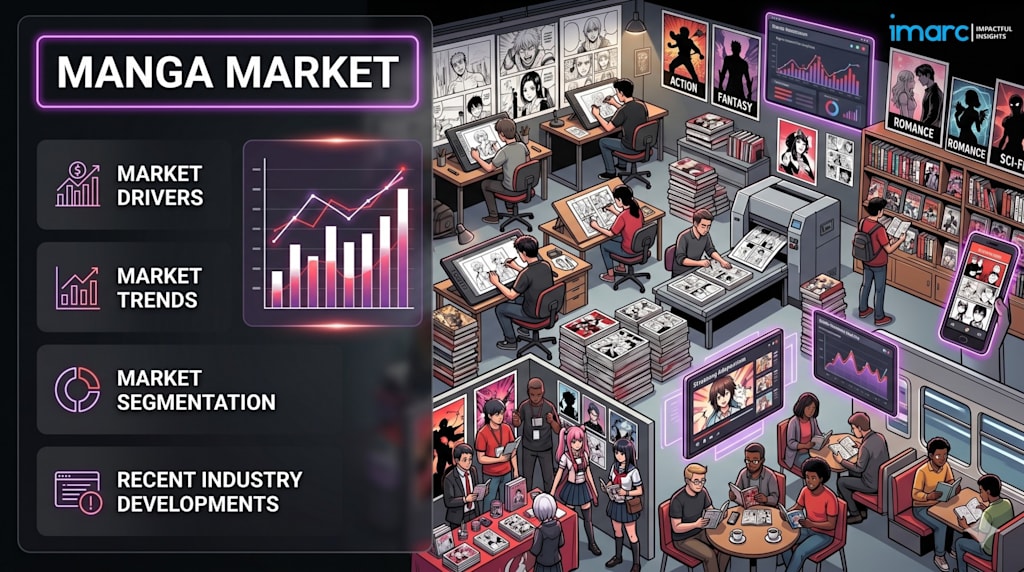
According to IMARC Group's latest research publication, the global manga market size reached USD 17.7 Billion in 2025. Looking forward, IMARC Group expects the market to reach USD 58.8 Billion by 2034, exhibiting a growth rate (CAGR) of 13.83% during 2026-2034.
How AI is Reshaping the Future of the Manga Market
- AI-Powered Localization and Translation at Scale: AI-driven localization platforms are fundamentally changing how manga reaches international readers by enabling rapid, high-quality multilingual translation without the prolonged timelines associated with traditional human-only workflows. AI localization start-up Orange secured USD 20 million in funding in May 2024 to scale its multilingual translation capacity from 100 to over 1,000 volumes per month while retaining human quality control oversight. This capability allows publishers to release titles simultaneously or near-simultaneously across multiple language markets, eliminating the long waiting periods that previously pushed international readers toward piracy and unauthorized scans. By compressing localization timelines and reducing per-volume costs, AI translation tools are enabling smaller publishers and independent creators to access global audiences that were previously only accessible to major publishing houses with substantial localization budgets.
- Recommendation Engines and Reader Retention on Digital Platforms: Machine learning recommendation systems embedded within manga platforms are lifting reader completion rates, increasing subscription renewals, and driving higher microtransaction volumes by personalizing content discovery for each user. Webtoon portals using AI-powered recommendation engines reported a 14% rise in advertising CPM yields in 2024, as brand marketers concentrated their spend in content-safe, high-engagement environments attracting Gen Z readership. These systems analyze reading speed, genre preferences, drop-off points, and session frequency to surface titles most likely to retain individual readers beyond initial sampling. Publishers are now designing titles specifically for scrolling-optimized formats based on behavioral feedback data these platforms generate, enabling near-real-time story pivot decisions driven by reader engagement metrics rather than traditional editorial intuition alone.
- Piracy Detection and IP Protection Systems: AI-based content fingerprinting and web crawling tools are being deployed by major publishers to identify unauthorized reproduction and distribution of manga across piracy networks, a segment that wiped an estimated USD 12.5 billion from global manga industry revenue in 2024. These tools scan image repositories, torrent networks, and gray-market aggregator sites to flag infringing content and automate takedown request workflows at a speed and scale impossible for manual monitoring teams. Publishers including Kodansha and Shueisha have invested in AI-assisted rights enforcement infrastructure as part of broader IP protection strategies, recognizing that containment of piracy is as material to revenue growth as new title development. The ability to detect and respond to unauthorized content within hours of release rather than weeks is materially improving the effectiveness of piracy suppression efforts across major international markets.
- Content Creation Support and Production Optimization: Generative AI tools are increasingly being adopted by manga studios and independent creators for background generation, panel layout assistance, and tonal consistency checking, reducing production time per chapter without displacing the creative judgment of human mangaka. Publishers design data pipelines that aggregate reader response signals from serialized digital releases, feeding editorial teams with real-time information on which narrative arcs, character dynamics, and genre elements are resonating most strongly with specific audience segments. Sony Group Corporation's USD 87 million investment in Shogakukan in May 2024 specifically targeted digital business strengthening and global expansion, reflecting the broader industry recognition that technology infrastructure underpins competitive positioning in the international manga market. Kadokawa Corporation received a further JPY 50 billion investment from Sony in October 2024 to fund new IP production and overseas distribution, with AI-assisted production workflows central to scaling output without proportional cost increases.
- Digital Subscription Analytics and Monetization Intelligence: AI analytics platforms are enabling manga publishers and platform operators to optimize subscription pricing, bundle design, and promotional timing by analyzing behavioral data across millions of active users simultaneously. The digital segment accounted for over 80% of manga revenue in 2024 in key markets including the United States, and premium e-book bundle formats reached a 38.45% share of the digital segment in 2025, with AI-driven upsell and cross-sell prompting contributing materially to that growth. Subscription models powered by machine learning churn prediction tools are enabling platforms to identify at-risk subscribers and deploy targeted retention interventions before cancellation decisions are made, improving lifetime value metrics across both individual and household account tiers.
Manga Industry Overview:
The global manga industry has moved well beyond its origins as a niche Japanese publishing format to become a mainstream global entertainment category with deep penetration across North America, Europe, Southeast Asia, and emerging markets including India. Manga covers a wide range of genres, including action, romance, fantasy, science fiction, horror, sports, and comedy, and follows a distinctive right-to-left reading format using visual storytelling techniques such as exaggerated facial expressions, dynamic action sequences, and intricate background artwork. It is serialized in magazines or released in tankobon volumes collecting multiple chapters into a single bound edition.
The industry's international expansion has been driven by the convergence of digital platform proliferation, anime adaptation popularity, and growing global appetite for Japanese cultural content across fashion, food, music, and entertainment. Digital formats accounted for 72.7% of manga consumption in 2025, with online channels commanding 68.55% of total sales, reflecting a structural migration from physical retail toward app-based and web-based reading that has compressed distribution costs and opened new revenue models including subscriptions and microtransactions. Publishers now derive approximately 27% of income from licensing, streaming, and merchandising, reinforcing franchise economics that extend the commercial life of individual IP well beyond initial serialization.
Japan's domestic manga market reached a record above JPY 700 billion for the first time in 2024, though a 1.7% contraction to JPY 693 billion followed in 2025 as physical manga volumes declined 14.4% year-on-year following the conclusion of several blockbuster series including My Hero Academia, Jujutsu Kaisen, and Oshi no Ko. The contraction underscores the structural dependence of print segment revenue on the performance of a small number of flagship titles, while confirming the irreversible shift toward digital consumption as the industry's long-term growth engine. International markets, led by North America and Asia Pacific ex-Japan, are expanding rapidly enough to more than offset domestic print softness at the global market level.
Manga Market Trends and Drivers:
The expanding distribution of manga titles through digital platforms and rapid globalization is acting as a significant growth driver across the global market. With the emergence of platforms offering translated versions in multiple languages, manga has transcended geographical boundaries and eliminated physical distribution limitations, enabling publishers to reach readers without location restrictions. Media Do, NTT Docomo, and Akatsuki launched the Manga Mirai platform in the United States in March 2025 with over 11,000 volumes across 780 titles, cross-promoted through MyAnimeList, exemplifying the scale at which Japanese publishers are now pursuing international digital distribution as a primary revenue expansion strategy rather than an ancillary channel.
The increasing number of anime adaptations plays an instrumental role in driving manga readership globally. When an anime series adapted from a manga title gains traction on streaming platforms, it generates substantial exposure among audiences who are not active manga readers, prompting a measurable proportion of that new audience to engage with the source material for additional story depth or content beyond the animated episodes. Shueisha's strategic partnership with Netflix in March 2024 to produce original anime series based on manga titles including Jujutsu Kaisen and One Piece reflects the calculated use of streaming platform relationships to amplify IP reach and funnel new readers back to the manga. The success of an anime adaptation and the popularity of the underlying manga reinforce each other in a positive feedback loop that elevates sales, merchandise licensing, and platform subscription numbers simultaneously.
The presence of a diverse range of genres and target audiences is also influencing market growth positively. Manga encompasses action, romance, fantasy, science fiction, horror, sports, and comedy, allowing it to engage readers across different age groups, cultural backgrounds, and preference profiles simultaneously. The Shonen genre, targeting younger male readers through action and adventure-heavy narratives, held more than half of the global manga comics market in 2024, sustained by high serialization frequency and strong licensed translation coverage across international markets. Meanwhile, the growing influence of Korean manhwa and Chinese manhua formats alongside traditional Japanese manga is expanding the broader category's reader base and introducing vertical-scroll reading conventions that publishers are increasingly adopting to optimize content for mobile consumption.
Leading Companies Operating in the Global Manga Industry:
- Akita Publishing Co. Ltd.
- Archie Comic Publications Inc.
- Bilibili Comics Pte. Ltd.
- Futabasha Publishers Ltd.
- Good Smile Company Inc.
- Kadokawa Corporation
- Kodansha Ltd.
- Nihon Bungeisha Co. Ltd. (Media Do Co. Ltd.)
- Seven Seas Entertainment Inc.
- Shogakukan Inc. (Hitotsubashi Group)
Manga Market Report Segmentation:
By Type:
- Printed
- Digital
Digital represents the largest segment, driven by the convenience of accessing vast title libraries across smartphones, tablets, and e-readers without location or time restrictions. The digital segment accounted for over 80% of manga revenue in the United States in 2024 and held a 72.12% share of global manga market revenue in 2025. Printed manga retains a dedicated audience among collectors and enthusiasts who value the physical presence of artwork, limited-edition series, and the tactile experience of high-quality tankobon volumes that digital formats cannot replicate.
By Genre:
- Action and Adventure
- Sci-Fi and Fantasy
- Sports
- Romance and Drama
- Others
Action and adventure represents the largest genre segment, driven by the manga medium's particular effectiveness in depicting high-impact action sequences through detailed panel artwork and dynamic visual composition. The Shonen genre within this category accounted for more than half of the global manga comics market in 2024, sustained by serialization frequency, strong international licensing coverage, and the deep investment readers develop in protagonist-centered character development arcs. Romance and drama, sports, and science fiction genres collectively serve a wide and diverse reader base with varying narrative preferences, further reinforcing manga's cross-demographic market reach.
By Audience:
- Children and Kids (Aged below 10 years)
- Teenagers (Aged between 10 to 16 years)
- Adults (Aged above 16 years)
Children and kids represent the largest audience segment, drawn to manga through vibrant illustrations, expressive character designs, captivating narratives, and age-appropriate themes that integrate educational elements alongside entertainment. Teenagers and adults are increasingly engaging with manga as a mainstream entertainment format, with adults in the United States holding the largest adult segment revenue share in 2024, driven by the adaptation of mature-themed manga into successful series on streaming platforms including Netflix and Crunchyroll. Manga now accounts for 43% of high school graphic novel purchases in U.S. school libraries, reflecting structural adoption across the teenage reading market.
By Gender:
- Male
- Female
Male readers represent the largest gender segment, drawn to manga through character-driven narratives featuring strong male protagonists, dynamic action scenes, detailed illustration styles, and emotive visual storytelling that caters directly to Shonen and Seinen genre preferences. Female readership is growing at a faster rate in key markets, driven by the introduction of diverse female protagonists, relatable character dynamics, and emotionally complex narratives in Shojo and Josei formats that explore relationships, personal identity, and character development in depth. The number of influential female manga creators is expanding internationally, contributing to a broadening of genre diversity and narrative perspectives that is attracting a larger and more varied female readership.
By Distribution Channel:
- Online
- Offline
Online holds the largest distribution channel share, driven by global accessibility without geographical limitations and the immediate availability of vast title libraries that eliminate the need for physical store visits. The online segment commanded 68.55% of total global manga sales in 2025, supported by e-commerce platforms, digital subscription services, and dedicated manga apps offering cost-effective access models. Offline channels retain importance for the collector segment and for readers who value the community experience of specialist comic retailers, manga-themed events, and artist signings that physical stores facilitate.
Regional Insights:
- North America (United States, Canada)
- Europe (Germany, France, United Kingdom, Italy, Spain, Others)
- Asia Pacific (China, Japan, India, South Korea, Australia, Indonesia, Others)
- Latin America (Brazil, Mexico, Others)
- Middle East and Africa
Asia Pacific holds the largest share of the global manga market, anchored by Japan as the medium's country of origin and supported by an established publishing ecosystem, a large domestic reader base, and significant regional consumption growth across China, South Korea, India, and Southeast Asia. Asia Pacific accounted for approximately three-fourths of the global manga comics market by revenue in 2024. North America is the fastest-growing regional market, with the United States manga segment valued at USD 1.06 billion in 2024, driven by social media-fueled demand, anime adaptation popularity, and a high rate of digital platform adoption. Europe maintains steady demand across Germany, France, the United Kingdom, and Italy. Latin America and the Middle East and Africa are emerging growth markets where expanding internet penetration and growing anime fan communities are building sustainable manga readership bases.
Recent News and Developments in the Manga Market:
- March 2025: Media Do, NTT Docomo, and Akatsuki launched the Manga Mirai platform in the United States with over 11,000 volumes across 780 titles, with MyAnimeList managing cross-promotion. The launch marked a direct push by Japanese publishers to capture international digital readership through a dedicated licensed platform.
- February 2025: Viz Media, a prominent American manga publisher, acquired Cinebooks, a European manga and graphic novel publisher, to expand its European market presence and broaden its catalog offering across the region.
- June 2025: Kikkoman deployed a manga-format marketing campaign targeting over 1.5 million Indian eatery owners, chefs, and culinary school students to communicate the characteristics of Kikkoman Soy Sauce using traditional manga storytelling conventions, illustrating the expanding application of manga as a commercial communication format beyond entertainment publishing.
- October 2024: Sony Group Corporation invested JPY 50 billion to increase its stake in Kadokawa Corporation to approximately 10%, with the investment earmarked for new IP production and overseas distribution infrastructure development.
Note: If you require specific details, data, or insights that are not currently included in the scope of this report, we are happy to accommodate your request. As part of our customization service, we will gather and provide the additional information you need, tailored to your specific requirements. Please let us know your exact needs, and we will ensure the report is updated accordingly to meet your expectations.
About the Creator
Abhay Rajput
I am working in market research company that provides market and business research intelligence across the globe.
Enjoyed the story? Support the Creator.
Subscribe for free to receive all their stories in your feed.
Comments
There are no comments for this story
Be the first to respond and start the conversation.