
Managed Mobility Services Market Gains Momentum with AI Adoption
How AI-driven device management, remote workforce expansion, and cloud mobility solutions are accelerating operational efficiency and enterprise mobility transformation globally

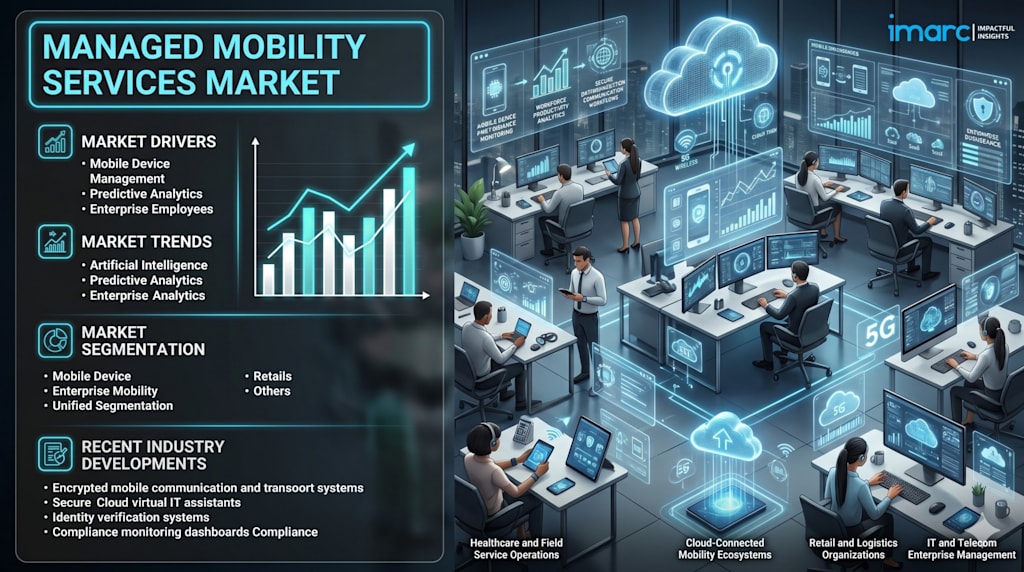
According to IMARC Group's latest research publication, The global managed mobility services market size was valued at USD 49.8 Billion in 2025. Looking forward, IMARC Group estimates the market to reach USD 385.3 Billion by 2034, exhibiting a CAGR of 24.75% from 2026-2034.
How Managed Mobility Services is Reshaping the Future of Enterprise IT
- BYOD Policy Management and Centralized Device Control: The widespread adoption of bring-your-own-device policies across corporate environments has fundamentally elevated the strategic importance of managed mobility services. As employees across sectors use personal smartphones, tablets, and laptops to access enterprise systems, organizations require centralized platforms that enforce security policies, manage application access, and ensure compliance without disrupting user experience.
- Mobile device management platforms deployed through MMS providers give IT administrators real-time visibility into every enrolled endpoint, enabling remote configuration, policy enforcement, and threat response without requiring physical access to devices.
- Centralized management consoles allow enterprises to segment corporate data from personal data on employee-owned devices, protecting sensitive information while preserving user privacy and maintaining a productive, flexible work experience.
- Organizations with globally distributed workforces benefit most from MMS-enabled centralization, as it eliminates the need for local IT support in every geographic location while ensuring consistent security standards across all devices and regions.
Managed Mobility Services Industry Overview
The managed mobility services sector operates at the intersection of enterprise IT strategy, cybersecurity, and workforce productivity, positioning it as one of the most structurally critical managed services categories within the broader technology industry. The market's expansion is underpinned by a global mobile device installed base that GSMA estimates at over 4.3 billion smartphone users, representing more than 54% of the global population. This scale of mobile device adoption creates the foundational demand for professional mobility management services that businesses across every industry and geography require.
North America holds the dominant regional position with over 32.0% of global market share, driven by the region's advanced IT infrastructure, high enterprise mobility maturity, and stringent regulatory environments that mandate robust data security practices. The United States accounts for 84.5% of North America's regional market share, reflecting the concentration of large enterprises, technology providers, and regulated industry sectors that represent the primary MMS customer base. Over 51% of U.S. businesses currently leverage cloud services as a foundational component of their mobility strategies, creating a structural dependency on professional management services to govern cloud-connected mobile ecosystems.
Europe represents a high-value market driven by GDPR compliance requirements and strong BFSI sector demand. With 784 foreign bank branches operating across the EU, multinational financial institutions require standardized mobility management frameworks that can enforce consistent security policies across jurisdictions with differing national data protection implementations. Internet penetration across EU households has reached 94%, with countries including the Netherlands and Luxembourg recording connectivity rates of 99%, providing the universal digital infrastructure that enables mobile-first enterprise strategies throughout the region.
Managed Mobility Services Market Trends and Drivers
Digital transformation initiatives are the primary commercial catalyst propelling enterprise investment in managed mobility services. Industry data indicates that approximately 91% of businesses are currently engaged in some form of digital transformation activity, with mobile enablement consistently identified as a core workstream within these programs. MMS providers serve as execution partners for digital transformation leaders, translating strategic mobility objectives into operational realities through device provisioning, application management, and security enforcement.
The retail and healthcare sectors in Latin America are emerging as high-growth MMS customer categories. Brazil's healthcare system, with 62% of its approximately 7,191 hospitals operating as private institutions, represents a substantial addressable market for MMS providers offering telemedicine enablement, electronic health record mobility, and patient monitoring device management services. Retail operators throughout the region are simultaneously deploying mobile point-of-sale systems, inventory management devices, and customer engagement applications that require professional lifecycle management to sustain operational continuity.
Manufacturing sector adoption of MMS is accelerating as industrial enterprises deploy connected mobile devices for quality control, supply chain visibility, and field service operations. Shop floor tablets, wearable scanning devices, and ruggedized mobile computers used in logistics and warehousing environments require specialized lifecycle management services distinct from standard corporate device management, creating a premium MMS service category with strong recurring revenue characteristics.
Leading Companies Operating in the Global Managed Mobility Services Industry
- Accenture PLC
- AT&T Inc.
- Deutsche Telekom AG
- Fujitsu Limited
- HP Development Company L.P.
- International Business Machines Corporation
- Orange S.A.
- Samsung Electronics Co. Ltd.
- Telefonica S.A.
- Unisys Corporation
- Vodafone Idea Limited
- Wipro Limited
Managed Mobility Services Market Report Segmentation
By Function:
- Mobile Device Management
- Mobile Application Management
- Mobile Security
- Others
Mobile device management leads the function segment with approximately 38.7% of market share, driven by enterprises prioritizing endpoint visibility, security policy enforcement, and compliance management across distributed device fleets operating in remote and hybrid work environments.
By Deployment:
- Cloud-based
- On-premises
On-premises deployment leads the market in 2024, particularly among organizations in regulated industries such as healthcare and financial services that prioritize full ownership of sensitive enterprise data and require direct control over mobility infrastructure without dependency on third-party cloud providers.
By Organization Size:
- Small and Medium-sized Enterprises
- Large Enterprises
Large enterprises command approximately 65% of market share, reflecting their extensive mobile device estates, complex security and compliance requirements, and geographically dispersed workforces that demand scalable, centrally managed mobility solutions.
By End Use Industry:
- IT and Telecom
- BFSI
- Healthcare
- Manufacturing
- Retail
- Education
- Others
IT and telecom leads with approximately 22.5% of market share, owing to the sector's fundamental reliance on mobile device connectivity for network management, customer support, and infrastructure monitoring operations across globally distributed teams.
Regional Insights:
- North America (United States, Canada)
- Asia Pacific (China, Japan, India, South Korea, Australia, Indonesia, Others)
- Europe (Germany, France, United Kingdom, Italy, Spain, Russia, Others)
- Latin America (Brazil, Mexico, Others)
- Middle East and Africa
North America holds the largest regional share at over 32.0%, supported by mature enterprise mobility adoption, advanced IT infrastructure, and a strong regulatory compliance environment that drives sustained investment in professional mobility management services.
Recent News and Developments in the Managed Mobility Services Market
- September 2024: Tata Consultancy Services, in collaboration with Google Cloud, launched two AI-powered cybersecurity solutions, Managed Detection and Response and Secure Cloud Foundation. These solutions are designed to enhance threat detection, accelerate incident response, and strengthen cloud security governance across hybrid enterprise environments.
- August 2024: Stratix Corporation announced the continuation of its strategic partnership with Omnissa to enhance managed mobility services delivery. The collaboration uses generative AI and cloud-based computing to streamline endpoint management and improve operational efficiency, with Stratix leveraging Omnissa's Workspace ONE Unified Endpoint Management platform for secure, automated enterprise device management.
- March 2024: Dynamic Digital Transformation, a joint venture between DMI and Dynamic Solutions Technology, secured a USD 14.5 Million contract with the U.S. Treasury's Office of the Comptroller of the Currency to deliver enterprise mobility management services. The contract underscores growing government sector demand for professionally managed mobility infrastructure at the federal level.
Note: If you require specific details, data, or insights that are not currently included in the scope of this report, we are happy to accommodate your request. As part of our customization service, we will gather and provide the additional information you need, tailored to your specific requirements. Please let us know your exact needs, and we will ensure the report is updated accordingly to meet your expectations.
About the Creator
Abhay Rajput
I am working in market research company that provides market and business research intelligence across the globe.
Enjoyed the story? Support the Creator.
Subscribe for free to receive all their stories in your feed.
Comments
There are no comments for this story
Be the first to respond and start the conversation.