
Magnet Market Registers Significant Growth with Industrial Automation
How industrial automation, smart manufacturing technologies, and increasing robotics adoption are creating new growth opportunities across the magnet market

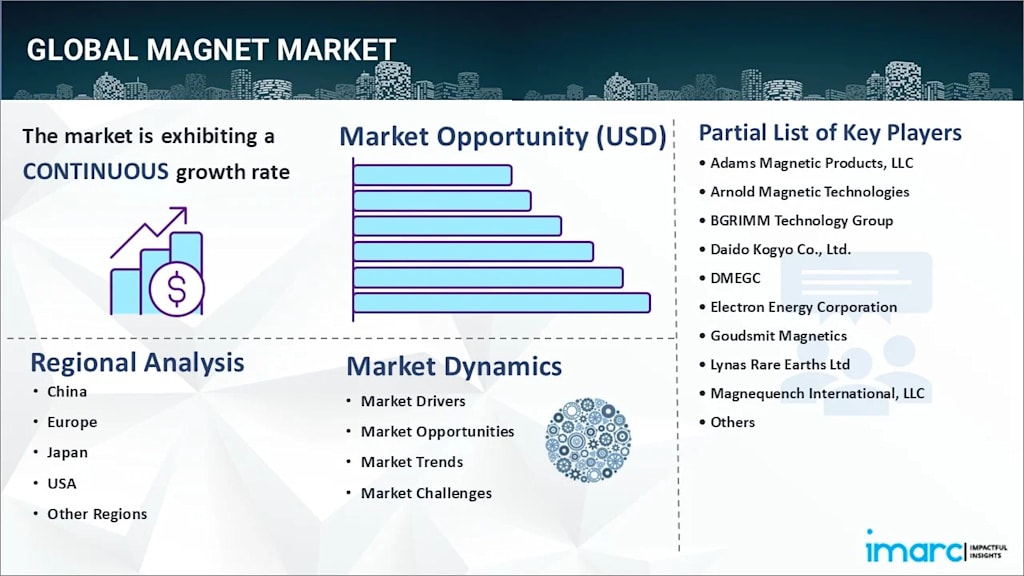
Accelerating electric vehicle production, expanding renewable energy infrastructure, and rising automation across industries are driving magnet demand, supported by heavy industrial manufacturing, product innovation, and expanding defense and electronics sectors. According to IMARC Group’s latest data, The global magnet market size was valued at USD 43.3 Billion in 2025. Looking forward, IMARC Group estimates the market to reach USD 59.8 Billion by 2034, exhibiting a CAGR of 3.50% from 2026-2034.
Magnets now represent a vital pillar of the global industrial and technology sectors, exhibiting steady expansion across diverse applications. Demand is heavily driven by global clean energy transitions, technological advancements in consumer electronics, and the widespread electrification of transport systems. Ongoing supply chain adjustments and international trade dynamics are prompting significant infrastructure investments in localized manufacturing hubs, while advanced product engineering focused on high-temperature resilience and material optimization is shaping next-generation design choices.
Magnet Market Growth Drivers:
- Rapid Adoption of Electric Vehicles (EVs)
Automakers rely extensively on permanent magnets, specifically high-strength neodymium grades, to optimize traction motors. These components are essential for converting electrical energy into mechanical movement while maximizing driving range and vehicle performance. Industry figures show worldwide EV sales surged by 25% to reach 17.1 million units annually, drastically increasing procurement volumes for high-flux magnets. Each battery-electric platform requires approximately 3.5 kilograms of specialized magnetic materials, which is significantly more than internal combustion engine designs require, positioning the automotive supply chain as a critical driver of global manufacturing volume.
- Expansion of Renewable Energy Systems
Global commitments to transition toward clean energy have accelerated the installation of massive wind power infrastructure. High-performance permanent magnets play a vital role in increasing the conversion efficiency of direct-drive wind turbines and utility-scale generators by 5%. This technical optimization minimizes energy loss and lowers maintenance costs in harsh offshore settings. Siemens Gamesa Renewable Energy expanded its regional procurement of high-coercivity permanent magnet materials to support large-scale offshore projects across Europe and Asia, ensuring reliable grid performance and establishing green energy utilities as major industrial consumers.
- Industrial Automation and Robotics Integration
The intensive push for automation in factories and smart warehouses drives the continuous deployment of advanced robotic arms and automated guided vehicles. These systems require high-precision servo motors engineered with top-tier sintered magnets to achieve precise motion control and reduce operational energy usage per task. Logistics operations scaling up their automated infrastructure utilize these components to handle increased payload throughput. With automation scaling up across the manufacturing sector, components prioritizing structural integrity and high magnetic permeability face substantial demand, keeping factory floors heavily reliant on robust global magnet supply chains.
Magnet Market Trends:
- Aggressive Domestic Supply Chain Reshoring Initiatives
Governments and regional manufacturers are actively shifting away from single-source dependencies to mitigate strategic supply vulnerabilities. In response to tightening export restrictions, international regulatory frameworks are funding local raw material processing hubs and component manufacturing. For example, Washington launched the 12 billion dollar Project Vault Strategic Critical Minerals Reserve to shield domestic industries. Additionally, heavy players are building integrated production plants, such as a 1.25 billion dollar manufacturing campus in Texas spanning 120 acres, which directly diversifies the geographic availability of critical high-performance sintered magnets for western defense and aerospace industries.
- Transition Toward Heavy Rare-Earth-Free Magnets
Due to massive volatility in rare-earth pricing structures, engineering groups are actively prioritizing the development of alternative compositions. Research initiatives focus heavily on minimizing heavy rare-earth elements like dysprosium or terbium through advanced grain-boundary diffusion techniques. Companies are implementing novel deep-tech discoveries, such as MagNex, an AI-discovered rare-earth-free permanent magnet capable of reducing direct production expenses by 80% and lowering manufacturing carbon emissions by 70%. This paradigm shift satisfies both economic cost-reduction mandates and strict corporate environmental sustainability compliance standards globally.
- Scaling Up Closed-Loop Recycling and Recovery Systems
Industrial organizations are embedding circular economy practices directly into their supply management programs to lower reliance on virgin mining activities. Leading tech developers are forming strategic closed-loop sourcing agreements to reclaim high-grade neodymium from end-of-life electronics and hardware. For instance, Apple committed approximately 500 million dollars toward utilizing recycled rare-earth magnets, providing a substantial 32 million dollar prepayment to secure early access to reclaimed materials. This trend transforms manufacturing waste streams into reliable feedstock channels, offering predictable price structures amidst raw material market fluctuations.
Recent News and Developments in Magnet Market
- April 2025: Beijing imposed strict export licensing regulations on several medium and heavy rare earth elements and the high-performance permanent magnets derived from them to regulate critical material distribution.
- January 2026: The U.S. Commerce Department issued a 1.6 billion dollar non-binding letter of intent to USA Rare Earth alongside private placements to accelerate domestic manufacturing capabilities.
- February 2026: MP Materials officially selected a 120-acre development site in Northlake, Texas to construct its 1.25 billion dollar 10X facility, a major integrated magnet manufacturing campus.
Note: If you require specific details, data, or insights that are not currently included in the scope of this report, we are happy to accommodate your request. As part of our customization service, we will gather and provide the additional information you need, tailored to your specific requirements. Please let us know your exact needs, and we will ensure the report is updated accordingly to meet your expectations.
About the Creator
Andrew Sullivan
Hello, I’m Andrew Sullivan. I have over 9+ years of experience as a market research specialist.
Enjoyed the story? Support the Creator.
Subscribe for free to receive all their stories in your feed.
Comments
There are no comments for this story
Be the first to respond and start the conversation.