
mRNA Synthesis Raw Materials Market Is Set to Hit $2.67 Billion by 2032
From pandemic-era shortages to vertical integration, the molecular supply chain behind mRNA therapeutics is becoming a strategic battleground.

When a Lab Reagent Becomes a Supply Chain Crisis
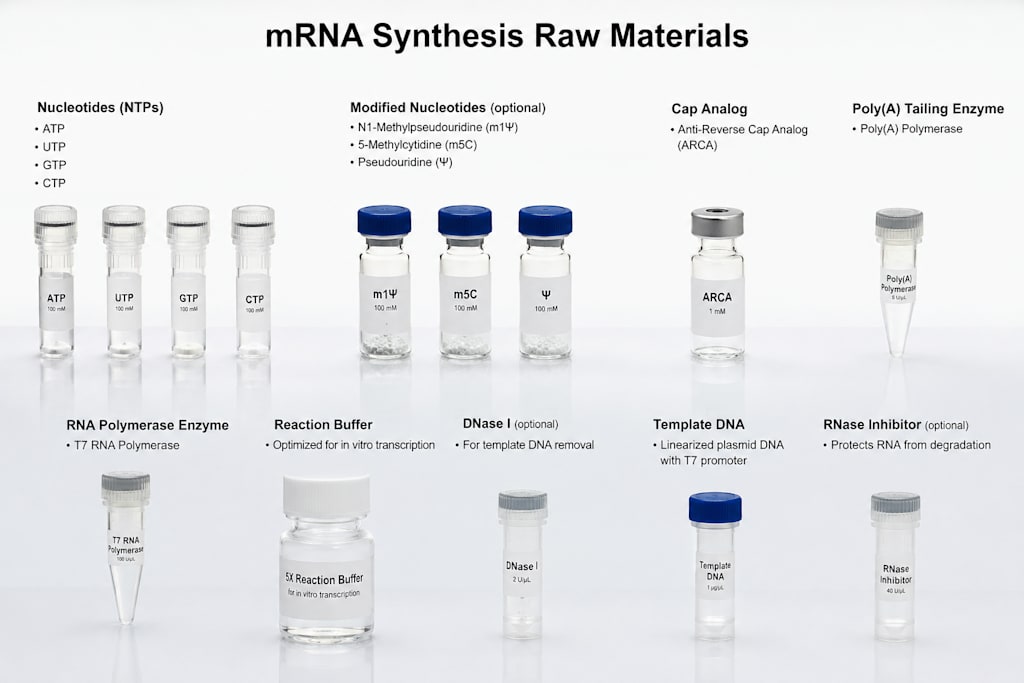
In 2024, more than 60% of mRNA developers reported running into raw material shortages. Not finished drugs. Not clinical trial delays. The bottleneck was upstream — enzymes, nucleotides, capping reagents — the molecular building blocks that make mRNA synthesis possible in the first place. For a technology that rewrote the rules of vaccine development in under a year, that's a striking vulnerability hiding in plain sight.
Global revenues for mRNA synthesis raw materials stood at roughly USD 1.70 billion in 2024. Forecasters now project the market will reach USD 2.67 billion by 2032 — a compound annual growth rate of 5.81%. That's a quieter growth curve than the mRNA therapeutics headline numbers, but it reflects something important: the infrastructure layer of a platform technology maturing into permanence.
Nucleotides Run the Process, Capping Agents Are Closing Fast
The nucleotides segment dominated in 2024, accounting for 36.9% of total revenue. That dominance is structural. ATP, GTP, CTP, and UTP are the literal substrate of in vitro transcription — no IVT process, no mRNA. As large-scale vaccine and therapeutic manufacturing has scaled, demand for GMP-grade nucleotides has scaled with it, with raw material requirements running five to ten times above pre-pandemic levels.
But capping agents are where the technical competition is intensifying. Advanced analogs like CleanCap and ARCA — anti-reverse cap analogs — directly determine mRNA stability and translational efficiency. In oncology and rare disease applications, where therapeutic windows are narrow and dosing precision matters enormously, capping chemistry is increasingly where product differentiation lives. The segment is projected to grow at the fastest rate of any materials category through 2032.
Vaccines Drive Volume, Therapeutics Drive Complexity
Vaccine production retained 82.3% of the application segment in 2024. That concentration reflects the sheer procurement weight of COVID-19, RSV, and influenza manufacturing programs still running at scale. When Moderna or BioNTech runs a production campaign, the upstream draw on nucleotides and enzymes is enormous — and consistent.
The therapeutics segment, however, is the more structurally interesting story. More than 190 active clinical trials globally were running mRNA therapeutics in 2024, spanning protein replacement, oncology, and CAR-T applications. Each of those programs requires customized, therapeutic-grade raw materials that don't come off a standard catalog. As those trials move toward commercialization, they will generate a new class of procurement demand — smaller volumes, higher specifications, less tolerance for batch variability. That transition will reshape supplier relationships across the industry.
Prototyping gave way to production in 3D printing. The same shift is now underway in mRNA.
The Supply Chain Problem Nobody Fixed
The tension at the center of this market isn't demand. Demand is unambiguous. It's supply reliability and standardization — and neither has been fully resolved.
In a 2024 BioPlan Associates survey, 68% of mRNA developers reported delays or shortages in accessing high-purity reagents. IVT reagent costs have risen 30–40% over three years. And the absence of globally harmonized raw material specifications means batch-to-batch variability remains a regulatory and reproducibility concern for manufacturers operating across jurisdictions. The FDA's revised CMC guidelines published in 2024 help on the U.S. side, but they also raise the qualification bar for suppliers — further narrowing the pool of compliant sources.
Large players are responding by internalizing. BioNTech announced a USD 1.07 billion expansion of its Marburg facility in April 2025 specifically to bring capping reagent and modified nucleotide production in-house, reducing third-party dependence. Thermo Fisher launched a new GMP-compliant IVT kit in January 2025 designed to reduce purification time at scale. The direction of travel is clear: vertical integration as a hedge against a supply chain that has already failed once.
Geography and the Localization Signal
North America held the largest regional share in 2024, with the U.S. market valued at USD 0.57 billion — anchored by Moderna, Thermo Fisher, and a government investment posture that has directed over USD 3.2 billion into mRNA research since 2022. BARDA alone committed over USD 400 million in 2024 toward advanced mRNA vaccine development, pulling upstream raw material demand with it.
Europe's story is Germany. BioNTech's manufacturing footprint and over €2 billion in German government biotech investment between 2021 and 2024 have made the country the regional center of gravity for raw material consumption. The U.K. is the fastest-growing European market, with the Vaccine Innovation Centre in Oxford generating sustained demand for cGMP-grade nucleotides and enzymes.
Asia Pacific is accelerating fastest overall. China is pursuing raw material self-sufficiency through state-backed players like Stemirna Therapeutics and Walvax Biotechnology. India is scaling rapidly through Biological E. and Gennova Biopharmaceuticals. Japan and South Korea are carving out positions in high-purity enzyme supply for precision therapeutics. The competitive geography of this market over the next decade will be shaped substantially by which regions close the gap between mRNA manufacturing ambition and domestic raw material capability.
The question for the next phase isn't whether mRNA therapies will proliferate. With USD 5.5 billion in global mRNA investment in 2023 alone, that outcome looks settled. The real question is whether the molecular supply chain beneath them can mature fast enough to support it — and which suppliers, and which countries, will own that infrastructure when it does.
About the Creator
Mayur Pande
Mayur Pande is an experienced SEO Specialist with 7 years of experience in Digital Marketing. Throughout his career, he has developed strong expertise in client relationship management, achieving business targets.
Enjoyed the story? Support the Creator.
Subscribe for free to receive all their stories in your feed.
Comments
There are no comments for this story
Be the first to respond and start the conversation.