
Long-term Care Software Market Outlook: Healthcare Digitization and Growth Opportunities
The Long-term Care Software Market is experiencing steady growth driven by increasing adoption of digital solutions in healthcare facilities such as nursing homes, assisted living centers, and home healthcare services.

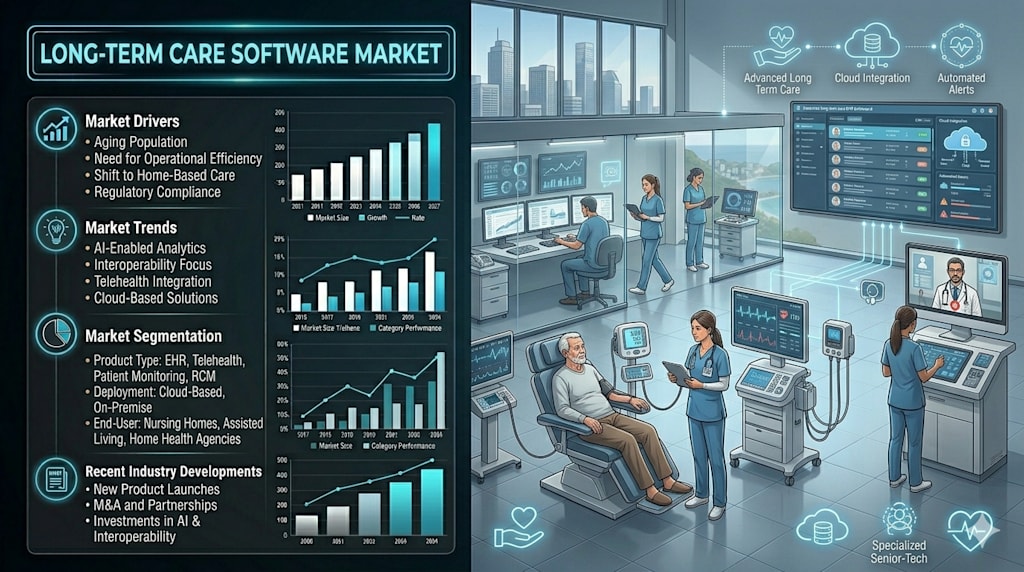
According to IMARC Group's latest research publication, The global long-term care software market size reached USD 6.3 Billion in 2025. Looking forward, IMARC Group expects the market to reach USD 13.9 Billion by 2034, exhibiting a growth rate (CAGR) of 8.96% during 2026-2034.
How AI is Reshaping the Future of the Long-term Care Software Market
- AI-Powered Clinical Decision Support and Predictive Analytics: AI-integrated long-term care software platforms are enabling care teams to anticipate patient deterioration before it becomes critical. Machine learning models trained on EHR data identify early warning signals for conditions such as sepsis, pressure ulcers, and cardiac events among elderly residents. Facilities deploying predictive analytics tools have reported measurable reductions in hospital readmission rates, with some nursing homes achieving up to 30% fewer avoidable transfers.
- Automated Medication Management and Error Reduction: AI-driven medication administration modules embedded in long-term care software cross-reference drug interactions, dosage thresholds, and resident allergy profiles in real time. Given that elderly patients frequently manage five or more concurrent medications, the risk of polypharmacy complications is substantial. Automated verification systems reduce medication error rates by flagging contraindications before administration.
- Intelligent Staffing Optimization and Workforce Management: AI-powered scheduling engines within long-term care software analyze historical occupancy trends, caregiver performance records, and regulatory staffing ratios to generate optimized shift assignments. Labor costs account for approximately 60% to 70% of total operating expenses in nursing homes and assisted living facilities, making workforce efficiency a critical financial lever.
Long-term Care Software Industry Overview
The long-term care software industry is undergoing structural transformation driven by demographic pressures, regulatory tightening, and widespread digitization of healthcare delivery. The United States alone has over 15,000 nursing homes serving approximately 1.4 million residents, with demand for professional long-term care services projected to intensify as the 65-and-older population surpasses 80 million by the end of this decade. Government programs remain the dominant funding mechanism, with Medicare and Medicaid collectively financing over 60% of nursing home expenditures in the United States, creating a direct regulatory dependency that makes CMS-compliant software not optional but essential for facility operations.
Long-term Care Software Market Trends and Drivers
The accelerating aging of global populations represents the most fundamental and sustained driver of long-term care software demand. In the United States, approximately 10,000 Baby Boomers cross the 65-year threshold every single day, a trend projected to continue through the late 2020s. This demographic wave is expanding the resident census at nursing homes, assisted living facilities, and home care agencies simultaneously, creating scale pressures that manual administrative systems cannot accommodate. Long-term care software addresses this capacity challenge by consolidating resident management, medication tracking, care planning, and billing operations into unified digital platforms.
Operational efficiency imperatives and cost containment pressures are amplifying software investment across all long-term care segments. Labor shortages in the care workforce represent an acute and growing crisis, with the American Health Care Association projecting a need for over 600,000 additional direct care workers in US nursing facilities alone over the coming decade. Long-term care software mitigates this constraint by automating administrative workflows that would otherwise consume clinical staff time.
The convergence of telehealth expansion, value-based care reimbursement models, and digital health policy frameworks is reshaping how long-term care software solutions are purchased, deployed, and evaluated. The US Centers for Medicare and Medicaid Services expanded its reimbursement coverage for remote patient monitoring services, directly incentivizing home care agencies to invest in software platforms with integrated telehealth and monitoring capabilities. Home care agencies now represent one of the most dynamic end-user segments in the market, driven by consumer preference for aging-in-place solutions and by payers seeking lower-cost alternatives to institutional care settings. Hospice care facilities are similarly investing in software to manage the complex interdisciplinary coordination required among nursing, social work, chaplaincy, and pharmacy teams serving patients with terminal diagnoses.
Leading Companies Operating in the Global Long-term Care Software Industry
- ADL Data Systems, Inc.
- BDM Healthware
- CareVoyant Inc.
- Eldermark
- Intellitec Solutions
- MatrixCare
- Netsmart Technologies, Inc.
- PointClickCare
- Smartlinx, LLC
- WellSky
- Yardi Systems, Inc.
Long-term Care Software Market Report Segmentation
By Product:
- Clinical Software
- Non-Clinical Solutions
Clinical software accounts for the majority of the market share, as it serves as the operational backbone for electronic health records management, medication administration tracking, and care coordination across nursing homes, assisted living facilities, and home care agencies.
By Deployment Type:
- Web-based
- On-premises
- Cloud-based
Web-based deployment holds the largest share in the market, driven by its accessibility from multiple facility locations, reduced upfront capital requirements, and scalability advantages for multi-site care operators.
By End User:
- Home Care Agencies
- Hospice Care Facilities
- Nursing Homes and Assisted Care
Fertility centers represent one of the fastest-growing end-user segments, while nursing homes and assisted care facilities currently account for the largest market share due to the scale and complexity of their resident management and regulatory reporting requirements.
Regional Insights:
- North America (United States, Canada)
- Asia Pacific (China, Japan, India, South Korea, Australia, Indonesia, Others)
- Europe (Germany, France, United Kingdom, Italy, Spain, Russia, Others)
- Latin America (Brazil, Mexico, Others)
- Middle East and Africa
North America exhibits clear dominance in the long-term care software market, supported by an advanced healthcare infrastructure, a mature regulatory framework administered through CMS, and high rates of digital adoption among nursing home and home care operators.
Recent News and Developments in the Long-term Care Software Market
- April 2025: PointClickCare announced an expanded partnership with Amazon Web Services to migrate its enterprise long-term care platform to a cloud-native architecture, enhancing scalability and data processing speeds for its network of over 27,000 care facilities across North America. The integration enables real-time analytics and AI-powered clinical decision support at the point of care.
- March 2025: WellSky launched an AI-assisted care planning module within its long-term care platform, enabling clinical staff at home health agencies to generate personalized care plans using predictive models trained on clinical outcome data. The module reduces care plan documentation time by an estimated 40% per patient episode.
- January 2025: Netsmart Technologies announced the integration of its long-term care EHR platform with Apple Health Records, enabling residents and their families to access care documentation, medication records, and appointment histories directly through iOS devices. The integration supports patient engagement goals aligned with interoperability mandates under the CMS Promoting Interoperability program.
- November 2024: MatrixCare expanded its remote patient monitoring capabilities through a strategic partnership with Medline Industries, embedding connected device data streams directly into its long-term care software platform. The solution targets post-acute care facilities seeking to reduce hospital readmission rates and improve chronic condition management for high-acuity residents.
- September 2024: Eldermark released version 2.0 of its point-of-care application for senior care facilities, incorporating voice-to-text documentation, automated shift handoff summaries, and real-time resident census updates. The upgrade addresses caregiver documentation burden, reducing charting time by several hours per shift across facilities piloting the system.
Note: If you require specific details, data, or insights that are not currently included in the scope of this report, we are happy to accommodate your request. As part of our customization service, we will gather and provide the additional information you need, tailored to your specific requirements. Please let us know your exact needs, and we will ensure the report is updated accordingly to meet your expectations.
About the Creator
Olivia Smith
Olivia Smits is a Research and Marketing Analyst who specializes in market research, trend analysis, and consumer insights. I help businesses make smarter marketing and strategy decisions by turning data into clear, actionable insights.
Enjoyed the story? Support the Creator.
Subscribe for free to receive all their stories in your feed.
Comments
There are no comments for this story
Be the first to respond and start the conversation.