
Logistics Market Witnesses Strong Growth Amid Global Trade Expansion
The logistics market is growing due to rising global trade and increasing demand for efficient transportation and supply chain solutions worldwide.

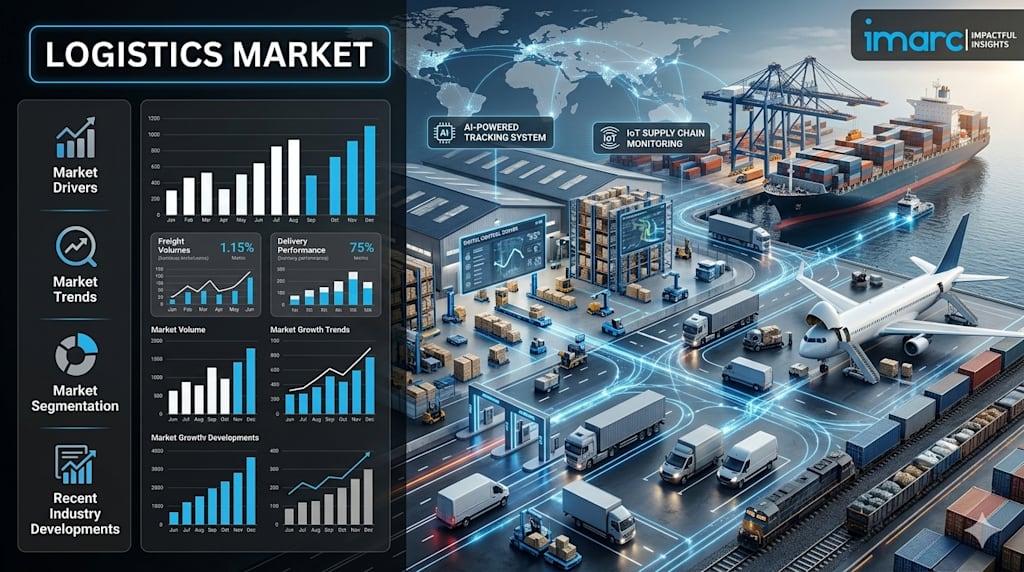
According to IMARC Group's latest research publication, the global logistics market size reached USD 5.88 Trillion in 2025. Looking forward, IMARC Group expects the market to reach USD 8.23 Trillion by 2034, exhibiting strong growth during the forecast period. The market encompasses freight transportation across roadways, seaways, railways, and airways, alongside warehousing, supply-chain management, and value-added logistics services operating at the intersection of global trade expansion, e-commerce proliferation, and digital transformation.
HOW AI IS RESHAPING THE FUTURE OF LOGISTICS MARKET
- Intelligent Warehouse Automation: AI-powered robotics and computer vision systems manage inventory, accelerate pick-and-pack operations, and reduce labor dependency. Modern fulfillment centers achieve 20-30% productivity gains through autonomous guided vehicles and real-time SKU tracking.
- Demand Forecasting and Inventory Optimization: AI analyzes historical patterns, market trends, and external variables to predict logistics demand with remarkable precision. Companies report 15-25% improvements in inventory accuracy and 10-12% reductions in carrying costs through data-driven planning.
- Fraud Detection and Supply Chain Visibility: AI-powered analytics identify emerging fraud patterns and anomalies across logistics networks in real-time. Enhanced visibility platforms enable data sharing among providers, strengthening security protocols and reducing financial losses across the industry.
LOGISTICS INDUSTRY OVERVIEW
The global logistics market operates as the critical backbone supporting international commerce, handling over USD 23 trillion in annual merchandise trade flows. The industry encompasses third-party logistics (3PL) providers managing integrated warehousing and transport solutions, asset-heavy carriers operating roadways and shipping corridors, and emerging 4PL orchestrators coordinating complex multinational supply chains. Government-backed infrastructure mega-programs including India's PM Gati Shakti (USD 1.3 trillion investment), the U.S.
LOGISTICS MARKET TRENDS & DRIVERS
E-commerce Expansion and Last-Mile Innovation: Global online commerce exceeded USD 4.4 trillion in 2023, with parcel volumes accelerating as retailers and marketplaces invest heavily in fulfillment infrastructure. Amazon's same-day delivery volumes surged 70% year-over-year, while digital freight platforms including Uber Freight and Full Truck Alliance are aggregating fragmented trucking capacity at scale.
Digital Transformation and Supply Chain Visibility: Logistics technology investment reached USD 36 billion globally in 2024, driven by transportation management systems (TMS), IoT-enabled tracking sensors, and blockchain-based documentation platforms improving transparency and reducing customs clearance times. Cloud-based TMS platforms from Oracle, SAP, and Manhattan Associates are standardizing shipment planning and carrier procurement across enterprises, while real-time visibility solutions including Project44 and FourKites enable precise tracking of temperature, location, and handling conditions critical for pharmaceutical and perishable shipments.
Infrastructure Investment and Supply-Chain Resilience: Government infrastructure programs are creating structural logistics cost reductions across emerging markets. India's PM Gati Shakti plan has commissioned 91 cargo terminals with 234 projects receiving approvals as of late 2024, targeting logistics cost reduction from 14% to 8% of GDP by 2030 and improving India's Logistics Performance Index ranking to top 25 globally. Mexico's emergence as the top U.S. trading partner, with cross-border freight volumes continuing to expand, is driving nearshoring-related logistics demand across North America.
LEADING COMPANIES OPERATING IN THE GLOBAL LOGISTICS INDUSTRY
- Deutsche Post AG (DHL Group)
- FedEx Corporation
- United Parcel Service of America (UPS)
- DSV A/S
- CEVA Logistics
- Expeditors International of Washington
- C.H. Robinson Worldwide, Inc.
- J.B. Hunt Transport Services
- XPO Logistics
- Americold Realty Trust
LOGISTICS MARKET REPORT SEGMENTATION
By Model Type:
- Third-Party Logistics (3PL)
- Second-Party Logistics (2PL)
- Fourth-Party Logistics (4PL)
By Transportation Mode:
- Roadways — 59.2% share, supporting global truck freight exceeding 22 trillion tonne-kilometers annually
- Seaways — 18.1% share, backbone of international trade handling over 85% of goods by weight
- Railways — 12.6% share, particularly strong in North American intermodal and European corridors
- Airways — 10.1% share, fastest-growing mode at approximately 4.6% annual expansion through cross-border e-commerce parcels and pharmaceuticals
By End-Use Sector:
- Manufacturing — 16.8% share, driven by outsourcing needs and supply-chain visibility requirements
- Retail and E-commerce — Significant share reflecting omnichannel distribution complexity
- Healthcare and Pharmaceuticals — Growing segment requiring cold-chain and validated logistics
- Consumer Goods, Automotive, and Other Verticals — Distributed across remaining market share
By Region:
- Asia Pacific — 48.7% share, led by China's USD 2.5 trillion domestic freight economy and India's infrastructure expansion
- North America — 20.5% share, anchored by U.S. e-commerce scale and Mexico cross-border integration
- Europe — 17.6% share, characterized by regulatory compliance and multi-modal rail expansion
- Latin America — 7.2% share, driven by Brazilian agribusiness and Mexican manufacturing growth
- Middle East and Africa — 6.0% share, supported by GCC logistics hubs and African trade integration
Asia Pacific emerges as the dominant logistics market, commanding 48.7% of global revenue in 2025 and advancing at approximately 4.3% annually through 2034.
RECENT NEWS AND DEVELOPMENTS IN LOGISTICS MARKET
May 2026: Amazon's same-day delivery volumes increased 70% year-over-year, reflecting accelerated fulfillment capabilities and customer adoption of fast-shipping options. The expansion underscores e-commerce's role as the primary demand driver for last-mile logistics innovation and infrastructure investment.
January 2025: India's PM Gati Shakti initiative advanced significantly, with 91 cargo terminals commissioned and 234 projects receiving in-principle approvals as of October 2024. The initiative targets structural logistics cost reduction from 14% to 8% of GDP by 2030, positioning India as a key growth market for 3PL and infrastructure development.
NOTE: If you require specific details, data, or insights that are not currently included in the scope of this report, we are happy to accommodate your request. As part of our customization service, we will gather and provide the additional information you need, tailored to your specific requirements. Please let us know your exact needs, and we will ensure the report is updated accordingly to meet your expectations.
About the Creator
sujeet. imarcgroup
With 2 years of hands-on experience at IMARC Group, I have conducted in-depth market research and analysis across diverse industries including technology, healthcare, agriculture, and consumer goods.
Enjoyed the story? Support the Creator.
Subscribe for free to receive all their stories in your feed.
Comments
There are no comments for this story
Be the first to respond and start the conversation.