
Logistics Market Outlook: Global Trade Expansion and Growth Opportunities
The Logistics Market is experiencing strong growth driven by the expansion of global trade, e-commerce, and supply chain networks.

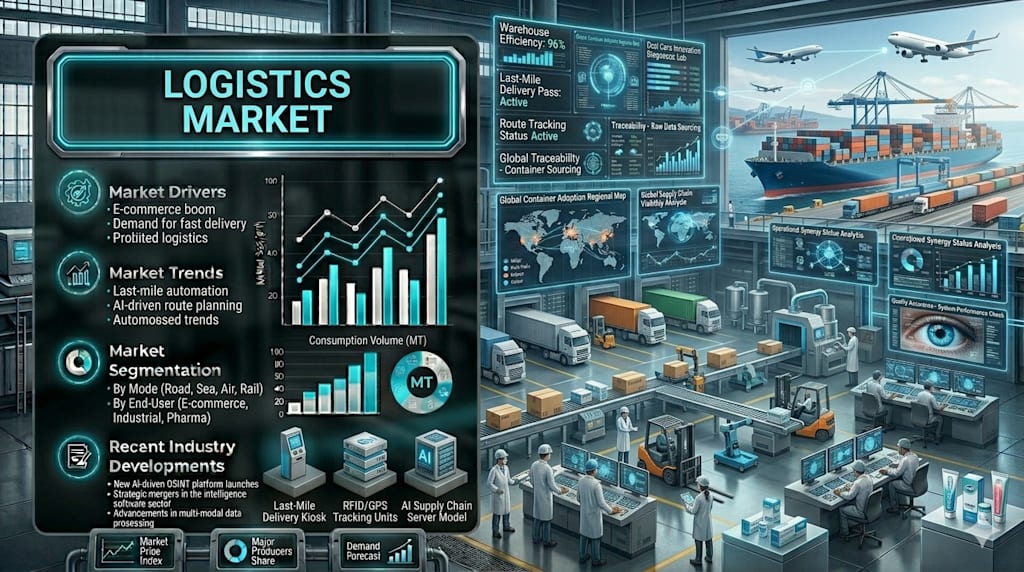
According to IMARC Group's latest research publication, The global logistics market size was valued at USD 5.9 Trillion in 2025. Looking forward, the industry is projected to reach USD 8.2 Trillion by 2034, exhibiting a CAGR of 3.71% during 2026-2034.
How Technology is Reshaping the Future of the logistics market
- Predictive Analytics and Demand Forecasting: AI and machine learning are being deployed across logistics networks to enable predictive analytics that enhance demand forecasting, routing optimization, and inventory management. Nearly 78% of supply chain leaders report achieving significant operational advantages through AI-based logistics solutions. These intelligent systems process historical freight data, weather conditions, and real-time port congestion signals to ensure that warehouses are stocked optimally and delivery routes are planned with precision, reducing delays and excess inventory costs simultaneously.
- AI-Powered Route Optimization and Last-Mile Delivery: Machine learning algorithms are transforming last-mile delivery by continuously analyzing traffic patterns, delivery windows, and vehicle capacity to identify the most efficient routes in real time. Companies such as Amazon have leveraged AI-driven logistics to deploy faster delivery at scale, including announcing in May 2025 an expansion of Same-Day Delivery across 20 additional European locations within the next 12 months. AI routing tools reduce fuel consumption, lower operational costs, and enable logistics providers to fulfill growing consumer expectations for same-day and next-day delivery without proportional increases in fleet size.
- Autonomous Warehouse Management and Robotics: AI-integrated robotics are revolutionizing warehouse operations by automating picking, sorting, and packing processes at speeds that far exceed manual labor. Smart warehouses equipped with IoT sensors and computer vision systems track inventory in real time, automatically triggering replenishment orders and detecting misplaced goods. These systems minimize human error, reduce handling time per order, and enable warehouses to operate around the clock without productivity loss, directly supporting the surge in e-commerce volumes where US retail e-commerce sales for Q1 2025 alone totalled USD 275.8 Billion.

Logistics Industry Overview
The global logistics sector is being fundamentally reshaped by the convergence of e-commerce growth, infrastructure investment, and digital transformation initiatives. Asia Pacific leads the market, accounting for over 48.7% of total market share, driven by manufacturing hubs in China, India, and Southeast Asia that rely on efficient outbound logistics networks. The 3PL (Third-Party Logistics) model dominates with a 56.3% segment share, as businesses across retail, healthcare, and manufacturing increasingly outsource warehousing, transport, and inventory management to specialized providers who offer scalable, technology-enabled solutions. Roadways remain the backbone of logistics infrastructure, contributing 59.2% of transportation mode share due to their flexibility, low cost, and extensive last-mile reach. Public-private partnerships and government-led infrastructure programs are accelerating port modernization, highway expansion, and cold-chain network development across emerging economies, creating new logistics corridors that reduce freight costs and delivery timelines.
Logistics Market Trends and Drivers
The explosive growth of e-commerce remains the single most powerful driver of logistics demand globally. Rising consumer expectations for convenience and speed have compelled logistics providers to invest heavily in automated sortation centers, last-mile delivery networks, and real-time tracking platforms. The manufacturing sector holds 16.8% of the logistics market's end-use share, underpinned by just-in-time supply chain models that require precise inbound logistics coordination to avoid production stoppages. Healthcare logistics is emerging as a high-growth vertical, with the rapid and temperature-controlled transportation of pharmaceuticals, vaccines, and medical devices requiring specialized cold-chain capabilities and strict regulatory compliance. Countries across Latin America and Southeast Asia are committing substantial capital to roads, ports, and airport expansions to integrate into global supply chains, opening new trade lanes and creating demand for third-party logistics providers capable of navigating multi-jurisdictional regulatory environments.
Digital transformation is simultaneously reshaping how logistics companies compete and differentiate. Real-time IoT device deployment in both vehicles and warehouses is delivering end-to-end supply chain visibility that was previously impossible, enabling shippers to proactively manage disruptions rather than react after the fact. Dynamic pricing tools and AI-powered capacity management platforms are helping freight carriers optimize revenue while offering customers more transparent and competitive rate structures. The rapid adoption of electric delivery vehicles, particularly in urban environments subject to emissions restrictions, is creating demand for integrated fleet management systems that balance charging infrastructure constraints with delivery schedules. Simultaneously, international trade liberalization through bilateral agreements and WTO-facilitated customs simplifications is reducing border friction, enabling logistics networks to operate with fewer delays and lower compliance costs across multi-country supply chains.
Leading Companies Operating in the Global Logistics Industry
- A.P. Moller-Maersk A/S
- Ceva Logistics AG (CMA CGM S.A.)
- DB Schenker (Deutsche Bahn AG)
- Deutsche Post AG (DHL Group)
- DSV A/S
- FedEx Corporation
- Kuehne + Nagel International AG
- Nippon Express Holdings Inc.
- Panalpina World Transport (Holding) Ltd. (DSV A/S)
- Ryder System Inc.
- United Parcel Service Inc. (UPS)
- XPO Inc.
Logistics Market Report Segmentation
By Model Type:
- 2PL
- 3PL
- 4PL
3PL holds the largest share at 56.3%, driven by businesses outsourcing logistics to focus on core competencies while leveraging third-party expertise in warehousing, transport, and inventory management.
By Transportation Mode:
- Roadways
- Seaways
- Railways
- Airways
Roadways dominate with a 59.2% share due to their flexibility, low cost, and extensive network reach across both urban and rural geographies.
By End Use:
- Manufacturing
- Retail and E-Commerce
- Healthcare
- Food and Beverages
- Others
The manufacturing sector holds a 16.8% share, reflecting the critical role of supply chain efficiency in sustaining production continuity and cost competitiveness.
Regional Insights:
- North America (United States, Canada)
- Asia Pacific (China, Japan, India, South Korea, Australia, Indonesia, Others)
- Europe (Germany, France, United Kingdom, Italy, Spain, Russia, Others)
- Latin America (Brazil, Mexico, Others)
- Middle East and Africa
Asia Pacific leads the market with over 48.7% share, supported by manufacturing export volumes, expanding e-commerce infrastructure, and heavy government investment in logistics networks.
Recent News and Developments in the Logistics Market
- May 2025: Amazon announced a major expansion of its Same-Day Delivery service across Europe, with plans to introduce the service in 20 additional European locations within the next 12 months, reflecting intensifying competition in last-mile logistics and rising consumer expectations for ultra-fast fulfillment.
- May 2025: India and the United Kingdom concluded a comprehensive Free Trade Agreement eliminating tariffs on approximately 99% of Indian exports, including key sectors such as textiles, engineering goods, and IT services. This landmark deal is expected to generate significant new freight and customs management demand for logistics providers operating on the India-UK corridor.
- April 2025: Global logistics technology firms accelerated investments in AI-powered route optimization and autonomous warehouse robotics, as rising fuel costs and tightening emissions regulations in Europe and North America prompted operators to seek efficiency gains through digital transformation rather than fleet expansion alone.
- November 2024: Multiple leading 3PL providers announced expanded cold-chain network investments across Southeast Asia and the Middle East to serve pharmaceutical and food and beverage clients requiring temperature-controlled warehousing and distribution capabilities aligned with growing healthcare logistics demand.
- October 2024: Major European logistics operators began deploying electric heavy-duty trucks on urban freight routes under new city-level emissions zone regulations, marking a significant operational shift toward green logistics fleet management supported by AI-based charging and route scheduling systems.
Note: If you require specific details, data, or insights that are not currently included in the scope of this report, we are happy to accommodate your request. As part of our customization service, we will gather and provide the additional information you need, tailored to your specific requirements. Please let us know your exact needs, and we will ensure the report is updated accordingly to meet your expectations.
About the Creator
Olivia Smith
Olivia Smits is a Research and Marketing Analyst who specializes in market research, trend analysis, and consumer insights. I help businesses make smarter marketing and strategy decisions by turning data into clear, actionable insights.
Enjoyed the story? Support the Creator.
Subscribe for free to receive all their stories in your feed.
Comments
There are no comments for this story
Be the first to respond and start the conversation.