
Lithium Compound Market Expands Rapidly on Clean Energy Demand
How advancements in lithium-ion battery technology and increasing renewable energy deployment are driving demand for lithium compounds worldwide

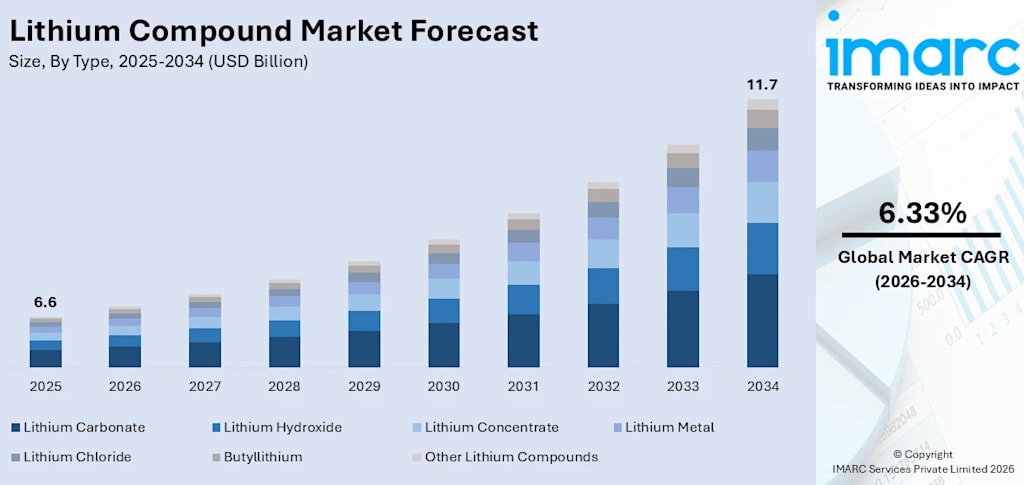
The rising global focus on clean energy, expanding adoption of electric vehicles, and significant advancements in energy storage infrastructure are driving the demand for lithium compounds. This momentum is further supported by government subsidies, localization of supply chains, and extensive product innovation in battery-grade chemicals. According to IMARC Group’s latest data, The global lithium compound market size was valued at USD 6.6 Billion in 2025. Looking forward, IMARC Group estimates the market to reach USD 11.7 Billion by 2034, exhibiting a CAGR of 6.33% from 2026-2034.
Lithium compounds now represent a major global sector exceeding billions in valuation and showing steady year-on-year expansion across primary industrial economies. Demand is fueled by an accelerating transition toward electric mobility, regional initiatives supporting clean grid systems, and a continuous demand for portable high-density electronic products. Ongoing developments in extraction technologies, joint venture mining projects, and strict chemical purity requirements are reshaping the supply network. Major product segments include lithium carbonate, lithium hydroxide, lithium concentrate, lithium metal, lithium chloride, and butyllithium.
Download the "Lithium Compound Market" Executive Summary Sample
Lithium Compound Market Growth Drivers:
- Surging Demand for Lithium-Ion Batteries in EVs
The rapid transformation of the automotive sector toward electric mobility is the foremost driver of this market. International climate initiatives and consumer preferences favor zero-emission transportation, boosting the need for battery-grade compounds. An electric vehicle battery pack requires significant amounts of lithium carbonate equivalent, turning the automotive supply chain into a primary consumer. To meet this massive requirement, automotive manufacturers are forming joint ventures with chemical refiners. This unprecedented demand volume ensures steady manufacturing growth for primary components like lithium carbonate and lithium hydroxide worldwide.
- Escalating Needs in Renewable Energy Storage Systems
The integration of clean energy sources like solar and wind into municipal power grids requires reliable utility-scale energy storage. Lithium-ion battery installations are the preferred choice for grid stabilization because they deliver long operational lifespans and high discharge power capabilities. For example, international energy agencies highlight a massive multi-fold expansion of installed grid-scale battery storage capacity. This massive scale-up requires reliable, continuous volumes of premium raw materials to prevent supply disruptions, establishing renewable energy infrastructure as a highly critical and reliable long-term market growth driver.
- Steady Expansion of Pervasive Consumer Electronics
The global consumer electronics industry maintains a massive, stable demand footprint for specialized chemical formulations. Modern portable electronics, including high-end smartphones, laptops, medical tools, and smart devices, rely entirely on compact, energy-dense power storage solutions. As digitalization deepens across developing regions, the escalating purchasing power of middle-class populations maintains high retail volumes. Electronics manufacturers continuously optimize product performance, requiring premium-grade components that feature extreme chemical stability. This consistent replacement cycle ensures steady raw material intake across international manufacturing hubs.
Lithium Compound Market Trends:
- Focus on Sustainable Processing and Localized Supply Chains
Primary market participants are prioritizing direct extraction and localized refining to build resilient supply networks. Heavy strategic funding, such as multi-billion-dollar investments from major infrastructure laws, supports regional extraction and recycling facilities. Companies like Standard Lithium are advancing direct lithium extraction technologies, achieving notable milestones by processing millions of barrels of brine. This shift reduces reliance on lengthy transport routes, minimizes environmental footprints, and addresses volatile pricing cycles. These regional chemical infrastructure initiatives help stabilize downstream manufacturing and secure domestic energy independence across key production zones.
- Shift Toward High-Purity Lithium Hydroxide Formulations
The rapid technological shift toward high-nickel battery chemistries is driving preference for high-purity lithium hydroxide over traditional carbonate forms. High-nickel formulations offer superior energy density and extended vehicle ranges, which are necessary for commercial transport applications. Refiners are expanding specialized processing facilities to deliver materials exceeding extreme purity thresholds. Despite short-term market adjustments and plant maintenance windows executed by leading producers like Albemarle, long-term capital deployments are heavily directed toward scaling up hydroxide output to satisfy advanced automotive manufacturing specifications globally.
- Rising Application in Advanced Industrial Materials and Solid-State Systems
Industrial applications are expanding beyond traditional consumer sectors into advanced solid-state battery systems and specialized metallurgical processes. Emerging solid-state designs employ lithium metal anodes to deliver vastly improved thermal safety and faster charging speeds, attracting substantial investment from aerospace and defense sectors. Concurrently, standard industrial sectors, such as heat-resistant glass-ceramics, lubricating greases, and continuous casting metallurgy, maintain highly stable consumption patterns. This dual-track demand from both speculative energy technologies and established heavy manufacturing sectors stabilizes overall market value across multiple industrial verticals.
Recent News and Developments in Lithium Compound Market
- February 2026: The United States and Argentina formalized a comprehensive critical minerals framework agreement, establishing secure bilateral supply chains and providing deep strategic investment support for regional lithium extraction projects.
- May 2026: Standard Lithium, in partnership with energy leader Equinor, signed a binding ten-year commercial offtake agreement with Trafigura Trading LLC to supply thousands of metric tonnes of battery-quality lithium carbonate annually from its South West Arkansas development.
- June 2026: Lithium Americas Corp. completed significant engineering design milestones and received a substantial hundred-million-dollar advance from the U.S. Department of Energy loan program to accelerate construction at the Thacker Pass project site.
Note: If you require specific details, data, or insights that are not currently included in the scope of this report, we are happy to accommodate your request. As part of our customization service, we will gather and provide the additional information you need, tailored to your specific requirements. Please let us know your exact needs, and we will ensure the report is updated accordingly to meet your expectations.
About the Creator
Andrew Sullivan
Hello, I’m Andrew Sullivan. I have over 9+ years of experience as a market research specialist.
Enjoyed the story? Support the Creator.
Subscribe for free to receive all their stories in your feed.
Comments
There are no comments for this story
Be the first to respond and start the conversation.