
Liquid Silicone Rubber Market: Smart Manufacturing, Automation Trends & Industry Outlook
How precision injection molding, automation technologies, and cost-efficient manufacturing processes are enhancing production capabilities within the liquid silicone rubber market

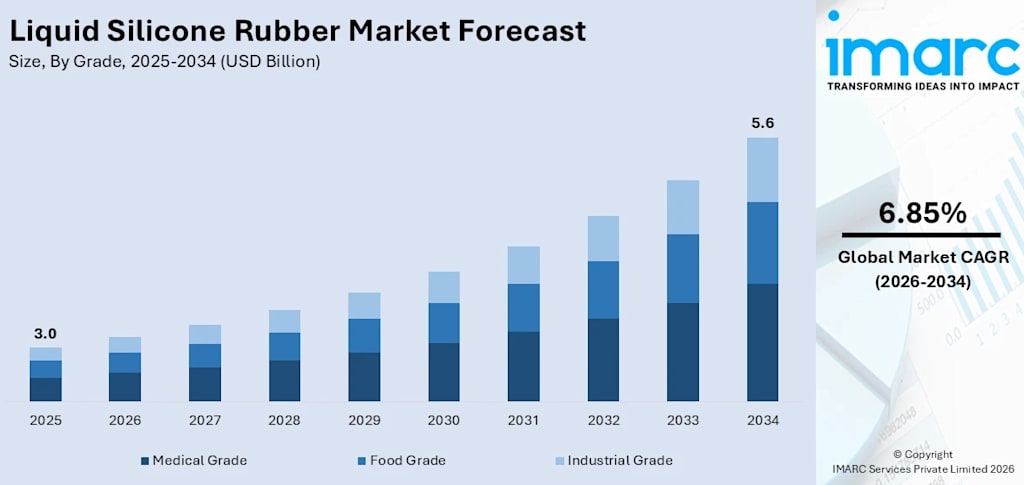
The global liquid silicone rubber (LSR) market has evolved into a cornerstone sector for high-precision manufacturing, driven by structural shifts across the medical, automotive, and consumer electronics landscapes. Renowned for its extreme thermal stability, chemical inertness, and exceptional biocompatibility, liquid silicone rubber has replaced traditional elastomers in high-performance applications. According to IMARC Group’s latest data, the global liquid silicone rubber market size was valued at USD 3.0 Billion in 2025. Looking forward, IMARC Group estimates the market to reach USD 5.6 Billion by 2034, exhibiting a CAGR of 6.85% during 2026-2034.
Liquid silicone rubber now represents a multi-billion-dollar global industry showing steady year-on-year expansion. Demand is heavily accelerated by the healthcare sector, where medical-grade LSR dominates a major portion of the market share due to strict regulatory compliance and its non-toxic, hypoallergenic properties. In the automotive realm, the massive transition toward electric vehicles (EVs) has spiked the need for durable seals, gaskets, and electrical insulation capable of handling high-voltage environments.
Liquid Silicone Rubber Market Growth Drivers:
- Surging Demand in Advanced Healthcare and Medical Devices
The medical sector relies heavily on materials that guarantee patient safety and long-term durability under harsh sterilization conditions. Medical-grade liquid silicone rubber has become the preferred choice for manufacturing critical components like catheters, respiratory masks, syringe seals, and implantable device housings. Its strict adherence to biocompatibility standards, such as ISO 10993 and USP Class VI, ensures it remains completely non-toxic and hypoallergenic within the human body. This shifting preference toward high-purity polymers drives substantial volume growth, especially as the global demand for diagnostic wearables and minimally invasive surgical tools escalates rapidly.
- Automotive Electrification and Lightweighting Trends
The global transition toward electric vehicles has fundamentally redefined material requirements in automotive manufacturing. Traditional internal combustion engines are giving way to high-voltage battery packs, electronic control units, and complex sensor networks that demand exceptional thermal management and electrical insulation. Liquid silicone rubber stands out for its ability to maintain mechanical flexibility and sealing integrity across extreme temperatures. Component manufacturers utilize LSR for high-precision gaskets, connectors, and heavy-duty seals that protect vulnerable EV powertrains from moisture and thermal spikes, simultaneously contributing to vehicle lightweighting strategies aimed at optimizing driving range.
- Advancements in High-Precision Injection Molding Technologies
Manufacturing efficiency remains a vital differentiator for industrial scale-up, and the widespread adoption of automated Liquid Injection Molding (LIM) has revolutionized the polymer processing sector. LIM technology enables high-volume production of intricate, flashless components with incredibly tight tolerances and virtually zero raw material waste. This rapid, cost-effective cycle time makes LSR highly attractive to electronics and consumer goods brands that require millions of perfectly uniform seals, keypads, and connectors. The process integration lowers labor overheads, improves design flexibility, and allows manufacturers to comfortably meet skyrocketing global procurement timelines.
Liquid Silicone Rubber Market Trends:
- Shift Toward Sustainable Formulations and Carbon-Neutral Production
Environmental regulations and corporate sustainability targets are prompting chemical manufacturers to re-engineer their product pipelines. The latest operational trends show a decisive move toward developing eco-friendly liquid silicone rubber formulations that reduce greenhouse gas emissions and energy consumption during curing. Companies are actively investing in circular economy initiatives, focusing on technologies that repurpose production scrap and industrial silicone waste. By optimizing supply chains and introducing bio-attributed or mass-balanced raw materials, major industry participants aim to lower the overall environmental footprint while maintaining the pristine mechanical characteristics required by end-user industries.
- Rising Integration in Next-Generation Consumer Electronics and 5G Infrastructure
As consumer devices become more compact, waterproof, and functionally complex, the demand for durable micro-sealing solutions has grown exponentially. Liquid silicone rubber is increasingly deployed in smartwatches, smartphones, and acoustic components to provide reliable ingress protection against water and dust. Beyond consumer gadgets, the rollout of 5G telecommunication infrastructure has created a niche market for specialized LSR grades. The material’s low dielectric constant and excellent weather resistance make it ideal for encapsulating outdoor base stations, delicate antenna arrays, and high-frequency electronic modules exposed to volatile environmental conditions.
- Expansion of Optical-Grade LSR in Lighting and Solar Applications
Optical-grade liquid silicone rubber is rapidly replacing glass and traditional plastics like polycarbonate in high-performance lighting designs. Its exceptional optical clarity, combined with superior resistance to ultraviolet (UV) radiation and yellowing, allows engineers to design complex lenses and light guides for automotive LED matrix headlights and architectural lighting. Furthermore, this transparency and environmental resilience have found a vital real-world application in the renewable energy sector. Solar panel manufacturers use optical LSR to encapsulate photovoltaic cells and concentrate light, protecting fragile components from extreme weather while maximizing solar energy conversion efficiency.
Recent News and Developments in Liquid Silicone Rubber Market
- July 2023: Shin-Etsu Chemical Co., Ltd. announced a major investment plan worth approximately USD 640 million to expand and improve its global silicone product portfolio. The strategic funding is directed toward increasing production capacity for eco-friendly silicone materials and expanding their line of highly functional products to assist downstream industries in achieving carbon neutrality.
- December 2022: Dow introduced the SILASTIC™ SA 994X Liquid Silicone Rubber series, a new lineup of primerless, self-adhesive, and self-lubricating LSRs. This innovative technology is specifically engineered for two-component injection molding with thermoplastic substrates, eliminating the need for separate priming steps and significantly accelerating assembly lines in automotive and industrial applications.
- October 2024: Elkem Silicones expanded its specialized medical-grade manufacturing footprint by opening a new cleanroom facility designed to produce ultra-pure silicone materials. This expansion targets the rising global demand for certified biomaterials used in long-term medical implants and advanced drug delivery systems, ensuring stricter compliance with international healthcare supply chain protocols.
Note: If you require specific details, data, or insights that are not currently included in the scope of this report, we are happy to accommodate your request. As part of our customization service, we will gather and provide the additional information you need, tailored to your specific requirements. Please let us know your exact needs, and we will ensure the report is updated accordingly to meet your expectations.
About the Creator
Andrew Sullivan
Hello, I’m Andrew Sullivan. I have over 9+ years of experience as a market research specialist.
Enjoyed the story? Support the Creator.
Subscribe for free to receive all their stories in your feed.
Comments
There are no comments for this story
Be the first to respond and start the conversation.