
Limestone Market: Steel Production Trends, Mining Expansion & Demand Forecast
Rising utilization in steel production, construction materials, and environmental solutions is supporting sustained demand growth across the limestone industry

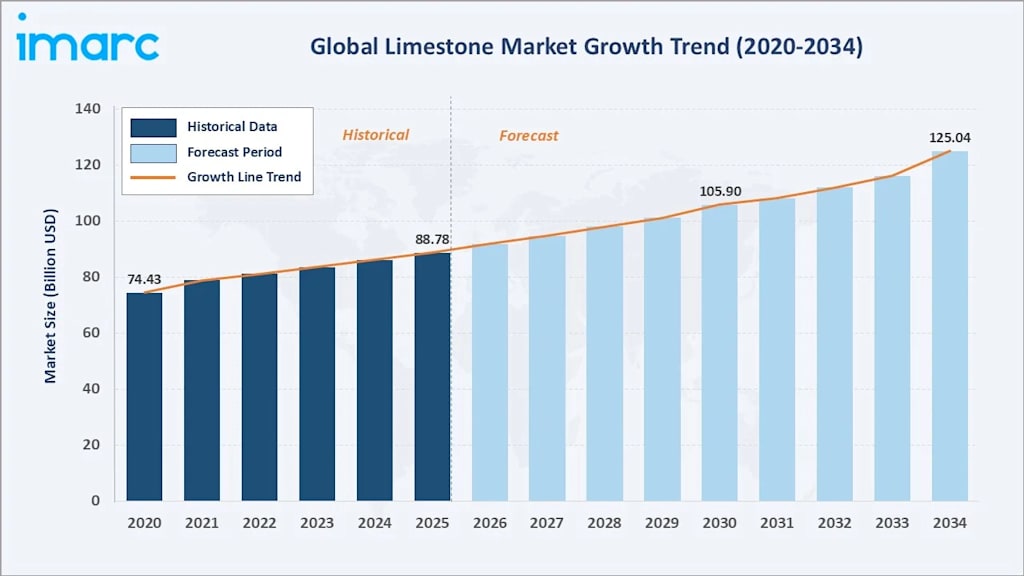
The construction, steel, and agricultural sectors continue to drive a surge in global limestone demand, fueled by massive infrastructure pipelines and a shift toward sustainable industrial chemistry. According to IMARC Group’s latest data, the global limestone market size was valued at USD 88.78 Billion in 2025. Looking forward, IMARC Group estimates the market to reach USD 125.04 Billion by 2034, exhibiting a CAGR of 3.59% from 2026-2034.
Limestone has solidified its position as a cornerstone of the global industrial economy, with annual consumption now exceeding 5,000 million tons. This expansion is powered by a "construction super-cycle" in emerging economies and the critical role of high-calcium limestone in environmental applications like flue gas desulfurization and wastewater treatment. As heavy industries like steel and cement transition toward lower carbon footprints, limestone-derived products are becoming indispensable for neutralizing emissions and creating high-performance, eco-friendly building materials.
Limestone Market Growth Drivers:
- Massive Global Infrastructure and Urbanization
The relentless pace of urban expansion, particularly in emerging Asia and Africa, acts as a primary engine for the limestone sector. With the construction industry accounting for a staggering 82% of total end-use, the demand for limestone as a foundational aggregate and cement feedstock is unbreakable. In regions like India, the National Infrastructure Pipeline is funneling billions into roads, bridges, and housing, which directly translates to a massive pull-through for quarrying operations. Because limestone typically makes up about 80% of cement feedstock, the mineral remains the lifeblood of the global skyline.
- Steel Manufacturing and Energy Transition Needs
The global push toward renewable energy is unexpectedly boosting limestone consumption through its link to steel. Modern wind turbine foundations require between 200 and 400 tons of steel per megawatt, and producing this steel necessitates high-purity limestone as a fluxing agent. Furthermore, as steelmakers transition to electric-arc furnaces and hydrogen-based direct reduction, they consume up to 20% more flux to manage impurities. This specialized industrial demand ensures that even as heavy industry goes green, the reliance on high-calcium limestone for chemical purification continues to scale upward.
- Environmental Compliance and Flue Gas Desulfurization
Tightening global emission standards are transforming limestone into a critical tool for pollution control. Coal-heavy economies are increasingly mandating flue gas desulfurization (FGD) systems in power plants to scrub sulfur dioxide from exhaust gases. High-calcium limestone, favored for its 95% carbonate purity, is the standard reagent for these scrubbers. Additionally, municipal utilities are shifting toward hydrated lime for pH correction in water treatment because it offers a 25% cost advantage over caustic soda. These environmental mandates create a stable, non-cyclical demand stream that complements the more volatile construction sector.
Limestone Market Trends:
- Innovation in Low-Carbon Cement and LC3 Blends
The industry is witnessing a significant shift toward Limestone Calcined Clay Cement (LC3), which can cut carbon intensity by up to 50%. By 2025, global LC3 capacity announcements exceeded 40 million tonnes, signaling a major transition in how the industry handles its environmental footprint. This trend is unlocking a premium market for finely ground limestone, allowing producers to move beyond bulk aggregates into high-value, specialized binders. Architects and developers are increasingly specifying these blends to meet green building certifications, turning a traditional commodity into a sophisticated sustainable solution.
- Digitalization and Automation in Quarrying Operations
Technology is fundamentally reshaping extraction efficiency through automated machinery and precision blasting. Major industry players are forming strategic alliances to implement digital solutions across their quarries to reduce operational overhead and carbon output. For instance, the use of AI-driven sorting and advanced crushing equipment has enabled the production of ultra-fine calcium carbonate grades for niche markets like bioplastics and pharmaceuticals. These technological leaps not only lower the cost-per-ton but also allow companies to access deeper or more complex reserves that were previously uneconomical to mine.
- Expansion into Regenerative Agriculture and Soil Health
Limestone is playing an increasingly vital role in global food security through soil conditioning. Agricultural lime application has become a standard practice for neutralizing acidic soils and enhancing nutrient uptake in crops. In the United States alone, nearly 20 million tonnes are applied annually to farmland. As global focus shifts toward regenerative agriculture, the demand for magnesian limestone and dolomitic lime is rising, as these variants provide essential magnesium while balancing pH. This trend is particularly strong in regions facing soil degradation, where mineral replenishment is key to maintaining yield.
Recent News and Developments in Limestone Market
- November 2025: Egyptian Steel announced a major investment program valued at approximately EGP 2 billion to upgrade its facilities, including the establishment of a dedicated limestone workshop aimed at boosting export capacity by 30%.
- May 2025: The European Commission cleared the merger of two major producers, Imerys and Sibelco, a move expected to consolidate the European supply chain and accelerate the development of specialized mineral solutions for the chemical and plastic industries.
- April 2025: Carmeuse strengthened its North American footprint by completing a USD 100 million acquisition of a significant limestone quarry in Indiana, securing long-term reserves to serve the growing Midwest construction and environmental sectors.
Note: If you require specific details, data, or insights that are not currently included in the scope of this report, we are happy to accommodate your request. As part of our customization service, we will gather and provide the additional information you need, tailored to your specific requirements. Please let us know your exact needs, and we will ensure the report is updated accordingly to meet your expectations.
About the Creator
Andrew Sullivan
Hello, I’m Andrew Sullivan. I have over 9+ years of experience as a market research specialist.
Enjoyed the story? Support the Creator.
Subscribe for free to receive all their stories in your feed.
Comments
There are no comments for this story
Be the first to respond and start the conversation.