
Lightweight Materials Market Strengthens with Industry Investments
How aerospace expansion, fuel efficiency requirements, and next-generation engineering are driving investments in high-performance lightweight materials

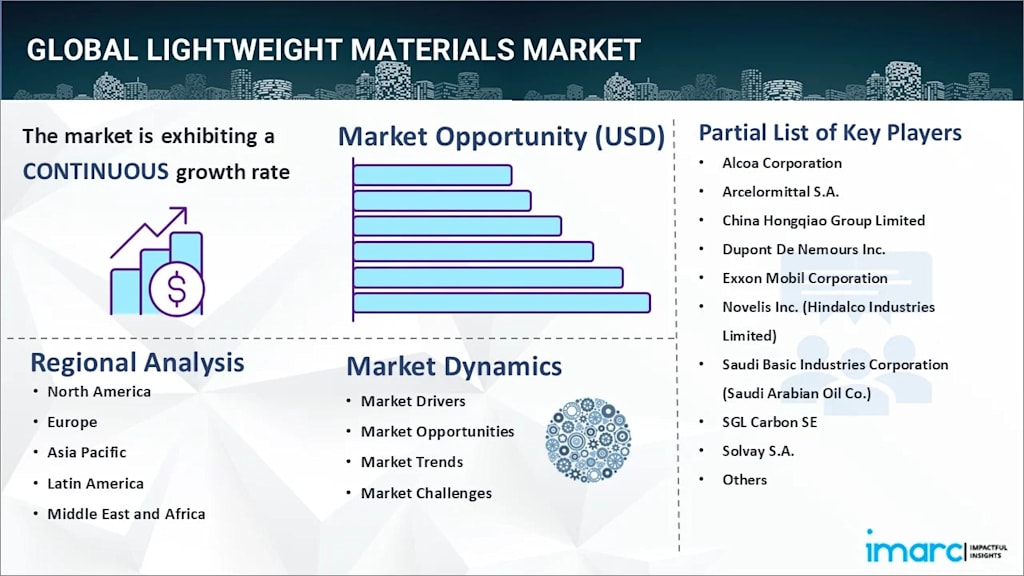
Rising environmental concerns, stringent vehicle emission regulations, and the rapid expansion of the electric vehicle sector are driving lightweight materials demand, supported by technological advancements, product innovation, and expanding application in aerospace and wind energy fields. According to IMARC Group’s latest data, The global lightweight materials market size was valued at USD 236.9 Billion in 2025. Looking forward, IMARC Group estimates the market to reach USD 407.2 Billion by 2034, exhibiting a CAGR of 6.02% from 2026-2034.
Lightweight materials now represent a multi-billion-dollar global market exceeding hundreds of billions and exhibiting steady year-on-year expansion. Demand is driven by strict environmental policies, the transition toward clean energy, and a strong industrial push to optimize fuel efficiency across transit systems. Industrial innovation, private sector investments, and advanced material formulations for structural integrity and high thermal resistance are further accelerating uptake. Major segments include metal alloys, composites, and polymers, with engineering applications focusing heavily on automotive, aerospace, wind energy, marine, electronics, and construction.
Get the Latest "Lightweight Materials Market" Competitive Analysis
Lightweight Materials Market Growth Drivers:
- Rapid Proliferation of Electric Vehicles (EVs)
Automakers utilize advanced compounds to offset the significant weight of large battery packs, which typically add 300 to 500 kilograms to a vehicle. Minimizing weight in non-battery components directly extends driving range and enhances overall efficiency. Because maintaining optimal performance is critical for consumer adoption, global manufacturers are heavily integrating aluminum alloys and engineering plastics into vehicle frames and chassis structures. This structural pivot creates an extensive demand baseline across international manufacturing lines, ensuring high consumption of dense yet featherweight structural options.
- Strict Government Regulations on Carbon Emissions
Regulatory bodies worldwide continue to enforce stringent fuel economy standards, penalizing high-emission vehicle fleets. To avoid massive compliance penalties, corporate engineering teams rely heavily on advanced high-strength steels and lightweight metal alloys to curb emissions substantially. Lowering total vehicle weight significantly reduces fuel consumption for traditional internal combustion engines. This policy-driven shift forces corporate procurement managers to prioritize low-density materials for body panels, bumpers, and internal components, sustaining a highly dependable and expanding high-volume industrial channel across global markets.
- Aerospace Industry Demand for Fuel Efficiency
Commercial and military aviation sectors prioritize high-strength, low-density materials to dramatically reduce operational fuel costs and maximize cargo capacity. Modern aircraft structures heavily utilize carbon fiber reinforced polymers and specialized titanium alloys in turbine blades, heat shields, and fuselage panels. These advanced materials provide exceptional mechanical strength and resistance to extreme operational temperatures without adding unnecessary structural mass. Consequently, aerospace defense contracts and commercial fleet expansions act as a critical driver for premium specialized materials that deliver uncompromised safety.
Lightweight Materials Market Trends:
- Integration of Sustainable and Recyclable Compounds
Manufacturing corporations are increasingly focusing on the lifecycle environmental impact of their inputs, boosting interest in natural fiber composites and highly recyclable aluminum strains. Industrial firms aim to build circular economies by adopting manufacturing scraps and post-consumer recycled metals into supply chains. Major enterprises are aggressively investing in closed-loop recycling infrastructure to guarantee a steady flow of high-purity secondary materials. This eco-conscious strategy aligns directly with corporate sustainability goals while mitigating raw material volatility and reducing the carbon footprints of heavy industrial sectors.
- Technological Breakthroughs in Polymer and Composite Manufacturing
Innovative production processes like automated fiber placement and advanced resin transfer molding are scaling up composite manufacturing efficiency. Historically, high processing costs restricted carbon fiber composites to elite aerospace designs, but modern automation lowers production cost barriers significantly. This structural transformation allows mass-market sectors like commercial electronics and wind energy to adopt high-performance polymer matrices cost-effectively. New formulations provide superior corrosion resistance and immense durability, making them highly attractive for industrial applications operating under harsh environmental conditions.
- Surging Utilization in Wind Energy Infrastructure
The global transition toward renewable energy infrastructure is accelerating the deployment of massive offshore and onshore wind turbines. Producing longer, more aerodynamically efficient turbine blades requires lightweight materials like glass fiber reinforced polymers to withstand severe wind loads without structural bending. Lowering blade weight minimizes mechanical stress on the central gearbox and main tower assemblies, reducing long-term maintenance overhead. This specific structural requirement ensures clean energy projects remain a prominent, highly active consumption market for premium, heavy-duty composite materials.
Recent News and Developments in Lightweight Materials Market
- August 2025: Alcoa Corporation finalized a multi-million-dollar expansion of its specialized alloy facility to meet skyrocketing demand from aerospace defense clients seeking high-durability, low-density materials for next-generation aircraft.
- September 2025: Novelis announced a major investment strategy aimed at expanding its specialized lightweight aluminum sheets production capacity across North America to support the production of aluminum-intensive electric vehicle frames.
- October 2025: DuPont De Nemours Inc. launched a new line of high-performance engineering polymers specifically designed to replace heavy metal components in vehicle powertrains, reducing weight while offering superior thermal resistance.
Note: If you require specific details, data, or insights that are not currently included in the scope of this report, we are happy to accommodate your request. As part of our customization service, we will gather and provide the additional information you need, tailored to your specific requirements. Please let us know your exact needs, and we will ensure the report is updated accordingly to meet your expectations.
About the Creator
Andrew Sullivan
Hello, I’m Andrew Sullivan. I have over 9+ years of experience as a market research specialist.
Enjoyed the story? Support the Creator.
Subscribe for free to receive all their stories in your feed.
Comments
There are no comments for this story
Be the first to respond and start the conversation.