
Leather Chemicals Market: Synthetic and Natural Chemical Integration & Market Transformation
How leather goods exports, sustainable production requirements, and specialty processing chemicals are supporting technological advancements in the leather chemicals market

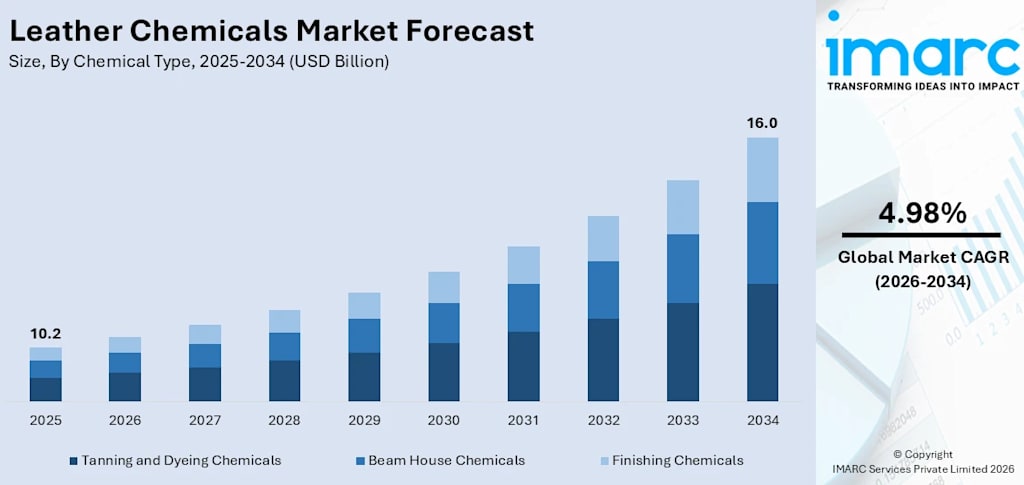
Rising environmental regulations, shifting consumer preferences toward eco-friendly products, and the expansion of the global footwear and automotive sectors are driving leather chemicals demand. This growth is strongly supported by innovations in bio-based tanning agents, strict government limits on hazardous effluents, and the widespread adoption of modern processing techniques. According to IMARC Group’s latest data, the global leather chemicals market size was valued at USD 10.2 Billion in 2025. Looking forward, IMARC Group estimates the market to reach USD 16.0 Billion by 2034, exhibiting a CAGR of 4.98% from 2026-2034.
Leather chemicals now represent a multi-billion-dollar global industry exceeding USD 8 billion and exhibiting steady year-on-year expansion. Demand is driven by rising quality standards in consumer luxury goods, strict global chemical compliance frameworks, and an intense industrial focus on reducing the chemical oxygen demand (COD) and total solids (TS) load in tannery wastewater. Industrial innovation, private-label chemical formulations, and product advancements in enzymatic dehairing and chrome-free retanning agents are further accelerating uptake.
Leather Chemicals Market Growth Drivers:
- Stricter Global Environmental Regulations and Compliance Standards
Regulatory bodies worldwide are imposing severe limits on hazardous discharges, directly forcing tanneries to abandon legacy formulations. For example, European Union regulations restrict hexavalent chromium content in leather goods to a maximum of 3 mg/kg, with ongoing policy assessments aiming to slash this threshold even further to 1 mg/kg (Jensen et al., 2024). These structural mandates compel global manufacturers to adopt advanced beamhouse and finishing chemicals. This regulatory transition expands the market for high-performance, compliant chemical systems, ensuring tanneries mitigate compliance violations and costly liability cases.
- Surging Production and Premiumization in Automotive and Footwear Industries
The massive scale of the global automotive trim and premium footwear sectors acts as a primary catalyst for leather chemical consumption. In automotive manufacturing, specialized surface coatings and finishing agents are vital; passenger cars account for a massive 78.0% share of synthetic and natural leather upholstery use within the automotive synthetic leather sub-segment (Kaitwade, 2026). To meet high-end consumer demands, suppliers require premium retanning chemicals and advanced polyurethane dispersions that provide exceptional flexibility, color stability, and resistance to repeated folding. Consequently, chemical formulators are experiencing heavy procurement volumes from tier-one automotive suppliers.
Claim Your Free "Leather Chemicals Market" Insights Sample PDF
- Industrial Shift Toward Green Chemistry and Bio-Based Materials
Industrial processors are heavily adopting sustainable chemistry to reduce their environmental footprint and align with global sustainability goals. Research shows that over 50.0% of leather industry participants now actively prefer eco-friendly or hybrid chemicals over traditional formulations (Marma, 2024). This structural shift has triggered a wave of corporate innovation, with companies commercializing bio-based tanning agents derived from renewable resources like olive oil mill wastewater (Pasquale, 2024). These green alternatives are experiencing high adoption because they deliver comparable softness and material strength while minimizing hazardous processing effluents.
Leather Chemicals Market Trends:
- Widespread Adoption of Low-Emission Waterborne Formulations
A prominent trend across the industrial landscape is the permanent replacement of solvent-heavy formulations with low-emission alternatives to satisfy tight interior air-quality thresholds. Vehicle assembly constraints and consumer demands for better cabin air quality have driven rapid growth in waterborne polyurethane dispersions, which significantly minimize volatile organic compound (VOC) release during the leather finishing stage (Kaitwade, 2026). This shift reduces the toxicity risks historically faced by factory workers and nearby communities. Manufacturers are prioritizing innovations that improve solid content and optimize curing complexity to seamlessly fit existing factory production lines.
- Biocatalytic and Enzyme-Assisted Processing Technologies
Tanneries are fundamentally modernizing their operations by replacing harsh inorganic materials with advanced biocatalytic systems. The conventional liming and reliming process historically accounts for 50.0% to 70.0% of the total biochemical and chemical oxygen demand loads in wastewater (Thanikaivelan, 2002). To combat this, factories are transitioning to enzyme-assisted dehairing methods utilizing alkaline bacterial proteases and amylase. These modern, bio-derived applications numerically reduce the total chemical oxygen demand load of a facility by 45.0% and decrease total solids by 20.0%, creating a highly attractive pathway for zero-discharge industrial compliance (Thanikaivelan, 2002).
- Traceability, Transparency, and Circular Economy Alliances
Global supply chains are rapidly restructuring around transparency, driving deep collaboration between chemical suppliers and major consumer brands. Because mass production involves complex and historically untransparent international networks, modern tanneries are utilizing advanced chemical tracing markers and specialized testing frameworks to verify product safety. This industrial shift allows consumer brands to definitively prove that their goods are free from toxic heavy metals and are sourced using circular economy practices. Leading chemical enterprises are actively partnering with livestock and food industry giants to ensure raw hides, which act as a natural industrial by-product, are processed cleanly.
Recent News and Developments in Leather Chemicals Market
- August 2025: BASF SE announced a strategic partnership with an international biotechnology group to co-develop a new line of high-performance, bio-based retanning agents. This collaboration aims to provide commercial tanneries with a scalable alternative to fossil-derived chemicals, effectively reducing carbon emissions across the textile supply chain.
- September 2025: Covestro AG successfully commercialized a next-generation series of waterborne polyurethane finishing agents tailored specifically for electric vehicle seating. The formulation addresses stringent automotive cabin requirements by drastically minimizing the release of volatile organic substances while offering superior scratch resistance.
- November 2025: Stahl Holdings B.V. expanded its global manufacturing footprint by opening a state-of-the-art chemical application center focused exclusively on zero-discharge beamhouse technologies. The facility is designed to help leather goods manufacturers in emerging markets transition smoothly toward strict compliance with global safety standards.
Note: If you require specific details, data, or insights that are not currently included in the scope of this report, we are happy to accommodate your request. As part of our customization service, we will gather and provide the additional information you need, tailored to your specific requirements. Please let us know your exact needs, and we will ensure the report is updated accordingly to meet your expectations.
About the Creator
Andrew Sullivan
Hello, I’m Andrew Sullivan. I have over 9+ years of experience as a market research specialist.
Enjoyed the story? Support the Creator.
Subscribe for free to receive all their stories in your feed.
Comments
There are no comments for this story
Be the first to respond and start the conversation.