
Lead Acid Battery Market: Energy Storage Trends, Automotive Demand & Growth Outlook
The lead acid battery market is growing due to rising demand for reliable and cost-effective energy storage solutions across industries.

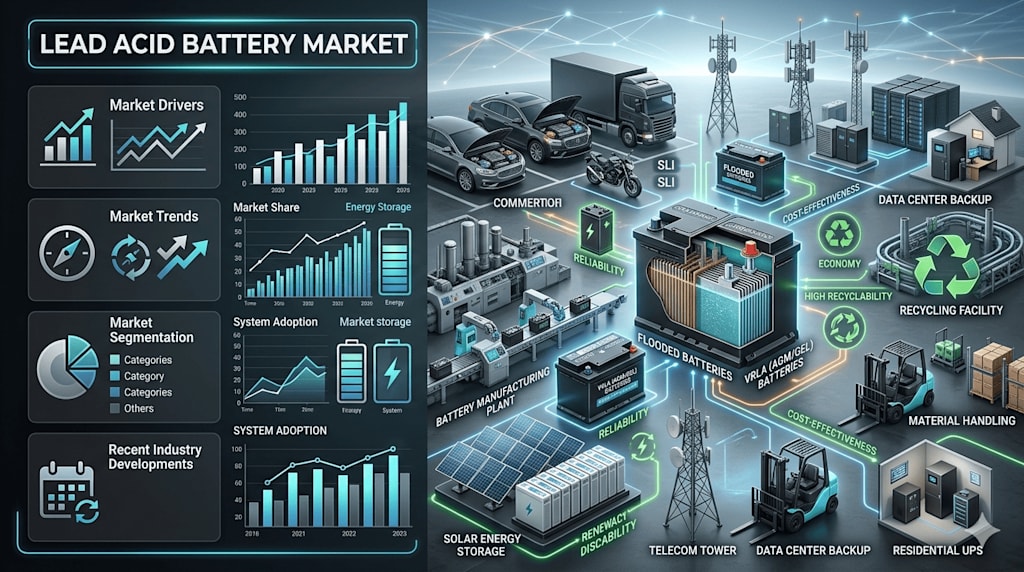
According to IMARC Group's latest research publication, the global lead acid battery market size reached USD 36.8 Billion in 2025. Looking forward, IMARC Group expects the market to reach USD 50.3 Billion by 2034, exhibiting a growth rate (CAGR) of 3.41% during 2026-2034.
How AI is Reshaping the Future of the Lead Acid Battery Market
- Predictive Battery Health Monitoring: AI-powered platforms track charge cycles, voltage patterns, and temperature data in real time, flagging degradation before failures occur and significantly reducing unplanned downtime in telecom and industrial backup applications.
- Smart Manufacturing and Quality Assurance: Machine learning systems analyze production line sensor data to detect plate defects and electrolyte inconsistencies early, cutting rejection rates and improving output consistency across high-volume battery assembly facilities.
- Demand Forecasting and Inventory Optimization: AI models process vehicle sales trends, seasonal patterns, and replacement cycles to accurately predict aftermarket battery demand, helping distributors reduce excess stock while preventing supply gaps at peak periods.

Lead Acid Battery Industry Overview
Lead acid batteries remain one of the most widely used energy storage technologies in the world, and for good reason: they are cost-effective, highly recyclable, and battle-tested across decades of real-world use. Today, over 85.4 million motor vehicles are produced globally each year, and the vast majority still rely on lead acid batteries for starting, lighting, and ignition.
Lead Acid Battery Market Trends and Drivers
The automotive sector is the single biggest engine powering this market, and that is not changing anytime soon. Around the world, vehicles are adding more electronic systems, which puts greater demand on the battery. Start-stop technology, now standard across a growing range of passenger cars in Europe and Asia, requires batteries that can handle frequent cycling without losing performance.
Beyond automotive, the single fastest-growing pull for lead acid batteries is reliable backup power. Data centers cannot afford blackouts, hospitals need continuous power, and telecom towers in developing markets often sit in areas with unreliable grid supply. All of these use cases need affordable, proven energy storage, and lead acid batteries consistently deliver on both fronts.
Environmental scrutiny is pushing manufacturers to innovate, and the companies that invest in sustainable practices are starting to gain a real edge. Unlike many emerging battery chemistries, lead acid has a mature and highly efficient closed-loop recycling ecosystem already in place. That is a significant advantage as governments tighten restrictions on battery disposal and push for greater producer responsibility.
Leading Companies Operating in the Global Lead Acid Battery Industry
- C&D Technologies, Inc.
- Clarios
- Crown Equipment Corporation
- East Penn Manufacturing Company
- EnerSys
- Exide Industries Limited
- GS Yuasa International Ltd.
- HBL Batteries
- HOPPECKE Batterien GmbH & Co. KG
- Leoch International Technology Limited Inc
- Teledyne Technologies Incorporated
- Lead Acid Battery Market Report Segmentation
By Product:
- SLI
- Stationary
- Motive
SLI (Starting, Lighting, and Ignition) batteries hold the largest share, given their essential role across the global automotive fleet.
By Construction Method:
- Flooded
- Valve Regulated Sealed Lead-acid Battery (VRLA)
Flooded lead-acid batteries hold the largest share of the market. Their straightforward design.
By Sales Channel:
- OEM
- Aftermarket
By Application:
- Automotive
- UPS
- Telecom
- Others
Automotive is the dominant application segment. With roughly 85.4 million vehicles produced globally each year and a well-established replacement cycle in the aftermarket.
Regional Insights:
- North America (United States, Canada)
- Asia Pacific (China, Japan, India, South Korea, Australia, Indonesia, Others)
- Europe (Germany, France, United Kingdom, Italy, Spain, Russia, Others)
- Latin America (Brazil, Mexico, Others)
- Middle East and Africa
Asia Pacific leads the global market, accounting for the largest share. The region benefits from a combination of massive vehicle production, rapid urbanization.
Recent News and Developments in the Lead Acid Battery Market
May 2025: Exide Industries inaugurated a state-of-the-art lead battery recycling plant in Gujarat, India, aimed at strengthening sustainable sourcing and cutting reliance on virgin lead materials across its manufacturing operations.
April 2025: EnerSys launched an AI-powered battery health management platform specifically targeting telecom and industrial backup applications, designed to enhance predictive maintenance capabilities and improve long-term performance reliability.
Note: If you require specific details, data, or insights that are not currently included in the scope of this report, we are happy to accommodate your request. As part of our customization service, we will gather and provide the additional information you need, tailored to your specific requirements. Please let us know your exact needs, and we will ensure the report is updated accordingly to meet your expectations.
About the Creator
sujeet. imarcgroup
With 2 years of hands-on experience at IMARC Group, I have conducted in-depth market research and analysis across diverse industries including technology, healthcare, agriculture, and consumer goods.
Enjoyed the story? Support the Creator.
Subscribe for free to receive all their stories in your feed.
Comments
There are no comments for this story
Be the first to respond and start the conversation.