
John Torrence Tate Jr: The Mathematician Who Built Bridges Across the World of Numbers
His ideas transformed number theory by connecting problems that had previously appeared completely unrelated
Introduction
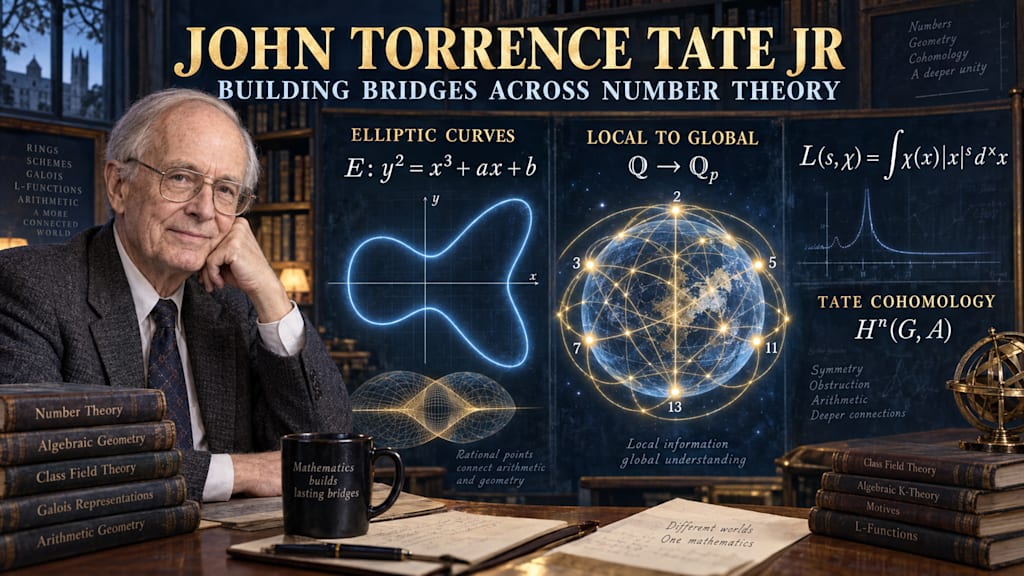
Some mathematicians become famous for solving one celebrated problem. John Torrence Tate Jr followed a different path because he created ideas, methods and mathematical structures that helped thousands of other researchers solve their own problems.
His work influenced number theory, algebra, geometry and several related subjects. Many of his concepts became so fundamental that mathematicians now use his name in numerous expressions, including the Tate conjecture, Tate modules, Tate curves, Tate cohomology and the Tate-Shafarevich group.
The Norwegian Academy of Science and Letters awarded him the Abel Prize in 2010 for his vast and lasting influence upon number theory. The award recognised a lifetime spent revealing connections between different parts of mathematics.
Growing Up Among Science and Language
John Torrence Tate Jr was born in Minneapolis, Minnesota, on 13 March 1925. His father, John Tate Sr, was a physics professor at the University of Minnesota and became an influential editor of the scientific journal Physical Review.
His mother, Lois Beatrice Fossler, taught English at secondary-school level. The combination of science and language within the family provided an appropriate background for someone who would later become known for expressing extremely deep mathematical ideas with remarkable economy.
Tate attended Harvard University and completed his undergraduate degree in 1946. He then entered Princeton University intending to study physics, but his interests gradually moved towards pure mathematics.
This change of direction proved important for modern number theory. Tate completed his doctorate at Princeton in 1950 under the supervision of the distinguished mathematician Emil Artin.
A Remarkable Doctoral Thesis
Most doctoral theses are read by a small group of specialists and then gradually disappear into university archives. Tate’s thesis became one of the most influential doctoral works in twentieth-century number theory.
The central problem concerned the relationships between ordinary numbers and more specialised systems known as number fields. A number field can be imagined as an expanded numerical world in which familiar numbers are joined by additional quantities needed to solve particular problems.
Earlier mathematicians often studied these worlds through separate calculations and specialised techniques. Tate found a more unified approach by combining ideas from number theory with methods associated with waves, frequencies and repeated patterns.
His method allowed mathematicians to examine a number field from several perspectives and then assemble the information into a coherent global picture. This approach became known informally as Tate’s thesis, and it continues to influence research more than seventy years later.
Looking Locally to Understand the Whole
One of Tate’s greatest strengths was his ability to connect local and global information. This distinction can be understood without using complicated mathematical symbols.
Imagine trying to understand the climate of the entire world. Measurements taken in London, New York or Sydney provide local information, but each measurement only describes one part of the planet. A global theory must explain how all those local conditions fit together.
Tate applied a similar philosophy to numbers. A difficult problem might be examined separately from the viewpoint of each prime number and from the viewpoint of ordinary size and distance. These local versions could then be combined to reveal what was happening across the complete number system.
The specialised number systems used in this approach are called p-adic numbers. They measure closeness according to divisibility by a chosen prime rather than according to ordinary distance.
Two numbers can therefore be extremely far apart by everyday measurement while appearing remarkably close within a p-adic system. Tate recognised that these unusual viewpoints were not merely curiosities because they provided powerful tools for investigating whole-number problems.
Adeles and a Mathematical Control Room
Tate’s thesis made important use of objects called adeles. An adele gathers information from all the different local number systems and places it within one larger framework.
A useful comparison might be an international airport control room. Every radar station observes a limited area, but the control room combines those separate reports into a single picture of the complete airspace.
Adeles perform a broadly similar role within number theory. They allow mathematicians to study local information simultaneously without losing sight of the global problem.
Tate did not invent every component used in this approach, but his treatment demonstrated their extraordinary power and clarity. His ideas helped turn adeles from specialised objects into essential tools of modern number theory.
Tate Cohomology
Tate also developed a construction now called Tate cohomology. The word cohomology sounds forbidding, although its underlying purpose can be described more simply.
Mathematicians frequently study objects by examining their symmetries. Some transformations may change the appearance of an object while preserving its essential structure, rather like rotating a perfectly symmetrical snowflake.
Cohomology provides a way of recording where local pieces fit together successfully and where obstructions prevent them from forming a consistent whole. Tate created a version particularly suited to finite groups and number theory.
His construction combined two previously separate processes into a single balanced theory. This provided mathematicians with a more efficient language for studying symmetry, extensions and hidden obstructions.
Elliptic Curves
Another major area of Tate’s work involved elliptic curves. Despite their name, these objects are not ellipses because they are special algebraic curves with an additional internal structure.
Elliptic curves have become central to modern number theory. They played an important role in the eventual proof of Fermat’s Last Theorem and are also used in some forms of computer encryption.
Tate developed new ways of examining these curves through local number systems. The Tate curve allowed certain complicated elliptic curves to be described using a repeating structure, making their behaviour easier to investigate.
He also helped develop methods for measuring the mathematical size of points upon elliptic curves. These measurements enable researchers to distinguish significant points from those produced by repetition or simple transformations.
The Tate-Shafarevich Group
Working with the Russian mathematician Igor Shafarevich, Tate helped identify one of the most mysterious objects associated with elliptic curves. It became known as the Tate-Shafarevich group.
This group records failures of the local-to-global principle. A problem might appear solvable when examined within every local number system, yet still have no solution when all the information is assembled globally.
A useful comparison involves a collection of jigsaw pieces. Every small group of neighbouring pieces may appear to fit correctly, but the completed groups may still refuse to form a single consistent picture.
The Tate-Shafarevich group measures this type of hidden obstruction. Mathematicians believe that it is always finite in important circumstances, but proving this remains one of the deepest unresolved problems in number theory.
The group is closely connected with the Birch and Swinnerton-Dyer conjecture. That conjecture is one of the seven Millennium Prize Problems, each carrying a prize of one million dollars for a correct solution.
The Tate Conjecture
Tate proposed another major idea that became known as the Tate conjecture. It concerns the relationship between algebraic shapes and the information that can be detected by studying their symmetries.
An algebraic shape can be imagined as a geometrical object defined by numerical rules. Some features of the shape are clearly produced by simpler substructures contained within it, while other features may be more difficult to explain.
The Tate conjecture predicts that certain symmetry-preserving features correspond precisely to genuine algebraic pieces of the object. In simple terms, it suggests that information detected through arithmetic symmetry should reflect real geometrical structure.
The conjecture has been proved in several important situations, but the complete statement remains unresolved. It continues to guide research in arithmetic geometry and is regarded as one of the central conjectures within the subject.
A Quiet and Influential Teacher
Tate taught at Princeton and Columbia before joining Harvard University in 1954. He remained at Harvard for thirty-six years and influenced generations of students and researchers.
In 1990, he moved to the University of Texas at Austin, where he continued teaching and conducting research until his retirement. Colleagues remembered him as someone who could recognise the essential core of a difficult problem and remove unnecessary complications.
His style was often described as economical and direct. He did not produce an enormous quantity of published work, but many of his papers created entire areas of research.
Tate was also generous with his ideas. Some important discoveries circulated through conversations, lectures and private letters long before they appeared formally in print.
Recognition Arrived Gradually
Tate received the Cole Prize in Number Theory in 1956 while he was still relatively young. He later received the Steele Prize for Lifetime Achievement and shared the Wolf Prize in Mathematics for his creation of fundamental concepts in algebraic number theory.
The greatest recognition arrived in 2010 when he received the Abel Prize. The prize committee stated that many important areas of modern algebraic number theory and arithmetic geometry had only become possible because of his contributions.
Tate was eighty-five when he received the award in Oslo. By then, ideas developed throughout his career had become part of the everyday language of advanced mathematics.
The University of Texas described him as one of the most influential mathematicians of the previous half-century. He died at his home in Lexington, Massachusetts, on 16 October 2019, aged ninety-four. The University of Texas published a detailed remembrance of his career.
Why Tate’s Work Matters
Tate’s importance cannot be explained through a single theorem or spectacular calculation. His real achievement was the creation of bridges between mathematical worlds.
He connected local information with global structures, linked algebra with geometry and turned abstract ideas about symmetry into practical research tools. Other mathematicians could then use those bridges to travel into areas that had previously been inaccessible.
Many of his concepts remain active areas of research. Some have contributed to major achievements, while others are connected to problems that remain unsolved.
His work demonstrates that mathematical progress does not always come from reaching the final answer. Sometimes the greatest contribution is creating the language, tools and viewpoints that allow future generations to ask better questions.
Conclusion
John Torrence Tate Jr was not widely known outside mathematics, but his influence within the subject was immense. He transformed number theory by showing how apparently separate problems could be understood through shared structures.
His ideas concerning local number systems, elliptic curves, symmetry and hidden obstructions helped shape modern arithmetic geometry. The many concepts carrying his name demonstrate how deeply his thinking became embedded within mathematics.
Tate rarely sought public attention, and his achievements cannot easily be reduced to a familiar calculation. However, much of modern number theory now travels along roads that he helped to build.
About the Creator
Alan Spencer
Have been an author and writer for over 20 years. Have been a journalist, editor, proofreader, and a designer and presenter of training courses. Have written over 100 articles, two books, and around 20 training courses.
Enjoyed the story? Support the Creator.
Subscribe for free to receive all their stories in your feed. You could also become a paid subscriber, letting them know you appreciate their work.
Comments
There are no comments for this story
Be the first to respond and start the conversation.