
Japan Personal Computer Market Set for Strong Growth Through 2033 as Hybrid Work, Digital Education, and AI Computing Reshape Demand
From Business Transformation to Consumer Innovation, Japan's PC Industry Enters a New Growth Era

The Japan Personal Computer Market is entering a dynamic phase of expansion as businesses, educational institutions, and consumers increasingly depend on advanced computing technologies. Driven by digital transformation initiatives, hybrid work environments, AI-powered applications, cloud computing, and evolving educational requirements, the market is projected to experience substantial growth over the coming years.
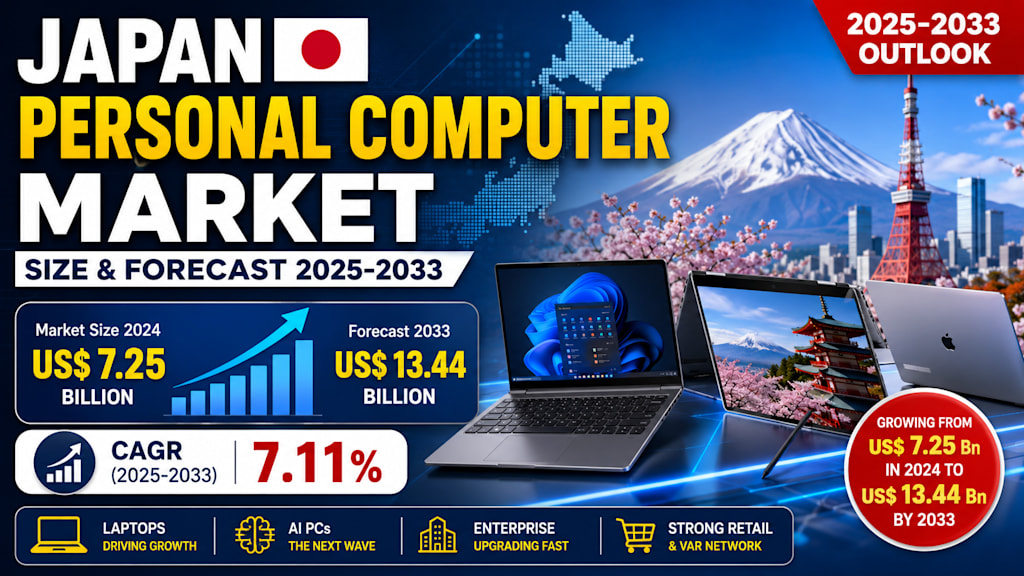
According to Renub Research, the Japan Personal Computer Market is expected to increase from US$ 7.25 billion in 2024 to US$ 13.44 billion by 2033, expanding at a CAGR of 7.11% between 2025 and 2033.
The growing popularity of portable computing devices, enterprise modernization projects, and demand for high-performance systems is creating significant opportunities for manufacturers and technology providers. While smartphones and tablets continue to dominate many daily activities, personal computers remain essential for productivity, software compatibility, content creation, engineering applications, and professional workloads.
As Japan continues its journey toward a digitally connected society, the personal computer industry is becoming a critical component of economic modernization and technological advancement.
Digital Transformation Accelerates PC Demand Across Japan
Japan has long been recognized as one of the world's most technologically advanced economies. However, the pace of digital transformation has accelerated significantly in recent years.
Organizations across manufacturing, finance, healthcare, education, retail, and government sectors are investing heavily in upgraded computing infrastructure. Digital workplaces require reliable personal computers capable of supporting cloud applications, cybersecurity solutions, virtual collaboration tools, and AI-enabled software.
The widespread adoption of hybrid and remote working arrangements has also increased demand for portable notebooks and enterprise-grade laptops. Employees now require devices that provide seamless connectivity, enhanced security, and long battery life to support flexible work environments.
These factors are helping sustain consistent PC replacement cycles and creating long-term growth opportunities throughout the Japanese market.
Laptops and Notebooks Continue to Dominate the Market
Laptops and notebooks remain the most influential segment within Japan's personal computer industry.
Japan's urban lifestyle and relatively compact residential spaces naturally favor portable devices over traditional desktop systems. Lightweight ultrabooks, thin-and-light notebooks, and versatile 2-in-1 devices have become increasingly popular among professionals, students, and consumers.
The educational sector has emerged as another major contributor to notebook demand. Government-led initiatives such as the GIGA School Program have encouraged widespread deployment of student computing devices across educational institutions.
Meanwhile, premium notebook models featuring advanced processors, OLED displays, dedicated graphics, and AI capabilities continue attracting creative professionals, software developers, and gamers.
As mobility becomes a central requirement for modern users, notebooks are expected to remain the largest revenue-generating category throughout the forecast period.
Enterprise Modernization Creates Stable Long-Term Demand
Large enterprises represent one of the strongest pillars supporting Japan's PC market growth.
Major corporations operating in manufacturing, automotive, banking, telecommunications, and technology sectors regularly upgrade computer fleets to maintain productivity, security, and operational efficiency.
Modern enterprises increasingly prioritize:
Advanced cybersecurity protection
Cloud-based collaboration tools
AI-assisted workflows
Endpoint management solutions
Sustainable IT infrastructure
Many organizations are also adopting Device-as-a-Service (DaaS) models, allowing them to streamline hardware procurement, deployment, maintenance, and replacement.
As a result, enterprise purchasing remains resilient even in periods of broader market uncertainty, helping stabilize overall industry performance.
ARM-Based PCs Gain Momentum
The shift toward ARM-based computing architectures represents one of the most notable developments in Japan's personal computer industry.
ARM-powered systems have gained attention because of their ability to deliver:
Extended battery life
Faster startup times
Improved energy efficiency
Reduced heat generation
Enhanced mobility
The success of Apple's MacBook lineup has demonstrated the commercial viability of ARM-powered computing for both consumers and professionals.
Software compatibility has improved significantly, encouraging broader adoption among businesses and creative users. As sustainability initiatives gain importance and organizations seek energy-efficient technologies, ARM-based systems are expected to capture an increasing share of the Japanese PC market.
Mid-Range PCs Remain the Volume Driver
Although premium devices receive considerable attention, the mid-range PC segment continues to generate substantial sales volume.
Priced between affordability and premium performance, these systems appeal to:
Students
Families
Small businesses
Home-office users
General consumers
Manufacturers are increasingly incorporating premium features into mid-range devices, including:
Solid-state drives (SSDs)
High-resolution displays
Improved battery life
Lightweight chassis
AI-enhanced productivity tools
This value-oriented approach has made mid-range PCs particularly attractive during periods of economic uncertainty, ensuring steady demand across multiple customer groups.
Offline Retail and VAR Channels Maintain Importance
Despite the rapid growth of e-commerce, offline retail stores continue to play a critical role in Japan's PC purchasing ecosystem.
Japanese consumers often prefer hands-on product evaluation before making technology purchases. Major electronics retailers provide opportunities to compare:
Display quality
Keyboard comfort
Device portability
Build quality
Performance capabilities
Value-added resellers (VARs) also remain essential for small businesses, educational institutions, and government organizations. These partners provide installation services, system integration, training, maintenance, and ongoing technical support.
As a result, offline channels continue contributing significantly to overall market revenue.
Windows PCs Retain Market Leadership
Windows remains the dominant operating system across Japan's personal computer landscape.
Several factors support its leadership position:
Business Compatibility
Most enterprises rely on Windows-based applications and workflows, making platform migration costly and complex.
Government Usage
Public institutions and government agencies continue to utilize Windows-based infrastructures for administrative operations.
Gaming Ecosystem
Windows remains the preferred platform for PC gaming because of extensive software compatibility and hardware flexibility.
Broad Device Availability
Manufacturers offer Windows-powered devices across virtually every price category, ensuring accessibility for diverse customer segments.
These advantages are expected to maintain Windows' market leadership throughout the forecast period.
Tokyo Leads Regional Market Growth
Tokyo remains the largest and most influential regional market for personal computers in Japan.
As the country's economic, political, and financial center, Tokyo generates substantial demand from:
Financial institutions
Government agencies
Technology firms
Media organizations
Creative industries
Professionals working in Tokyo increasingly seek lightweight, high-performance notebooks suitable for commuting and hybrid work environments.
The city's ongoing digital transformation initiatives further support continuous investment in advanced computing technologies.
Aichi Strengthens Enterprise PC Adoption
Aichi Prefecture serves as one of Japan's most important industrial hubs, home to major automotive and manufacturing operations.
Organizations within the region require powerful computing systems for:
Engineering design
Product development
Manufacturing simulation
Supply chain management
Industrial automation
These requirements drive strong demand for enterprise-grade desktops, workstations, and high-performance notebooks.
As Industry 4.0 adoption accelerates, Aichi's PC market is expected to remain highly active.
Shizuoka Benefits from Education and SME Demand
Shizuoka's personal computer market is shaped by a combination of educational institutions, households, and small businesses.
Government-supported educational programs continue generating recurring notebook replacement cycles. At the same time, SMEs require affordable computing solutions capable of supporting day-to-day business operations.
Family households increasingly invest in laptops that accommodate remote learning, online services, and entertainment, supporting steady consumer demand across the prefecture.
Artificial Intelligence Creates New Growth Opportunities
One of the most transformative trends influencing Japan's PC market is the emergence of AI-enabled personal computers.
Modern AI PCs incorporate dedicated neural processing units (NPUs) that support:
Real-time language translation
Intelligent productivity tools
Automated content creation
Enhanced video conferencing
Advanced cybersecurity
As AI applications become more integrated into workplace and consumer experiences, demand for next-generation AI-ready devices is expected to accelerate significantly.
This emerging category could become a major growth engine during the latter half of the forecast period.
10 Recent Developments Among Leading PC Companies
1. Lenovo Group Limited
Lenovo expanded its AI PC portfolio with new enterprise-focused devices featuring advanced AI productivity capabilities and enhanced security features.
2. HP Inc.
HP introduced next-generation AI-powered business notebooks designed to improve hybrid work experiences and collaboration efficiency.
3. Dell Technologies Inc.
Dell expanded its commercial PC lineup with AI-enabled systems optimized for enterprise productivity and cloud-based workflows.
4. Apple Inc.
Apple continued strengthening its ARM-based computing ecosystem through advanced MacBook models featuring improved performance and battery efficiency.
5. Acer Incorporated
Acer launched new environmentally sustainable laptops utilizing recycled materials and energy-efficient components.
6. Microsoft Corporation
Microsoft accelerated AI PC adoption through deeper integration of Copilot capabilities across Windows-powered devices.
7. Samsung Electronics Co., Ltd.
Samsung expanded cross-device ecosystem functionality between Galaxy mobile devices and Windows-based personal computers.
8. Huawei Technologies Co., Ltd.
Huawei introduced upgraded notebook solutions emphasizing productivity, connectivity, and intelligent software experiences.
9. Xiaomi Corporation
Xiaomi broadened its laptop portfolio with premium productivity-focused models targeting young professionals and students.
10. LG Electronics Inc.
LG enhanced its Gram laptop lineup with lighter designs, extended battery life, and AI-enhanced performance features.
Competitive Landscape
The Japan personal computer market remains highly competitive, with global technology leaders competing through innovation, performance improvements, ecosystem integration, and AI functionality.
Major companies operating in the market include:
Lenovo Group Limited
HP Inc.
Dell Technologies Inc.
Apple Inc.
Acer Incorporated
Microsoft Corporation
Samsung Electronics Co., Ltd.
Huawei Technologies Co., Ltd.
Xiaomi Corporation
LG Electronics Inc.
These companies continue investing in AI computing, enterprise mobility, sustainability initiatives, cloud integration, and next-generation hardware technologies to strengthen their positions in the Japanese market.
Final Thoughts
Japan's personal computer market is entering a promising growth phase driven by digital transformation, AI adoption, enterprise modernization, educational technology initiatives, and evolving consumer preferences. With the market projected to grow from US$ 7.25 billion in 2024 to US$ 13.44 billion by 2033, manufacturers have significant opportunities to capitalize on rising demand for intelligent, secure, and highly portable computing devices.
As hybrid work becomes permanent, AI-powered PCs gain mainstream acceptance, and businesses accelerate digital investments, Japan is poised to remain one of the most attractive and technologically advanced personal computer markets in the Asia-Pacific region throughout the forecast period.
About the Creator
Enjoyed the story? Support the Creator.
Subscribe for free to receive all their stories in your feed.
Comments
There are no comments for this story
Be the first to respond and start the conversation.