
Japan E-Commerce Market: Size, Trends, and Growth Outlook
How Digital Payments, Mobile Commerce, and AI Personalization Are Transforming Online Retail in Japan

Market Overview
The e-commerce market in Japan has emerged as one of the most advanced digital retail ecosystems globally, supported by high internet penetration, strong logistics infrastructure, and tech-savvy consumers. Online shopping in Japan spans categories such as fashion, electronics, groceries, and lifestyle products, making it a core part of modern retail.
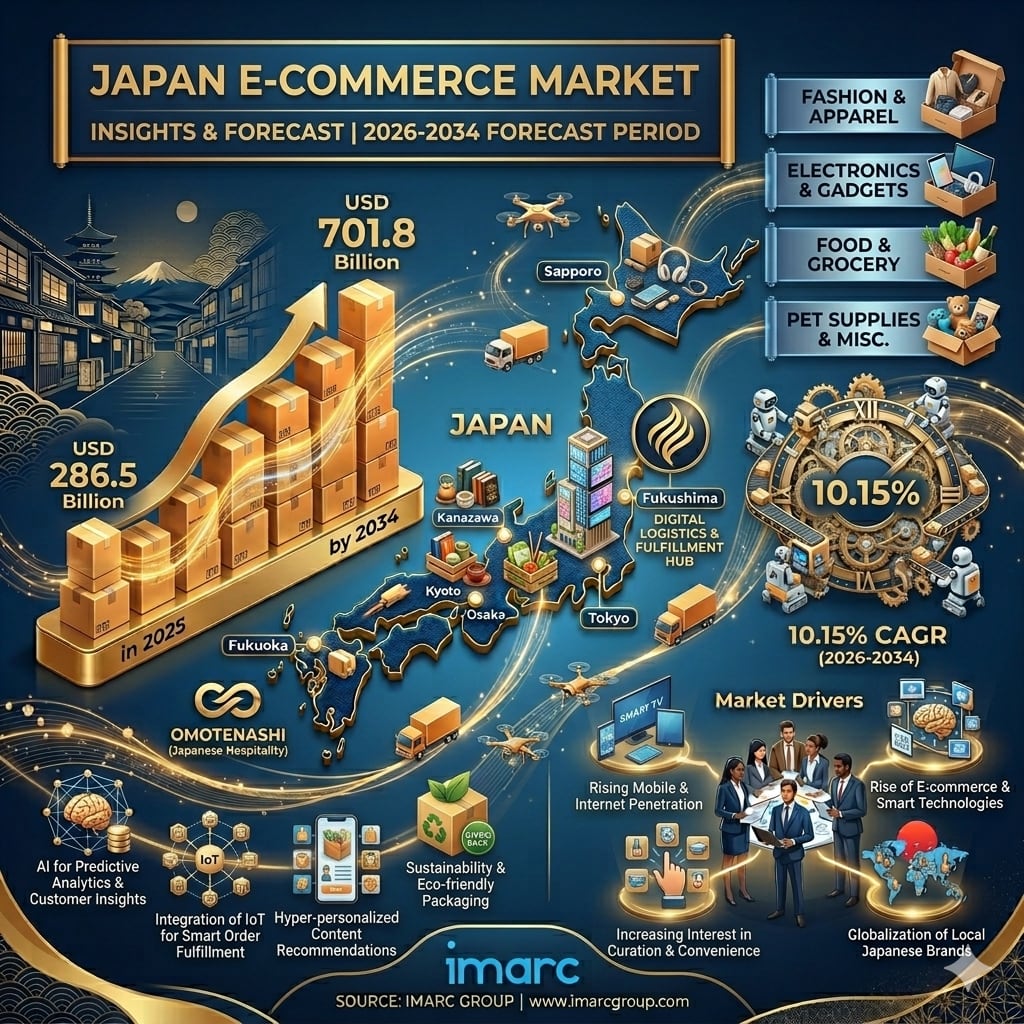
According to the latest analysis by IMARC Group, the Japan e-commerce market reached USD 286.5 billion in 2025 and is expected to grow significantly, reaching approximately USD 701.8 billion by 2034. This represents a robust CAGR of 10.15% during 2026–2034.
This strong growth is driven by increasing smartphone usage, expansion of digital payment systems, and continuous innovation in online retail platforms.
As consumer behavior shifts toward convenience and digital-first experiences, e-commerce is becoming a dominant force in Japan’s retail landscape.
Explore Industry Trends, Forecasts, and Opportunities — Get the Sample Report
Key Drivers Fueling Market Growth
- High Internet and Smartphone Penetration
Japan’s widespread internet access and growing smartphone adoption are key enablers of e-commerce growth. A significant portion of consumers now shop online via mobile devices, making mobile commerce a major revenue contributor.
- Growth of Digital Payments and Cashless Economy
The increasing use of digital wallets, mobile payments, and contactless transactions is simplifying online purchases and improving customer experience, encouraging more frequent online shopping.
- Convenience-Driven Consumer Behavior
Modern consumers in Japan prioritize convenience, speed, and product variety. E-commerce platforms offer easy price comparison, home delivery, and access to a wide range of products, making them highly attractive.
Role of Technology and Innovation
- AI-Driven Personalization
Artificial intelligence and machine learning are transforming online shopping by offering personalized product recommendations, improving customer engagement, and increasing conversion rates.
- Mobile Commerce Expansion
Mobile commerce continues to reshape the market, with a large share of consumers preferring to shop through apps due to ease of use, one-click checkout, and personalized interfaces.
- Logistics and Fulfillment Advancements
Japan’s efficient logistics network supports fast and reliable delivery services, including same-day and next-day delivery, enhancing customer satisfaction.
Japan E-Commerce Industry Trends & Drivers
The e-commerce landscape in Japan is evolving rapidly, influenced by both technological innovation and changing consumer expectations.
Fashion and apparel remain the largest product category, driven by younger, brand-conscious consumers who frequently browse and purchase online.
Business-to-consumer (B2C) transactions dominate the market, supported by well-established platforms that provide seamless shopping experiences.
Emerging trends such as social commerce, cross-border e-commerce, and quick commerce (rapid delivery services) are further expanding the market’s scope.
Japan E-Commerce Market Segmentation
By Type
- Home Appliances
- Apparel, Footwear, and Accessories
- Books
- Cosmetics
- Groceries
- Others
By Transaction Type
- Business-to-Consumer (B2C)
- Business-to-Business (B2B)
- Consumer-to-Consumer (C2C)
- Others
By Region
Kanto
Kansai / Kinki
Chubu
Kyushu–Okinawa
Tohoku
Chugoku
Hokkaido
Shikoku
The Kanto region, including Tokyo, dominates the market due to its large population, high digital adoption, and presence of major e-commerce platforms.
Competitive Landscape
The Japan e-commerce market is highly competitive, with the presence of major domestic and global players such as Rakuten, Amazon Japan, and other leading platforms.
Competition is driven by pricing strategies, delivery speed, user experience, and product variety. Companies are increasingly investing in AI, logistics, and customer engagement tools to strengthen their market position.
Market Outlook
The Japan e-commerce market is expected to witness strong and sustained growth through 2034, supported by continuous digital transformation and evolving consumer preferences.
Key growth areas will include mobile commerce, AI-powered personalization, and cross-border trade. Additionally, innovations such as immersive shopping experiences and social commerce will further reshape the market.
As convenience, speed, and personalization become central to consumer expectations, e-commerce will continue to redefine retail in Japan—making it more digital, data-driven, and customer-centric.
About the Creator
David Michel
David Michel brings precision and depth to the world of market research. By uncovering trends, analyzing data, and delivering meaningful insights, he helps businesses navigate opportunities with confidence.
Enjoyed the story? Support the Creator.
Subscribe for free to receive all their stories in your feed.
Comments
There are no comments for this story
Be the first to respond and start the conversation.