
Japan Digital Payment Market to Surpass US$ 1.32 Trillion by 2033 as Cashless Innovation Reshapes Consumer Finance
Government Initiatives, Smartphone Adoption, E-Commerce Growth, and Fintech Innovation Are Accelerating Japan's Transformation into a Cashless Economy

Japan's digital payment industry is undergoing one of the most significant transformations in its financial history. Traditionally known as a cash-dominant economy, Japan is rapidly embracing digital transactions as consumers, businesses, financial institutions, and government agencies shift toward faster, safer, and more convenient payment methods.
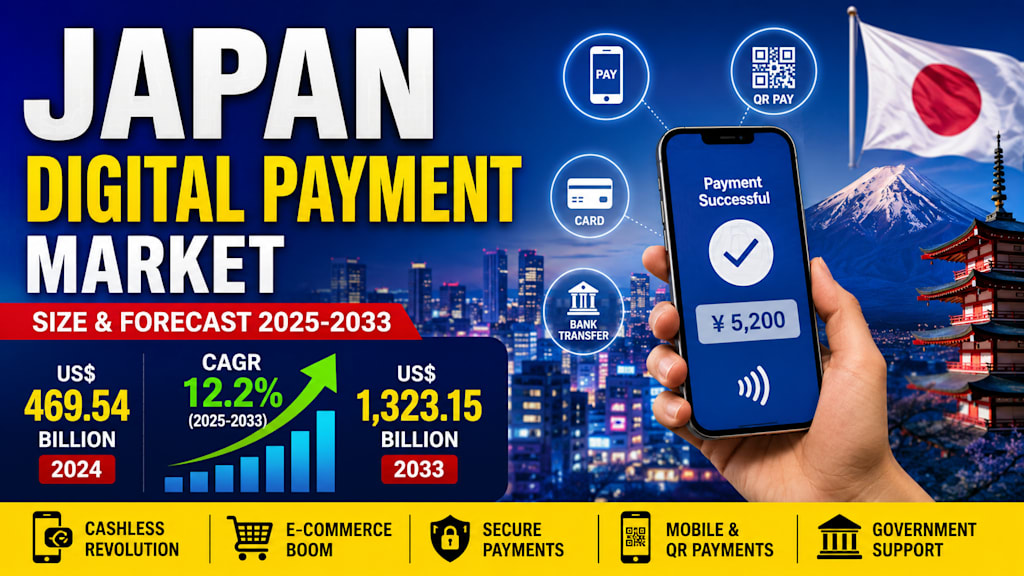
According to Renub Research, the Japan Digital Payment Market is expected to grow from US$ 469.54 billion in 2024 to US$ 1,323.15 billion by 2033, expanding at a robust CAGR of 12.2% during 2025–2033. This remarkable growth reflects the country's increasing smartphone penetration, expanding e-commerce ecosystem, government support for cashless initiatives, and rising consumer preference for seamless digital financial experiences.
As Japan continues modernizing its economy, digital payments are becoming the foundation of everyday commerce, transforming how citizens shop, travel, access healthcare services, and manage financial transactions.
Japan's Journey Toward a Cashless Society
For decades, Japan maintained one of the highest cash usage rates among developed nations. Consumers valued the reliability, security, and familiarity of cash transactions, while businesses often preferred cash due to lower processing fees.
However, this landscape has changed dramatically over the last several years.
The widespread availability of smartphones, increasing internet connectivity, changing consumer behavior, and government-backed digital transformation programs have accelerated the shift toward electronic payments. The COVID-19 pandemic further reinforced demand for contactless payment solutions as consumers prioritized safety and convenience.
Today, digital wallets, QR code payments, online banking platforms, contactless cards, and mobile payment applications have become commonplace across Japan's retail, transportation, hospitality, and service sectors.
Leading payment platforms such as PayPay, Line Pay, Apple Pay, and other digital wallet services have simplified transactions while offering incentives, cashback programs, and loyalty rewards that encourage adoption.
Smartphone Penetration Fuels Digital Payment Expansion
One of the strongest growth drivers in Japan's digital payment market is the country's extensive smartphone usage.
By early 2025, Japan had approximately 194 million active cellular mobile connections, representing 157% of the population. Additionally, nearly 97 million social media user identities were active, accounting for almost 79% of the population.
The widespread use of smartphones has created ideal conditions for mobile payment adoption. Consumers increasingly use QR codes, Near Field Communication (NFC) technology, and digital wallets to complete purchases quickly and securely.
The rollout of advanced 5G networks is further enhancing transaction speeds, improving payment reliability, and enabling smoother user experiences. As mobile devices become central to daily life, smartphone-based payment solutions are rapidly replacing traditional cash transactions across many sectors.
Younger consumers, in particular, are driving adoption, embracing digital-first lifestyles that prioritize convenience, speed, and accessibility.
Government Policies Accelerate Cashless Transformation
Japan's government has played a critical role in promoting digital payment adoption through various cashless initiatives and financial modernization programs.
Historically, Japan's dependence on cash created inefficiencies related to cash management, handling costs, and transaction processing. To address these challenges, policymakers introduced incentives designed to encourage consumers and merchants to adopt digital payment methods.
Cashback campaigns, merchant subsidies, fintech innovation support, and regulatory reforms have all contributed to a more favorable environment for electronic transactions.
A notable development has been the government's support for digital salary payments through smartphone applications. This initiative aims to simplify wage distribution, support foreign workers, expand financial inclusion, and stimulate innovation within Japan's financial services industry.
By fostering collaboration between regulators, technology providers, banks, and merchants, Japan is creating a comprehensive ecosystem capable of sustaining long-term cashless growth.
E-Commerce Growth Creates Massive Payment Opportunities
The rapid expansion of e-commerce is another major catalyst driving Japan's digital payment market.
Japanese consumers increasingly purchase products and services online, ranging from retail goods and groceries to entertainment subscriptions and digital services. This shift has elevated demand for secure and convenient payment solutions capable of supporting high transaction volumes.
Digital wallets, online banking services, and card-based payment systems have become essential components of the e-commerce experience.
Cross-border e-commerce has also expanded significantly, enabling Japanese consumers to purchase products from international marketplaces while encouraging domestic businesses to reach global customers.
The partnership between Mitsui & Co. and Shopify Japan to launch innovative logistics support solutions highlights how digital commerce ecosystems continue evolving. Improved logistics, integrated payment solutions, and streamlined online shopping experiences are expected to generate substantial opportunities for payment providers throughout the forecast period.
As consumers increasingly prioritize convenience and speed, digital payments will remain central to Japan's growing online economy.
Persistent Challenges Remain
Despite strong momentum, several challenges continue to influence market development.
Cultural Preference for Cash
Japan's deep-rooted trust in cash remains one of the most significant barriers to full digital payment adoption.
Many elderly consumers continue to prefer physical currency due to familiarity and perceived reliability. Small businesses, rural communities, and traditional establishments also maintain cash-focused operations.
Although adoption rates continue rising, changing long-standing consumer habits requires sustained education, incentives, and user-friendly payment solutions.
Cybersecurity and Consumer Trust
As digital transactions increase, so does exposure to cybersecurity risks.
Payment providers face growing threats from phishing attacks, fraud schemes, identity theft, and data breaches. Since Japanese consumers place high value on security and reliability, maintaining trust is essential.
To address these concerns, companies are investing heavily in biometric authentication, encryption technologies, tokenization, fraud detection systems, and multi-factor authentication frameworks.
Strong cybersecurity infrastructure will remain a key success factor as the market continues expanding.
Digital Commerce Payments Lead Market Growth
Digital commerce payments represent one of the largest and fastest-growing segments within Japan's digital payment ecosystem.
Online marketplaces, subscription services, food delivery platforms, travel booking websites, and entertainment applications increasingly rely on digital payment systems to facilitate transactions.
Consumers appreciate the convenience of one-click payments, recurring billing options, and integrated checkout experiences. Businesses benefit from faster settlements, improved customer experiences, and broader market reach.
As online shopping continues gaining popularity, digital commerce payments are expected to contribute significantly to overall market growth.
Mobile POS Solutions Revolutionize Retail Payments
Mobile Point-of-Sale (POS) solutions are transforming how merchants accept payments across Japan.
By allowing smartphones and tablets to function as payment terminals, mobile POS systems reduce infrastructure costs and improve payment accessibility for small and medium-sized enterprises.
Retailers increasingly accept contactless cards, QR code payments, and mobile wallets through flexible POS platforms.
Beyond payment acceptance, these systems offer valuable business intelligence capabilities, including inventory management, customer analytics, and real-time sales monitoring.
The combination of affordability and functionality is driving widespread adoption across urban and semi-urban markets.
Digital ACH Transfers Strengthen Financial Operations
Automated Clearing House (ACH) transfers continue playing an important role in Japan's digital financial infrastructure.
Businesses and government agencies rely on ACH systems for salary payments, utility bill processing, tax collection, and recurring financial transactions.
Digital banking platforms have enhanced ACH accessibility, enabling consumers and businesses to initiate transfers conveniently through mobile and online channels.
Although instant payment technologies are gaining popularity, ACH transfers remain essential for high-volume financial operations due to their efficiency and cost-effectiveness.
Healthcare Sector Embraces Digital Payments
Japan's healthcare industry is increasingly adopting digital payment solutions to improve patient experiences and operational efficiency.
Hospitals, clinics, and healthcare providers are implementing mobile payment systems, contactless transactions, and integrated billing platforms.
These solutions reduce administrative burdens, minimize cash handling, and enhance payment convenience for patients.
Given Japan's aging population and ongoing healthcare digitization initiatives, digital payments are expected to become an increasingly important component of healthcare service delivery.
Telecom and IT Companies Drive Payment Innovation
Telecommunications and information technology companies have become influential participants in Japan's digital payment ecosystem.
Through mobile wallets, carrier billing services, subscription payment platforms, and integrated financial applications, telecom providers are helping expand payment accessibility.
The emergence of 5G technology, Internet of Things (IoT) devices, and connected ecosystems is creating new opportunities for embedded payment solutions.
As digital lifestyles continue evolving, telecom and IT companies will remain key drivers of innovation and market expansion.
Retail and E-Commerce Remain Core End Users
Retailers and e-commerce businesses account for a substantial share of digital payment transactions across Japan.
Physical retailers increasingly deploy contactless payment terminals and QR code systems to meet changing customer expectations. Simultaneously, online merchants depend on digital payment gateways to support seamless purchasing experiences.
Digital payments also enable personalized marketing campaigns, loyalty programs, and enhanced customer engagement strategies.
As consumer expectations for convenience continue rising, digital payment adoption within retail and e-commerce is expected to accelerate further.
Regional Analysis: Tokyo Leads the Digital Payment Revolution
Tokyo remains Japan's largest digital payment market due to its dense population, advanced infrastructure, extensive fintech ecosystem, and concentration of financial institutions.
The city has consistently pioneered innovations in contactless transportation payments, mobile wallets, and digital commerce solutions.
Meanwhile, Saitama is emerging as a strong regional growth center, benefiting from urban expansion and close economic integration with Tokyo.
Aichi Prefecture, home to Nagoya and numerous industrial centers, is also experiencing strong adoption as businesses integrate digital payment technologies into both consumer and enterprise operations.
Together, these regions are helping shape the future of Japan's cashless economy.
10 Recent Developments from Leading Digital Payment Companies
1. Visa Inc.
Visa expanded its tap-to-pay capabilities across Asia-Pacific markets, supporting increased contactless transaction volumes and merchant acceptance.
2. Mastercard Incorporated
Mastercard strengthened real-time payment infrastructure investments to enhance cross-border and domestic digital payment capabilities.
3. PayPal Holdings Inc.
PayPal continued expanding merchant solutions and digital wallet functionality, enabling smoother international e-commerce transactions.
4. Apple Inc.
Apple enhanced Apple Pay integrations across transportation, retail, and digital commerce ecosystems, improving consumer convenience.
5. Amazon.com Inc.
Amazon expanded digital checkout capabilities and embedded payment technologies to streamline online purchasing experiences.
6. Fiserv Inc.
Fiserv introduced advanced payment processing and merchant solutions focused on improving digital transaction efficiency.
7. ACI Worldwide Inc.
ACI Worldwide expanded real-time payments technology offerings, helping financial institutions accelerate digital transformation.
8. American Express Company
American Express enhanced premium digital payment services and strengthened fraud protection technologies for cardholders.
9. Novatti Group Limited
Novatti continued developing digital banking and payment infrastructure solutions supporting global payment connectivity.
10. Aliant Payment Systems Inc.
Aliant expanded integrated payment processing services designed to support evolving merchant payment requirements.
Competitive Landscape
The Japanese digital payment market is highly competitive, featuring a combination of global payment giants, fintech innovators, technology companies, and domestic payment providers.
Competition increasingly centers on user experience, transaction security, merchant acceptance networks, rewards programs, and technological innovation.
Major participants continue investing in artificial intelligence, machine learning, fraud detection systems, blockchain-enabled infrastructure, and real-time payment technologies to strengthen market positions.
Strategic partnerships among banks, retailers, telecom providers, and technology companies are also becoming increasingly important in driving ecosystem growth.
Final Thoughts
Japan's digital payment industry stands at a pivotal moment. While cash remains culturally significant, changing consumer behavior, supportive government policies, rising smartphone usage, expanding e-commerce activity, and continuous fintech innovation are rapidly reshaping the nation's payment landscape.
With the market projected to grow from US$ 469.54 billion in 2024 to US$ 1,323.15 billion by 2033, digital payments are becoming a cornerstone of Japan's broader digital economy. Organizations that prioritize security, convenience, interoperability, and innovation will be best positioned to capitalize on the tremendous opportunities emerging across this dynamic market.
As Japan advances toward a more connected and cashless future, digital payments will continue transforming how businesses operate and how consumers interact with the modern economy.
About the Creator
Enjoyed the story? Support the Creator.
Subscribe for free to receive all their stories in your feed.
Comments
There are no comments for this story
Be the first to respond and start the conversation.