
Japan 3D Printing Plastics Market: Size, Share, Trends, Growth and Forecast 2034
How medical device expansion, custom implants demand, and biocompatible polymers are driving revenue growth across the Japan 3D printing plastics market.
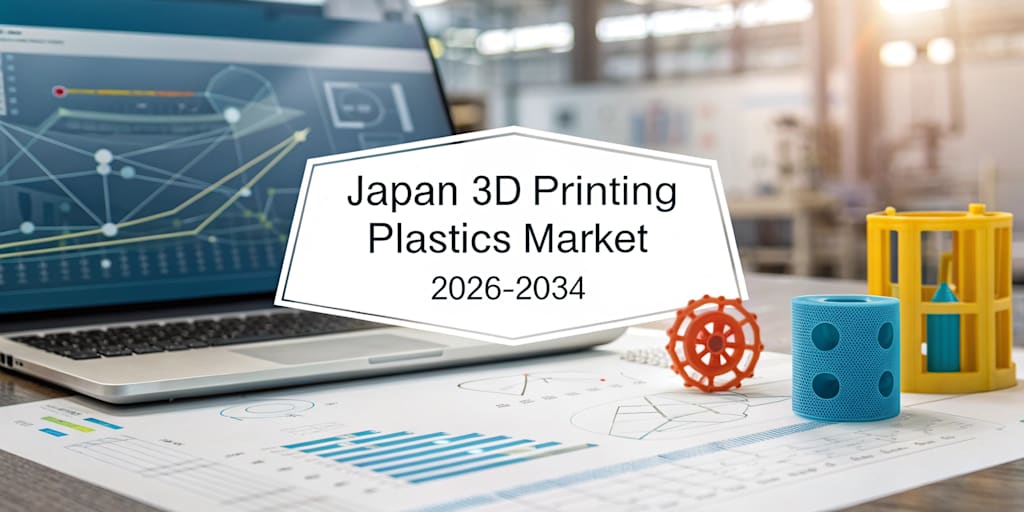
The Japan 3D printing plastics market is witnessing steady growth, supported by increasing demand for lightweight components, expanding adoption of additive manufacturing technologies, and ongoing innovation across multiple industries. According to industry data, the market was valued at USD 110.2 Million in 2025 and is projected to reach USD 456.3 Million by 2034, growing at a CAGR of 17.10% during 2026–2034. The Kanto region, particularly Tokyo, remains a key hub due to its concentration of technology companies, research institutions, and advanced manufacturing facilities.
Plastic materials continue to dominate Japan’s 3D printing ecosystem because of their versatility, affordability, and compatibility with widely used technologies such as fused deposition modeling (FDM), stereolithography (SLA), and selective laser sintering (SLS). Industries such as automotive, healthcare, aerospace, and consumer electronics are increasingly integrating plastic-based additive manufacturing into their workflows to improve efficiency and design flexibility.
Evaluate Market Potential Before You Invest – Get the Report Sample
Market Growth Drivers
1. Expanding Automotive and Aerospace Applications
Japan’s automotive sector plays a major role in driving demand for 3D printing plastics. Manufacturers are using additive manufacturing for rapid prototyping, enabling faster development cycles and reducing the need for traditional tooling. Plastic components are especially useful in testing complex geometries and improving product design before mass production.
In aerospace, lightweight materials are essential for improving fuel efficiency and performance. Plastic 3D printing allows engineers to produce intricate, lightweight parts that are difficult to achieve using conventional manufacturing methods. This capability supports innovation while reducing material waste and production time.
2. Government Support and Industry Collaboration
Government initiatives and public-private partnerships are helping accelerate the adoption of additive manufacturing in Japan. Various funding programs and research collaborations are focused on advancing materials science, robotics, and precision engineering. These efforts aim to strengthen the country’s manufacturing competitiveness and encourage small and medium-sized enterprises to adopt new technologies.
Regional development programs are also contributing to market expansion by promoting innovation beyond major urban centers. Investments in advanced manufacturing infrastructure and cross-border collaborations highlight Japan’s long-term commitment to modernizing its industrial base.
3. Rising Demand in Healthcare and Medical Devices
The healthcare sector is emerging as a significant user of 3D printing plastics in Japan. The ability to produce customized prosthetics, dental products, and surgical models is transforming patient care. Additive manufacturing allows for precise, patient-specific solutions that improve comfort and treatment outcomes.
Japan’s aging population is another factor supporting demand for medical applications. As healthcare providers look for cost-effective and scalable solutions, plastic 3D printing offers an efficient way to produce low-volume, highly specialized devices. Collaboration between medical institutions and technology providers continues to expand the scope of these applications.
Market Trends
1. Shift Toward Sustainable Materials
Sustainability is becoming an important focus in Japan’s manufacturing sector, including 3D printing plastics. Companies are increasingly exploring biodegradable, recycled, and bio-based materials to reduce environmental impact. This shift aligns with national and global efforts to lower carbon emissions and promote circular economy practices.
The development of eco-friendly materials that maintain high performance standards is expanding the market’s potential. Manufacturers are investing in research to ensure that sustainable plastics meet the mechanical and durability requirements of industrial applications.
2. Integration of AI and IoT Technologies
The use of artificial intelligence (AI) and the Internet of Things (IoT) is improving the efficiency of 3D printing processes. AI-powered design tools help engineers optimize structures, reduce material usage, and enhance product performance. These tools can automatically suggest design improvements that would be difficult to identify manually.
At the same time, IoT-enabled monitoring systems allow real-time tracking of printing conditions such as temperature, layer quality, and precision. This leads to better consistency, fewer errors, and improved overall productivity. The combination of AI and IoT is making additive manufacturing more reliable and scalable for industrial use.
3. Emerging Applications in Construction and Architecture
A newer area of growth for 3D printing plastics in Japan is the construction and architectural sector. Advances in large-scale printing and composite materials are enabling the creation of building components using additive manufacturing. This approach has the potential to reduce construction time, labor costs, and material waste.
Innovative projects have demonstrated the feasibility of using 3D printing for structural elements while meeting strict safety standards. As the technology matures, it could play a larger role in addressing challenges such as urbanization and resource efficiency in the construction industry.
Industry Developments
Recent developments highlight the ongoing evolution of the market. Investments in AI-driven design technologies and sustainable materials are strengthening innovation across the sector. Partnerships between Japanese companies and international firms are also contributing to knowledge exchange and technological advancement.
In the healthcare space, startups are using 3D printing to produce affordable prosthetics and medical devices, expanding access to personalized care. Meanwhile, collaborations in materials development are leading to stronger and more environmentally friendly plastic formulations suitable for industrial applications.
The construction sector has also seen notable progress, with experimental projects showcasing the use of 3D printing for building structures. These initiatives demonstrate the growing versatility of additive manufacturing beyond traditional industrial uses.
Conclusion
The Japan 3D printing plastics market is evolving rapidly as industries adopt more flexible, efficient, and innovative manufacturing solutions. Growth is supported by strong demand from automotive, healthcare, and aerospace sectors, as well as increasing government support and technological advancements.
Trends such as sustainability, AI integration, and expanding applications in construction are shaping the future of the market. As additive manufacturing continues to mature, plastic materials are expected to remain central to its development due to their adaptability and cost-effectiveness.
While the market shows strong long-term potential, its growth will depend on continued innovation, regulatory support, and the ability of manufacturers to scale production efficiently. Overall, 3D printing plastics are becoming an important part of Japan’s advanced manufacturing landscape, offering new possibilities for design, production, and industrial transformation.
Note:
This article is intended for informational purposes only and is based on publicly available industry insights and general market observations. It does not constitute financial or investment advice. Market conditions may vary across regions and industries, and readers are encouraged to conduct independent research or consult industry experts before making business or investment decisions.
About the Creator
Enjoyed the story? Support the Creator.
Subscribe for free to receive all their stories in your feed.
Comments
There are no comments for this story
Be the first to respond and start the conversation.