
Israel Military Aircraft Avionics Market: Combat Data as Competitive Moat
How IAF operational records, not just engineering specs, are driving a USD 8.41 billion export story through 2035

Combat-Proven and Export-Ready: How Israel's Avionics Industry Became NATO's Emergency Supplier
In December 2025, Germany took delivery of the Arrow-3 missile defense system, a transaction valued at approximately USD 4.6 billion and the largest single defense export in Israel's history. The prime contractor was Israel Aerospace Industries.
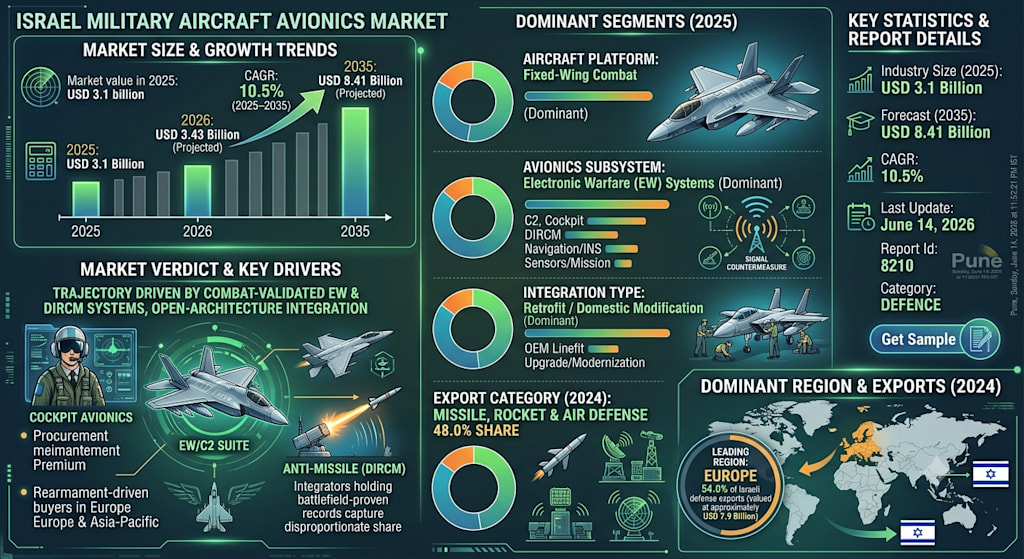
The radar was ELTA's Green Pine. No European system could match the delivery timeline or the operational certification record. That sequence, necessity overriding preference, is the clearest explanation for why the Israel military aircraft avionics market reached USD 3.1 billion in 2025 and is projected to reach USD 8.41 billion by 2035 at a 10.5% CAGR.
Europe now accounts for 54% of Israel's total defense exports at approximately USD 7.9 billion in 2024, up sharply from 35% in 2023. Electronic warfare systems hold the dominant avionics subsystem position, retrofit and domestic modification leads integration type, and fixed-wing combat platforms anchor demand across the forecast period. The full segmentation picture across aircraft platform, subsystem, integration type, and export category is documented in this Israel military aircraft avionics industry structure and forecast overview.
Why Europe Became the Primary Customer Almost Overnight
The procurement mechanism running through NATO rearmament is not strategic preference. It is timeline enforcement. European Defence Agency member states spent EUR 343 billion on defense in 2024, a 19% year-on-year increase, with equipment procurement reaching a record EUR 88 billion, up 39%.
The problem is that existing European avionics production capacity cannot scale fast enough to absorb those budget authorizations on NATO's required timelines. Israeli integrators, carrying IAF combat-validated certifications that European competitors lack, became the only suppliers with both immediate delivery capability and documented operational performance records.
The DDR&D certification requirement imposed by Israel's Ministry of Defense creates a quality gateway that benefits export customers. Any avionics system earning IMOD certification has survived an upgrade cycle driven by live combat feedback, not laboratory testing.
When a German or Polish procurement ministry writes a competitive tender with delivery timeline as a contract-award criterion, that operational record converts directly into a pricing premium that winning bidders collect and losing bidders cannot close through specification improvements alone.
Elbit's May 2025 USD 512 million Nasdaq share offering, with proceeds earmarked specifically for European production infrastructure, signals that the company is scaling capacity ahead of committed demand rather than responding to orders already in hand. That distinction matters. Firms that expand manufacturing in anticipation of confirmed pipeline capture margin that reactive competitors surrender when they face capacity ceilings mid-program.
The EW Monopoly That Nobody Set Out to Build
Electronic warfare system dominance in this market was not designed from a commercial standpoint. It accumulated through operational necessity. Every IAF fixed-wing aircraft operating in contested airspace carries a self-protection suite that is upgraded after each significant deployment cycle. The threat library feeding those upgrades includes radar signatures, missile tracking modes, and electronic countermeasure responses collected in live operational environments that no NATO test range replicates.
That library is the durable competitive asset. Elbit Systems, with a USD 28.1 billion backlog as of December 2025 with 72% sourced internationally, and IAI, carrying a backlog exceeding USD 30 billion, are not holding those figures because of superior engineering talent alone. They hold them because procurement ministries are paying for access to a frequency and threat database that accumulates only through continuous combat deployment. Thales, Northrop Grumman, and BAE Systems participate in this market through subcontract and partnership channels rather than direct competition on Israeli prime contracts, and that is not an accident of geography. It reflects the DDR&D certification barrier that effectively structures the competitive boundary.
The January 2025 IMOD contract awarding Elbit USD 80 million to integrate an advanced self-protection suite combining EW, DIRCM, and chaff/flare systems onto the F-16I fleet is the clearest near-term illustration of how upgrade cycles generate recurring revenue independent of new platform procurement. Legacy aircraft with operationally exposed self-protection configurations are a standing backlog.
The Retrofit Cycle That Keeps Rewinding
Israel's platform strategy has always been to acquire foreign airframes and reconfigure them domestically with Israeli-developed avionics, which makes retrofit the structural dominant in integration type without requiring any deliberate market strategy to produce that outcome. The F-35I Adir fleet, at 46 operational aircraft in 2025 targeting 75 by 2030, undergoes Israeli-specific EW architecture modifications post-delivery from Lockheed Martin. Each modification cycle is a retrofit program. Each upgrade following operational deployment is another. The revenue per platform over its operational life is substantially higher than any OEM linefit contract generates.
The February 2026 NIS 400 million agreement for Elbit to integrate avionics, EW, C2, and DIRCM systems into 12 new CH-53K Pereh heavy-lift helicopters is structurally identical: foreign platform, domestic avionics modification, multi-year integration program. Lockheed Martin's March 2025 establishment of a dedicated production line specifically for Israeli avionics integration into CH-53K helicopters formalizes this pattern at the OEM level, confirming that the retrofit workflow has matured into an institutionalized production architecture rather than a program-by-program arrangement.
What the Export License Risk Actually Means for Revenue
European arms export restrictions represent the most consequential near-term uncertainty in this market, and it is one that headline backlog figures obscure. Export license restrictions can halt revenue recognition on committed contracts without triggering formal cancellation, creating a cash flow gap that sits between signed agreements and receivable revenue. Firms with European revenue concentration above 30% are exposed to this mechanism in ways that their order intake figures do not communicate.
Israeli defense-tech startups attracted over USD 1 billion in investment in 2025, exceeding all prior years combined, at precisely the moment export license stability is most uncertain. The expansion of the ecosystem and the regulatory instability are occurring simultaneously rather than in sequence, which complicates investment timing for anyone evaluating Israeli avionics mid-tier exposure.
The Israel military aircraft avionics market share analysis points toward a related structural tension: the acquisition of Bird Aerosystems by US defense firm Ondas in March 2026 at approximately USD 133 million confirmed that Western primes are choosing to acquire proven Israeli DIRCM technology rather than develop competing systems internally. That acquisition pattern is healthy for Israeli mid-tier valuations but simultaneously reduces the number of independent avionics specialists available for domestic program competition over time.
India, the Gulf, and the Next Demand Layer
The Abraham Accords normalization framework opened a procurement corridor to Gulf air forces that had no previous pathway to Israeli avionics. Middle East exports from Abraham Accords partner countries reached approximately USD 1.76 billion in 2024, rising from 3% to 12% of Israel's total export base in a single year. Fighter aircraft upgrades represented 72% of the Middle East military aircraft segment in 2026. That concentration reflects air force modernization programs, running across Saudi Arabia, UAE, and Qatar simultaneously, where avionics upgrade content per platform is high and political procurement barriers have partially dissolved.
India's December 2025 Defence Acquisition Council approval of a USD 8.7 billion arms package incorporating Rafael, IAI, and Rampart systems activates a co-production and avionics integration pipeline governed by Atmanirbhar Bharat local content thresholds. The Adani-Elbit Advanced Systems joint venture in Hyderabad, which had supplied more than 20 Hermes 900 MALE UAVs internationally by early 2024, demonstrates what compliant co-production looks like in practice. For Israeli integrators without established Indian manufacturing presence, the follow-on sustainment revenue from that USD 8.7 billion package is structurally inaccessible regardless of technology quality.
As directed-energy weapons transition from R&D programs to operational procurement, the March 2026 IMOD contract for Elbit's XCalibur airborne high-power laser establishes a new subsystem category that will eventually attach to export programs across European and Gulf customers. The timeline between Israeli operational validation and export certification typically runs 24 to 36 months, placing the first export-ready directed-energy avionics contracts in the 2028 to 2029 window. The firms that secure operational validation data from IDF deployment in that interim period will arrive at export tenders with a documented performance record that competitors offering untested equivalents cannot match by specification alone.
About the Creator
Suge kun
Research Analyst passionate about data & market insights. I turn complex information into clear, actionable strategies. Detail-driven & results-focused — helping businesses make smarter decisions. — Suge Kun
Enjoyed the story? Support the Creator.
Subscribe for free to receive all their stories in your feed.
Comments
There are no comments for this story
Be the first to respond and start the conversation.