
IoT Testing Market Witnesses Strong Growth Amid Device Expansion
How connected device adoption, cybersecurity requirements, and interoperability testing are driving innovation and quality assurance across the evolving IoT testing market.

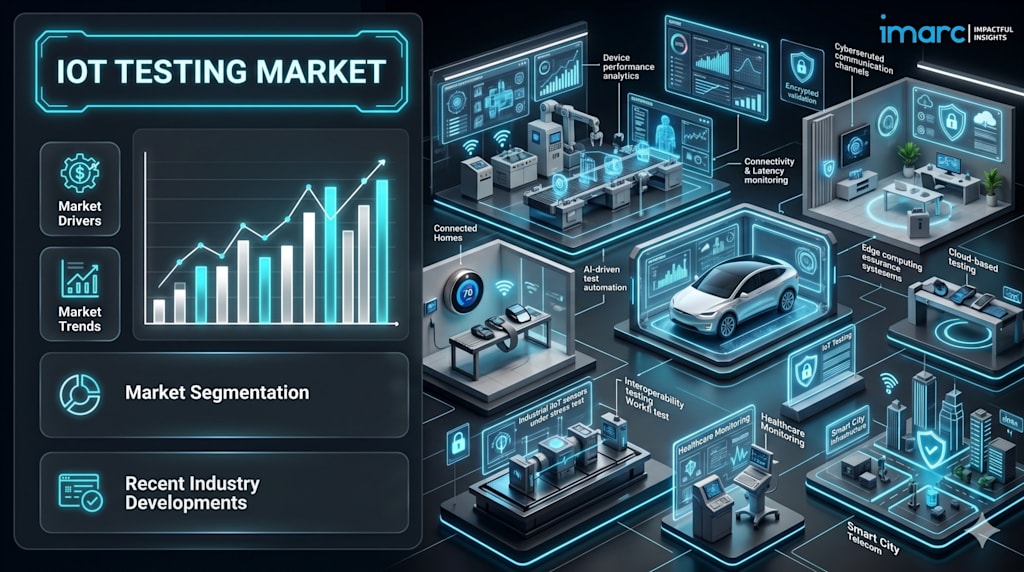
According to IMARC Group's latest research publication, The global IoT testing market size reached USD 4.9 Billion in 2025. Looking forward, the market is expected to reach USD 44.2 Billion by 2034, exhibiting a growth rate (CAGR) of 26.99% during 2026-2034.
How AI is Reshaping the Future of the IoT Testing Market
- AI-Powered Automated Test Generation: Artificial intelligence is fundamentally transforming how IoT test suites are built and executed. AI-driven systems can autonomously generate test cases by analyzing device communication patterns, protocol behaviors, and historical defect logs, dramatically reducing the manual effort required to achieve comprehensive coverage across hundreds of interconnected endpoints. Organizations adopting AI-based test automation report significant reductions in regression cycle times, enabling continuous deployment pipelines that were previously impractical for complex IoT ecosystems spanning industrial floors, smart buildings, and connected vehicles.
- Predictive Quality Monitoring and Anomaly Detection: Machine learning models embedded within IoT testing platforms continuously analyze telemetry streams from devices under test, identifying behavioral anomalies before they translate into field failures. Rather than relying solely on pass-or-fail thresholds, these systems learn baseline performance signatures and flag statistical deviations in latency, packet loss, and power consumption in real time. This shift from reactive to predictive quality assurance is particularly critical in smart healthcare and smart manufacturing environments where device malfunctions carry direct operational and safety consequences.
- AI-Augmented Security Vulnerability Assessment: Cybersecurity testing for IoT has been transformed by AI-assisted penetration frameworks that simulate adversarial attack patterns at scale. These platforms model evolving threat vectors against IoT firmware, communication stacks, and cloud interfaces, automatically prioritizing vulnerabilities by exploitability and potential impact. With connected device deployments expanding across utilities, transportation, and financial services infrastructure, AI-augmented security testing enables organizations to maintain continuous compliance postures without proportionally scaling human security testing teams.
- Digital Twin Integration for Scalable Device Simulation: AI is enabling the creation of intelligent digital twins that replicate the behavioral and environmental profiles of physical IoT devices, allowing validation teams to run large-scale test matrices in software before hardware is available. These simulations can model full device lifecycles including network degradation, firmware update responses, and edge-case sensor inputs, reducing physical test lab hardware costs while expanding coverage. Digital twin environments are particularly valuable for connected vehicle programs and smart city infrastructure where physical test setups involve prohibitive cost and coordination complexity.
- Natural Language-Driven Test Orchestration: Emerging AI interfaces now allow test engineers to describe desired validation scenarios in plain language, with underlying systems automatically translating requirements into executable test scripts across functional, performance, and security testing dimensions. This capability accelerates onboarding of domain experts who understand IoT application logic but lack deep test automation expertise, broadening the contributor base for QA activities. By bridging the gap between business requirements and technical test execution, natural language orchestration is improving both test coverage and the alignment of validation efforts with real-world operational conditions.
IoT Testing Industry Overview
The IoT testing market is expanding rapidly as enterprises across virtually every sector accelerate the deployment of connected device ecosystems. With China alone reporting over 2.57 billion active IoT terminals as of August 2024, the sheer scale of endpoint proliferation is creating exponentially larger test matrices that manual processes cannot address. A single smart factory environment may simultaneously integrate Zigbee sensors, LoRaWAN gateways, and 5G RedCap robotics systems, forcing validation teams to assure seamless interoperability across diverse protocol combinations. This complexity is transforming IoT testing from a peripheral quality activity into a core infrastructure investment.
North America currently holds the dominant regional position in the market, commanding approximately 38% of global revenue, driven by early enterprise IoT adoption, a mature regulatory framework around data privacy and cybersecurity, and a dense concentration of technology vendors investing in next-generation testing infrastructure. The United States leads particularly in industrial IoT and connected healthcare applications, sectors where testing failures carry direct regulatory and liability consequences. The region's stringent requirements around device certification and network security compliance continue to generate sustained institutional demand for professional and managed testing services.
Asia Pacific represents the fastest-growing regional segment, propelled by its manufacturing scale, expanding smart city programs, and strong government investment in digital infrastructure. Japan's Ministry of Economy, Trade, and Industry formalized IoT security testing requirements aligned with international standards, scheduled for launch in March 2025, reflecting a regulatory trend across the region toward mandatory compliance validation for connected devices. The Middle East, anchored by UAE and Saudi Arabia's ambitious giga-projects such as NEOM and Dubai's Smart City initiative, contributes a growing share of global IoT testing demand as large-scale public infrastructure deployments require performance and security validation across connected transportation, utilities, and urban management systems.
IoT Testing Market Trends and Drivers
The proliferation of 5G connectivity and the parallel rise of edge computing are among the most consequential structural forces reshaping IoT testing requirements. Low-latency use cases including autonomous vehicle coordination, industrial robotics, and real-time healthcare monitoring require testing frameworks capable of capturing millisecond-level performance variations under variable network conditions. Edge deployments introduce distributed, decentralized architectures that strain traditional centralized testing approaches, generating sustained demand for specialized testbeds and simulation environments. Keysight Technologies reported fiscal 2024 revenues of USD 4.98 billion, with USD 894 million generated specifically from communications testing solutions, reflecting the institutional scale of demand for AI-assisted IoT and 5G validation tools across enterprise and government clients.
Cybersecurity concerns are serving as a powerful demand catalyst across all IoT testing segments. As connected device ecosystems expand into critical infrastructure, financial services, and healthcare, the attack surface exposed to adversarial actors grows proportionally. Regulatory bodies globally are tightening IoT security mandates, with compliance requirements now stipulating ongoing vulnerability assessment and penetration testing as conditions of market access. Organizations are actively increasing spend on security testing services that span encryption protocol validation, access control mechanisms, and firmware integrity verification. This regulatory pressure is particularly pronounced in Europe and North America, where data privacy frameworks impose penalties for breaches traced to inadequate device security controls, making comprehensive IoT security testing a non-negotiable operational requirement rather than a discretionary investment.
The growing digitization of business operations, combined with the expanding footprint of smart building automation, vehicle telematics, and smart utilities, is broadening the application base for IoT testing services. Network testing remains the largest single testing type given that connectivity reliability underpins every IoT value proposition, while cloud-based deployment of testing infrastructure is gaining share as organizations seek scalable, remotely accessible validation environments without proportional capital expenditure on physical testing hardware. Managed testing services are gaining particular traction among mid-market enterprises that lack the internal expertise to design and maintain comprehensive IoT testing programs, outsourcing end-to-end validation to specialized providers equipped with multi-protocol testbeds and security assessment frameworks.
Leading Companies Operating in the Global IoT Testing Industry
- AFour Technologies Pvt. Ltd.
- Apica AB
- Beyond Security (HelpSystems LLC)
- Capgemini SE
- Happiest Minds Technologies Limited
- HCL Technologies Limited
- Infosys Limited
- Keysight Technologies
- Praetorian
- Rapid7 Inc.
- Saksoft Limited
- Singapore Telecommunications Limited
IoT Testing Market Report Segmentation
By Testing Type:
- Functional Testing
- Performance Testing
- Network Testing
- Compatibility Testing
- Usability Testing
- Security Testing
Network testing represents the dominant testing type in the IoT testing market. It encompasses validation of communication protocol functionality, bandwidth and latency performance, encryption and access control mechanisms, and network scalability under increasing device loads. Network testing ensures that IoT endpoints can reliably transmit data with minimal delay while maintaining security and interoperability across heterogeneous device populations. Functional testing, performance testing, compatibility testing, usability testing, and security testing collectively form the broader testing type landscape, each addressing distinct risk dimensions across IoT device and application deployments.
By Service Type:
- Managed Services
- Professional Services
The market is divided between managed services and professional services. Managed service providers offer scalable, expertise-driven testing programs that can flex to accommodate growing IoT deployments without proportional expansion of internal testing teams. Professional services bring end-to-end testing competencies for organizations requiring project-based engagements across complex, heterogeneous IoT ecosystems, providing comprehensive coverage from hardware validation through application-layer security assessment.
By Deployment Mode:
- On-premises
- Cloud-based
On-premises deployment enables organizations to conduct validation in real-world environments, assessing network connectivity, device interference patterns, and environmental operating conditions within controlled infrastructure. Cloud-based deployment eliminates upfront capital expenditure on physical testing infrastructure, offering remote accessibility, global team collaboration, and elastic resource scaling. Cloud deployment is gaining accelerating adoption as IoT test matrices grow in complexity and organizations require geographically distributed testing capabilities.
By Application:
- Smart Building and Home Automation
- Capillary Network Management
- Smart Utilities
- Vehicle Telematics
- Smart Manufacturing
- Smart Healthcare
Smart building and home automation, capillary network management, smart utilities, vehicle telematics, smart manufacturing, and smart healthcare constitute the primary application segments. Smart manufacturing and smart healthcare are particularly high-priority testing verticals given the direct operational and safety stakes of device performance failures, while vehicle telematics is driving substantial demand as automotive OEMs integrate increasingly complex connected systems requiring multi-protocol interoperability validation across diverse geographic and network environments.
Regional Insights
- North America (United States, Canada)
- Asia Pacific (China, Japan, India, South Korea, Australia, Indonesia, Others)
- Europe (Germany, France, United Kingdom, Italy, Spain, Russia, Others)
- Latin America (Brazil, Mexico, Others)
- Middle East and Africa
North America exhibits clear dominance in the IoT testing market, driven by advanced enterprise IoT adoption, stringent cybersecurity regulatory frameworks, and a mature ecosystem of specialized testing vendors. The region's industrial and healthcare IoT deployments generate continuous demand for comprehensive validation services spanning functional performance, network reliability, and security compliance.
Recent News and Developments in the IoT Testing Market
- March 2025: Keysight Technologies completed its acquisition of Spirent Communications for USD 1.46 billion, simultaneously divesting Spirent's Ethernet and security testing units to VIAVI Solutions for USD 410 million. This strategic transaction created a significantly expanded platform for cloud and 5G IoT testing, consolidating Keysight's position as a leading provider of connected device validation infrastructure across enterprise and telecommunications markets.
- February 2025: Anritsu announced that Wellell, a major global medical device manufacturer, selected its IoT wireless transmission testing technologies to ensure stability and reliability of wireless communications in smart medical devices. The partnership supports ongoing development of high-quality connected healthcare solutions, reflecting the expanding demand for specialized IoT testing in regulated medical applications.
- January 2025: Samsara expanded its collaboration with Stellantis through the Mobilisights platform, streamlining European fleet telematics integration and reinforcing IoT testing requirements across a large-scale connected vehicle program involving thousands of endpoints across multiple vehicle architectures and network environments.
- November 2024: Keysight Technologies reported fiscal 2024 revenues of USD 4.98 billion, with communications testing solutions generating USD 894 million of that total. The strong performance in this segment reflected robust institutional demand for AI-assisted IoT and 5G validation tools from enterprise, automotive, and telecommunications customers globally.
- June 2025: Telenor IoT unveiled a significant expansion of its advanced IoT test lab in Karlskrona, Sweden. The upgraded facility, originally launched in spring 2024, added new capabilities aimed at offering increased flexibility and control within the testing environment, solidifying its position as a leading center for optimized IoT solutions serving customers across Europe and beyond.
Note: If you require specific details, data, or insights that are not currently included in the scope of this report, we are happy to accommodate your request. As part of our customization service, we will gather and provide the additional information you need, tailored to your specific requirements. Please let us know your exact needs, and we will ensure the report is updated accordingly to meet your expectations.
About the Creator
Abhay Rajput
I am working in market research company that provides market and business research intelligence across the globe.
Enjoyed the story? Support the Creator.
Subscribe for free to receive all their stories in your feed.
Comments
There are no comments for this story
Be the first to respond and start the conversation.