
Intraoperative Imaging Market Set to Reach US$ 5.24 Billion by 2033 as AI and Real-Time Surgical Precision Transform Healthcare
Advanced Imaging Technologies Are Revolutionizing Modern Operating Rooms Worldwide

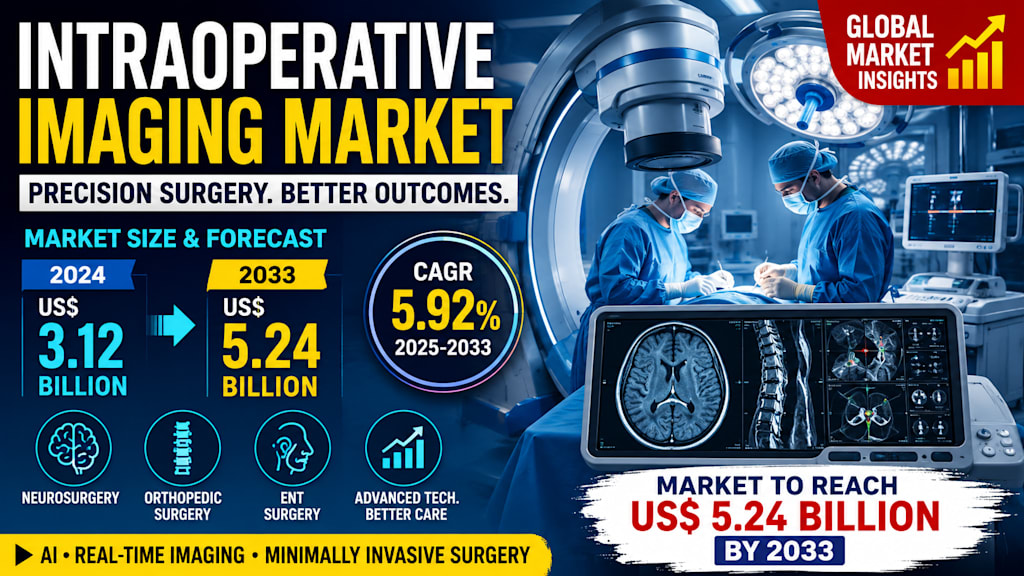
The global healthcare industry is rapidly embracing advanced surgical technologies, and intraoperative imaging is emerging as one of the most transformative innovations in modern medicine. From neurosurgery and orthopedic procedures to ENT and minimally invasive surgeries, real-time imaging technologies are helping surgeons perform with greater accuracy, confidence, and efficiency.
According to the latest industry analysis, the Global Intraoperative Imaging Market is projected to grow from US$ 3.12 billion in 2024 to US$ 5.24 billion by 2033, expanding at a CAGR of 5.92% during the forecast period from 2025 to 2033. The increasing need for surgical precision, rising prevalence of chronic diseases, growing adoption of minimally invasive surgeries, and rapid advancements in imaging technologies are driving the market forward.
What is Intraoperative Imaging?
Intraoperative imaging refers to the use of advanced imaging technologies during surgical procedures to provide real-time visualization of a patient’s internal anatomy. These systems allow surgeons to monitor surgical progress, identify abnormalities instantly, and make critical decisions during operations.
Technologies such as intraoperative MRI (iMRI), CT scanners, ultrasound systems, and C-arms have become essential in complex procedures where accuracy is critical. These systems help reduce surgical errors, minimize complications, and improve patient outcomes.
Unlike traditional imaging methods used before or after surgery, intraoperative imaging delivers live guidance during procedures. This has significantly enhanced surgical workflows, particularly in specialties like neurosurgery, orthopedic surgery, and spinal interventions.
Rising Demand for Precision Surgery Driving Market Expansion
One of the biggest factors fueling the growth of the intraoperative imaging market is the increasing demand for precision-based surgery. Modern surgical procedures are becoming more complex, and physicians require highly accurate visualization tools to ensure better outcomes.
Real-time imaging enables surgeons to navigate delicate anatomical structures more effectively while minimizing damage to surrounding tissues. In procedures involving the brain, spine, or cardiovascular systems, even the slightest error can have serious consequences. Intraoperative imaging helps reduce such risks by providing instant feedback during surgery.
The rise in chronic diseases, trauma cases, and age-related medical conditions is also increasing the number of surgeries performed worldwide. This growing surgical volume is directly contributing to the adoption of advanced imaging systems in hospitals and surgical centers.
Artificial Intelligence is Transforming Surgical Imaging
Artificial Intelligence (AI) is becoming a game-changing technology within the intraoperative imaging landscape. AI-powered imaging systems can process large amounts of surgical data in real time, helping surgeons identify anatomical structures with improved clarity and accuracy.
Machine learning algorithms are increasingly being integrated into imaging systems to assist in tissue recognition, surgical navigation, and predictive analytics. These intelligent systems can reduce human error, improve procedural efficiency, and support clinical decision-making during complex operations.
AI is also enhancing minimally invasive surgeries by enabling better visualization in confined surgical spaces. As hospitals continue to invest in digital healthcare infrastructure, AI integration is expected to become a major competitive advantage for imaging technology providers.
Minimally Invasive Surgery Boosting Adoption
The global shift toward minimally invasive surgical (MIS) procedures is another major growth catalyst for the intraoperative imaging market. Patients and healthcare providers increasingly prefer minimally invasive approaches because they offer reduced pain, shorter hospital stays, faster recovery times, and lower risk of complications.
However, MIS procedures require advanced imaging support because surgeons operate through smaller incisions with limited direct visibility. Intraoperative imaging technologies provide critical guidance during these procedures by enabling precise instrument positioning and real-time monitoring.
C-arms, intraoperative ultrasound systems, and portable imaging devices are especially valuable in minimally invasive orthopedic and spinal surgeries. As healthcare systems continue prioritizing patient-centric care, the demand for imaging-assisted surgical techniques is expected to rise steadily.
Technological Advancements Creating New Opportunities
Rapid innovation in medical imaging technology is continuously expanding the capabilities of intraoperative imaging systems. Manufacturers are developing compact, mobile, and hybrid imaging solutions that improve surgical flexibility and workflow efficiency.
One notable example is the FDA approval of GE Healthcare’s OEC 3D imaging system, which supports both 2D and 3D imaging during orthopedic and spine surgeries. These advancements allow surgeons to obtain highly detailed volumetric images during procedures, significantly improving surgical precision.
Hybrid operating rooms are also becoming increasingly popular. These advanced surgical environments integrate imaging systems directly into operating suites, enabling seamless imaging and intervention during procedures.
Additionally, improvements in image resolution, software integration, robotic-assisted surgery compatibility, and cloud-based surgical data management are opening new growth opportunities for the market.
Government Investments Supporting Industry Growth
Governments and healthcare organizations worldwide are investing heavily in advanced healthcare infrastructure and surgical innovation. Public and private funding initiatives are supporting research and development activities focused on improving surgical outcomes and patient safety.
Many countries are modernizing hospitals with next-generation imaging systems to strengthen healthcare delivery. National healthcare policies are also encouraging the adoption of digital health technologies, AI-based solutions, and minimally invasive surgical systems.
Research collaborations between academic institutions, hospitals, and medical technology companies are accelerating the development of next-generation intraoperative imaging systems. These partnerships are expected to play a crucial role in shaping the future of precision surgery.
Challenges Limiting Market Expansion
Despite its strong growth potential, the intraoperative imaging market faces several challenges.
High Equipment Costs
Advanced intraoperative imaging systems such as MRI and CT scanners require substantial investments. The cost of purchasing, installing, and maintaining these systems can be extremely high, especially for smaller hospitals and healthcare facilities in developing regions.
Additional expenses related to software integration, infrastructure upgrades, radiation shielding, and staff training further increase the overall financial burden.
As a result, many healthcare providers struggle to justify the return on investment, limiting adoption in cost-sensitive markets.
Complex Installation Requirements
Intraoperative imaging systems often require specialized operating room infrastructure, including reinforced flooring, advanced electrical systems, and dedicated imaging suites.
Older hospitals may need major renovations to accommodate these technologies, leading to operational disruptions and higher installation costs.
Furthermore, integrating imaging systems with robotic surgery platforms and navigation systems can be technically complex, requiring highly trained personnel and strict regulatory compliance.
United States Leading Global Adoption
The United States remains one of the largest and most advanced markets for intraoperative imaging technologies. The country benefits from a highly developed healthcare infrastructure, strong research ecosystem, and rapid adoption of advanced medical technologies.
Hospitals across the United States are increasingly using intraoperative imaging systems to improve surgical outcomes and reduce complications. The growing popularity of minimally invasive surgeries and robotic-assisted procedures is also driving demand.
Leading medical device manufacturers continue investing heavily in innovation, helping the U.S. maintain its leadership position in the global market.
Germany Strengthening European Leadership
Germany is a major hub for intraoperative imaging innovation in Europe. The country is home to several leading medical imaging companies, including Siemens Healthineers, Brainlab, and Ziehm Imaging.
Germany’s strong regulatory standards and commitment to healthcare innovation are supporting widespread adoption of advanced imaging systems. Neurosurgery and orthopedic procedures remain key application areas driving market demand.
The country’s emphasis on research and development continues to strengthen its role in shaping future surgical imaging technologies.
India Emerging as a High-Growth Market
India is rapidly becoming an important growth market for intraoperative imaging technologies. Improvements in healthcare infrastructure, increasing awareness of advanced surgical procedures, and rising investments in medical technology are contributing to market expansion.
Government initiatives aimed at modernizing hospitals and expanding healthcare access are encouraging adoption of advanced imaging systems across the country.
The increasing burden of chronic diseases and rising demand for precision surgeries are also accelerating market growth. With continued investments in healthcare infrastructure, India is expected to witness strong long-term demand for intraoperative imaging solutions.
Saudi Arabia Investing in Advanced Surgical Technology
Saudi Arabia is actively modernizing its healthcare sector under Vision 2030, creating significant opportunities for intraoperative imaging technologies.
Strategic partnerships between international imaging companies and local healthcare institutions are helping bring advanced surgical solutions to the region.
The country’s focus on improving healthcare quality, expanding diagnostic capabilities, and integrating cutting-edge medical technologies is expected to drive substantial market growth over the coming years.
Competitive Landscape
The global intraoperative imaging market remains highly competitive, with leading companies focusing on technological innovation, strategic partnerships, and product expansion.
Major companies operating in the market include:
GE HealthCare
Siemens Healthcare GmbH
Medtronic plc
Koninklijke Philips N.V.
Canon Medical Systems Corporation
Brainlab AG
Ziehm Imaging GmbH
NeuroLogica Corp.
These companies continue investing in AI integration, hybrid operating rooms, robotic-assisted imaging solutions, and portable imaging technologies to strengthen their market positions.
10 Recent Developments in the Intraoperative Imaging Industry
GE HealthCare partnered with Biofourmis in February 2024 to expand advanced care-at-home solutions.
Siemens Healthineers expanded its collaboration with City Cancer Challenge (C/Can) in January 2024 to support cancer care initiatives in developing countries.
FDA approval of GE Healthcare’s OEC 3D imaging platform strengthened intraoperative 3D imaging capabilities in orthopedic surgeries.
Brainlab continued advancing surgical navigation technologies integrated with real-time imaging platforms.
Philips increased investments in AI-driven image-guided therapy systems for minimally invasive procedures.
Medtronic expanded its imaging-assisted spinal surgery portfolio with advanced navigation technologies.
Ziehm Imaging introduced upgraded mobile C-arm solutions for enhanced surgical flexibility.
Canon Medical Systems focused on improving intraoperative CT imaging quality and workflow efficiency.
Hospitals worldwide accelerated adoption of hybrid operating rooms equipped with advanced imaging systems.
Increased global investments in robotic-assisted surgeries created new opportunities for intraoperative imaging integration.
Final Thoughts
The future of surgery is increasingly dependent on precision, real-time data, and intelligent imaging technologies. Intraoperative imaging has become a critical component of modern healthcare, enabling surgeons to perform safer and more accurate procedures across multiple specialties.
As artificial intelligence, minimally invasive surgery, and hybrid operating rooms continue reshaping healthcare delivery, the intraoperative imaging market is positioned for substantial long-term growth.
Although challenges related to cost and infrastructure remain, ongoing technological innovation and government healthcare investments are expected to accelerate adoption globally.
With the market projected to surpass US$ 5.24 billion by 2033, intraoperative imaging is set to play a transformative role in the next generation of surgical care.
About the Creator
Enjoyed the story? Support the Creator.
Subscribe for free to receive all their stories in your feed.
Comments
There are no comments for this story
Be the first to respond and start the conversation.