
Inside the Laser Cutting Machine Market's Decade of Growth
Fibre laser economics, EV manufacturing demand, and lights-out automation are reshaping fabrication at every scale.

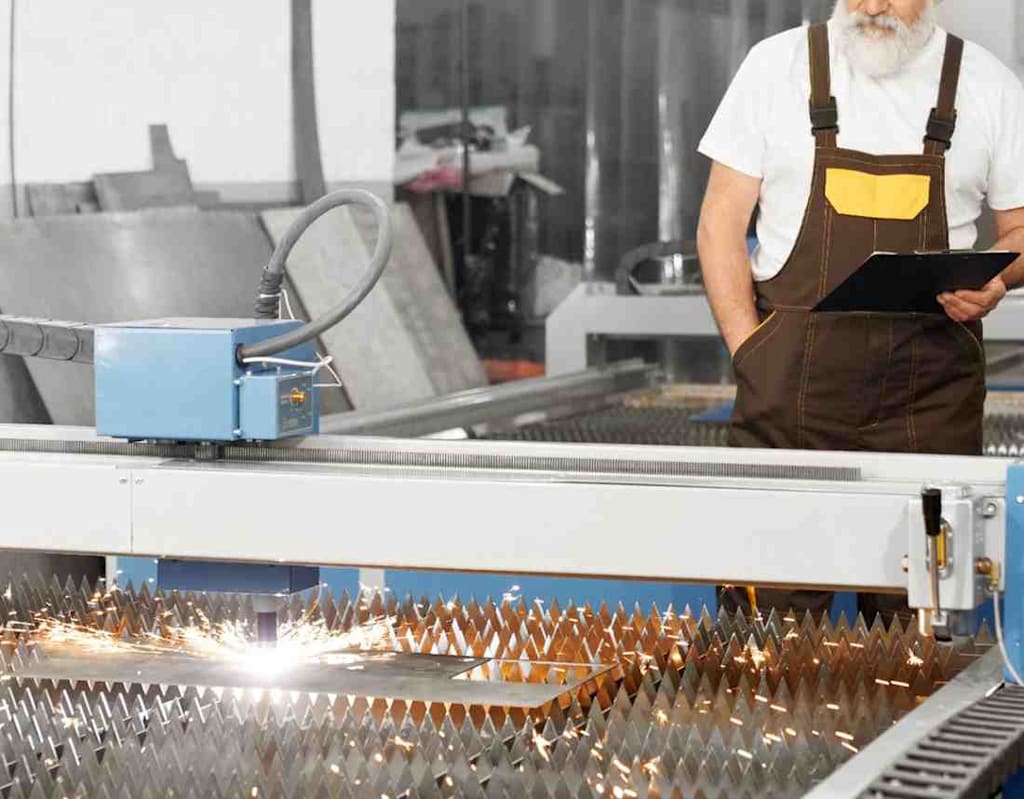
Precision That Starts With Light
A sheet of steel that once required multiple machine setups, tool changes, and operator interventions now moves through a single process in minutes. The cut edges need no finishing. The tolerances hold across thousands of identical parts. No blade touched the material at any point. That is what fibre laser cutting delivers at scale, and it is why the Laser Cutting Machine Market has become one of the more consequential capital equipment categories in modern manufacturing — not because it is new, but because its economics have finally reached the point where replacement of older technologies is happening across fabricator sizes simultaneously.
The underlying segment figures, regional breakdowns, and ten-year forecasts for this market are compiled in this research sample.
The Technology Shift That Changed the Economics
CO2 lasers dominated industrial cutting for decades. They worked, and for non-metals and certain thick materials they still do. But their beam wavelength is poorly absorbed by copper and aluminium, their optical delivery systems require regular mirror realignment, and their electrical efficiency is relatively low.
Fibre lasers changed the calculation on all three counts. The beam travels through optical fibre rather than open-air mirrors, eliminating the alignment maintenance that CO2 systems require. Electrical-to-optical conversion efficiency is substantially higher. The wavelength is better absorbed by reflective metals, making aluminium and copper cutting practical at production speeds for the first time. And as Chinese manufacturers entered the market at volume, entry-level pricing fell far enough that job shops and mid-scale fabricators — not just large manufacturers — could justify the investment.
Available power levels have also climbed sharply. Systems delivering 20, 30, and 40 kilowatts are now commercially available, moving laser cutting into thick structural steel applications previously handled by plasma or oxyfuel processes.
Where the Demand Is Concentrating
Electric vehicle production has become one of the clearer demand drivers of the current period. Battery enclosures, structural body components, cooling system parts, and the copper busbars that carry current through battery packs all require precision cutting at volumes where laser systems have a meaningful advantage over stamping for low-to-medium runs. The construction of battery gigafactories across the United States, Europe, and Asia is generating capital equipment investment cycles that include substantial laser cutting capacity.
Data informing the Laser Cutting Machine Market analysis points to Asia-Pacific as the dominant regional segment — China in particular leads both machine production and domestic consumption — with North America showing accelerating demand driven by aerospace manufacturing, EV facility investment, and reshoring incentives that are directing fabrication capital expenditure back into domestic capacity.
Automation as the Next Layer
A laser cutting machine operating as a standalone unit is already a capable tool. The same machine integrated into an automated cell — with robotic material loading, intelligent nesting software that minimises scrap from each sheet, and downstream connections to bending or welding equipment — becomes something different: a production system that can run unattended through a night shift.
Lights-out fabrication, where facilities operate without operators for extended periods, depends on laser cutting as the primary separation process precisely because it has no tooling that wears out mid-run and no physical setup that requires human intervention between jobs. The economics of that operating model have pushed automation integration from a premium option to a standard consideration for fabricators at the mid-to-large scale.
A Market Still Replacing Its Predecessors
Laser cutting has not finished displacing the technologies it competes with. Plasma cutting equipment still operates in heavy fabrication shops where the economics of upgrading have not yet tipped. Punch presses remain in service for applications where their speed on simple geometries still justifies the tooling cost. Waterjet systems hold on in applications where heat-affected zones cannot be tolerated.
Each of those holdouts represents addressable demand as power levels rise, pricing continues to improve, and the operational case for laser systems becomes harder to argue against. The decade ahead will not be defined by laser cutting entering new industries — it is already in most of them — but by how completely it displaces what came before.
About the Creator
Enjoyed the story? Support the Creator.
Subscribe for free to receive all their stories in your feed.
Comments
There are no comments for this story
Be the first to respond and start the conversation.