
Inside the Growing Baby Food Packaging Market: What’s Driving Change
Rising birth rates, health-conscious parents, and eco-friendly trends are reshaping how baby food is packaged worldwide.

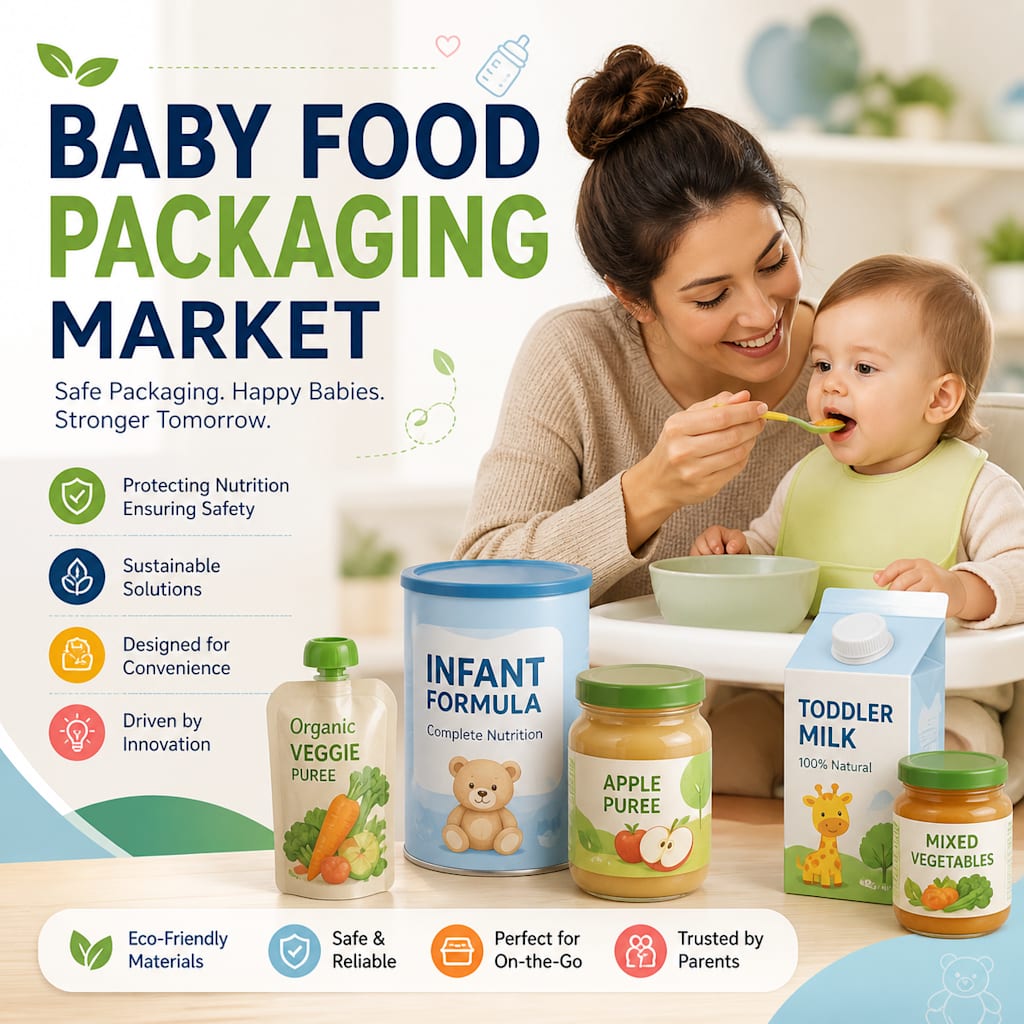
The parents' priorities when buying baby food primarily revolve around ingredients, nutrition and brand reliability; however, another unseen element that influences their decision making is the packaging.
Modern baby food packaging has evolved beyond its primary role of simply storing the food; it now plays an indispensable part in ensuring safety, ease of use, freshness and is also influenced by the global need for environmentally conscious products. Due to changing parenting trends, and an ever increasing worldwide demand for baby food, the packaging is increasingly becoming a driving force behind many innovations in the industry.
What once seemed like a basic packaging container now offers carefully engineered solutions for both the parents and the infant.
A market driven by lifestyle choices
The overall worldwide market value of baby food packaging reached nearly $9.9 billion dollars in 2025 and is predicted to grow to nearly $13.3 billion by 2034.
While a growth rate of approximately 3.19% a year may appear to be a moderate pace, it can be translated to stable, predictable demand owing to a variety of global factors, which includes changing family lifestyles as well as an increasing global population, the increasing popularity of pre-made ready-to-eat baby food packages also mean that packaging is no longer just an accessory to the product.
The effect of rising birth rate and city life
The increased global birth rates in specific developing countries such as Africa and Asia-pacific countries are considered the most straightforward factor contributing to the market's growth; however, it's not solely about a higher birth rate that is the factor.
Families' daily lifestyles play a significant part as well. Due to rapid urbanization and hectic daily routines the concept of pre-packaged, ready-to-eat baby food products are becoming increasingly convenient and an integral part of parents' lifestyle in today's world and is expected to rise, more especially for working parents who can make use of single-serving food products for ease and portability. As a result of this increased trend in product usage the demand for convenient, easy to carry, food safe packaging that is simple to use and designed for optimum feeding experience has become crucial.
Parental focus on the health aspects of food are transforming packaging needs
In today's world parents are highly conscious of their child's health, and as such it is vital that the packaging of the baby food products used is transparent and safe to be considered for purchase. In addition to what parents already look for in baby food products (ingredients, nutrients, etc.) the packaging now serves as a visual communicator that has to instill trust in parents for these reasons:
- Nutrient labeling should be clear.
- Parents demand to know all the ingredients.
- Allergen content must be accurately indicated.
- Non-toxic, safe materials must be used.
The increasing trend towards organic and natural baby food is now encouraging companies to employ packaging materials that can sustain the product quality and freshness without compromising the integrity of the organic/natural constituents of the food.
The ever-changing industry through technological innovation
Technology is a major factor playing a role in the development of the baby food packaging. Parents are more aware now than ever of the product their children are consuming. With the need to deliver safe, healthy and easy to use products to babies manufacturers are now looking at materials and packaging forms which are:
- BPA-free
- Recyclable
- Durable
Some of the advancements in the industry are already present in product packaging such as the use of resealable pouches for increased feeding ease and the re-usability of packaging during feeding, single serving packages designed for precise portioning, and temperature-sensitive labels that can monitor if the food product within has reached an unfavorable temperature, and spill-proof designs which are more efficient when traveling with infants. Although these changes may seem minimal, they have had a significant impact on the daily child-rearing experiences of thousands of parents worldwide.
Packaging forms evolving toward the convenient choice
While several forms of baby food packaging exist, one in particular has rapidly grown to become a favorite for millions of parents worldwide: pouches. Pouches are generally light and portable and do not require parents to use utensils during feeding. The use of squeezable bottles makes the whole feeding process easy, even when traveling with young babies; however other types of packaging continue to remain popular:
- Glass containers- favored for their purity and premium quality.
- Plastic containers-valued for their durability and ease of use.
- Cartons- commonly used for liquid baby food.
- Cans-widely used for powdered formulas.
While these forms all fulfill different needs, the paramount importance on convenience and safety remain the dominant factors influencing consumer preferences.
Sustainable and environmentally conscious packaging at its best
In recent times, sustainability has turned into a defining attribute of product design and development, and this is the case for the baby food packaging industry too. Parents are concerned with the impact that everyday items like baby food have on the environment and are looking to make purchases of sustainable products where ever possible. This growing demand has seen companies developing:
- Recyclable packaging materials.
- Biodegradable containers.
- Reduced use of plastic packaging.
- Lightweight designs to minimize waste during transportation.
One of the materials that is gaining popularity is paperboard packaging as it's easily recyclable and eco-friendly. However, these companies are also conscious of the fact that such materials must maintain strict hygiene and food safety standards.
Regional dynamics in the market
The market for baby food packaging continues to grow at different paces in various regions across the world, and every region seems to be contributing to the market in its own individual way. North America and Europe have always led the market in terms of the consumption of high value packaging solutions owing to high disposable income and awareness of product safety and baby nutrition. They have also been keen on products that are produced sustainably. Asia-pacific countries have the most substantial growing population, with rising income levels coupled with increasing demand of packaged baby foods, making it a key driving force for growth in the region. Latin America and the middle east, on the other hand are developing more slowly, driven by growing public health access, lifestyle choices and baby nutrition.
Competition and the role of innovation in the industry
Baby food packaging market can be termed as a highly competitive sector with every company striving to make a distinctive place for its products. Manufacturers have now invested significantly in development of:
- Cutting-edge packaging materials.
- Easier and more efficient user designs.
- Environmentally friendly designs.
The packaging industry has gone beyond what would be considered the basic standards; it has evolved to make feeding easier for both the parent and the child and at the same time, more portable and sustainable. Many companies have also been exploring new markets; particularly growing markets, that have seen a rise in popularity for their baby foods due to a growing population and evolving consumer patterns.
Challenges facing the industry
There are however certain challenges that can have an effect on the industry's future. Stricter packaging regulations that are implemented for food safety and quality require constant evaluation of packaging materials and methods, this can increase production complexity and the cost of products, moreover consumers are increasingly concerned with the amount of plastic waste being generated; and it forces the industry to consider traditional packaging models from a fresh perspective. These challenges are, however also being used as opportunities to innovate new methods and ideas for better and safer baby food packaging.
Looking at what's ahead
The future of the baby food packaging market can be broadly predicted through 3 main factors:
1. Sustainability- Environmentally conscious packaging forms are going to be considered essential by 2034.
2. Smart packaging-This kind of packaging can be used to monitor product freshness and quality of the food product inside, through specific sensors in the packaging; it also reduces the chance of parents giving spoiled food products to their infants.
3. Convenience-as parents continue to embrace busier lifestyles, this factor will continue to drive demand for easy-to use, portability.
With the global population increasing and the demand for baby food being consistent, the packaging sector of this market will be of more significance than ever before ensuring quality, safety and ease of use in children's feeding habits.
A concluding thought
Parents may not always look into the packaging of the baby food that they buy for their children as being an important product consideration, yet packaging plays an imperative role in children's feeding time from preserving nutrition to assuring safe usage, as well as simplifying feeding rituals for parents. Considering the steady growth forecast up until 2034 as well as an increased demand for technological and environmental advancements within the market, the packaging sector is expected to remain an integral part of the global food system; after all it's not just about storing food but also about ensuring healthier and more convenient lives for both the infant and their parents.
About the Creator
Robert
Senior Market Researcher at IMARC Group, specializing in global market analysis, industry trends, and data-driven insights across diverse sectors.
Enjoyed the story? Support the Creator.
Subscribe for free to receive all their stories in your feed.
Comments
There are no comments for this story
Be the first to respond and start the conversation.