
Insect Repellent Market Outlook: Personal Protection Demand and Growth Opportunities
The Insect Repellent Market is experiencing steady growth driven by increasing awareness of vector-borne diseases and the need for effective personal protection solutions.

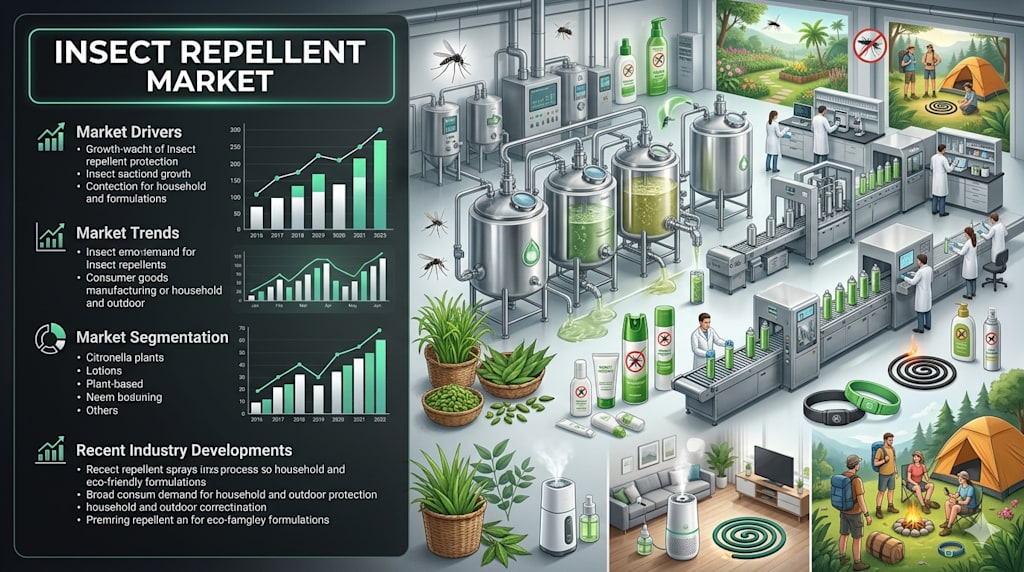
According to IMARC Group's latest research publication, The global insect repellent market size reached USD 5.5 Billion in 2025. Looking forward, IMARC Group expects the market to reach USD 9.0 Billion by 2034, exhibiting a growth rate (CAGR) of 5.42% during 2026-2034.
How AI is Reshaping the Future of the Insect Repellent Market
- Smart Formulation Development and Ingredient Optimization: AI-powered research platforms are accelerating the discovery and testing of novel active ingredients by analyzing molecular structures, efficacy data, and skin-safety profiles simultaneously. Companies are using machine learning to reduce the formulation development cycle significantly, enabling faster regulatory approvals. This is particularly critical as pyrethroid resistance in malaria vectors is now a global concern, affecting over 80% of monitored sites, pushing the industry to deploy AI in identifying next-generation alternative actives faster than traditional lab-based trials allow.
- Predictive Disease Outbreak Mapping and Demand Sensing: AI systems integrate satellite imagery, climate sensor data, and public health surveillance feeds to generate real-time risk heatmaps, enabling manufacturers and distributors to pre-position inventory before disease outbreaks peak. In 2024, more than 13 million cases of dengue were reported in North, Central, and South America and the Caribbean, with transmission remaining high into 2025, underlining how outbreak-linked demand spikes can be better anticipated through AI-driven epidemiological models that connect weather anomalies with purchasing patterns weeks in advance.
- Personalized Product Recommendations Through E-Commerce AI: Machine learning algorithms embedded within digital retail platforms analyze consumer browsing behavior, geographic location, and seasonal risk factors to deliver hyper-relevant product suggestions. Online retail is the fastest-growing distribution channel at an 8.5% growth rate, with Amazon-driven personalized recommendations boosting a 25% increase in online insect repellent sales in 2024. AI recommendation engines are directly converting health-awareness signals into purchase decisions, compressing the consumer journey.
Insect Repellent Industry Overview
The Asia Pacific insect repellent market dominated the industry with a revenue share of 41% in 2024, driven by the region's tropical climate, high population density, and pervasive burden of mosquito-borne disease. Countries including India, Indonesia, Sri Lanka, and Thailand are among the 30 most dengue-affected nations globally, translating directly into consistent consumer demand for household and personal protection products. Offline retail commands a 65% share of overall distribution in 2025, supported by supermarkets and pharmacies that facilitate bulk and impulse-driven purchases, while in the US alone, Walmart and drugstores account for 40% of insect repellent sales. In North America, the US insect repellent market held a size of USD 1,624.77 million in 2024, amplified by government initiatives promoting public health and hygiene. The competitive landscape is shaped by both multinational corporations and regional innovators responding to climatic, regulatory, and consumer preference shifts across diverse geographies.
Insect Repellent Market Trends and Drivers
The acceleration of vector-borne disease prevalence is the single most powerful structural driver of insect repellent demand globally. Climate change is pushing vector habitats further north, bringing malaria and dengue threats to temperate regions that were previously considered safe. This geographic expansion of risk is activating entirely new consumer cohorts in Europe and North America who previously had little need for routine repellent use. Mosquito repellents accounted for the largest market segment with over 50.7% revenue share in 2024, directly attributable to the escalating burden of diseases like malaria, dengue, Zika virus, and chikungunya, which together affect hundreds of millions of people annually.
The shift toward natural and eco-conscious formulations is redefining product development priorities across the industry. In June 2025, NC State startup Arkus launched EcoArmor, a DEET-free plant-based insect repellent offering protection against mosquitoes and ticks, developed from university research as a safer alternative for families and outdoor enthusiasts. This innovation reflects the broader market pivot away from synthetic actives, with brands positioning botanical ingredients as both efficacy solutions and lifestyle statements. Vaporizers held the majority product type market share in 2024, valued for the continuous, passive indoor protection they provide without the need for frequent reapplication, while the sprays segment is simultaneously gaining momentum among outdoor activity participants seeking portable, instant-coverage options.
Wearable technology and smart repellent devices are creating a premium product category that merges personal protection with consumer electronics. In March 2025, Thermacell Repellents launched the E65 rechargeable mosquito repeller, featuring a fast-charging dock and a 6.5-hour battery life providing a 20-foot protective zone, addressing growing consumer demand for convenient and durable outdoor repellent solutions. These innovations are expanding the total addressable market beyond traditional topical formats, appealing to tech-savvy outdoor enthusiasts who prioritize hands-free protection during activities like hiking and camping.
Leading Companies Operating in the Global Insect Repellent Industry
- Dabur India Limited
- Enesis Group
- Godrej Consumer Products Limited
- Himalaya Wellness Company
- Jyothy Laboratories Ltd
- Newell Brands Inc.
- Quantum Health
- Reckitt Benckiser Group plc
- S. C. Johnson and Son Inc.
- Sawyer Products Inc.
- Spectrum Brands Inc.
Insect Repellent Market Report Segmentation
By Insect Type:
- Mosquito Repellent
- Bugs Repellent
- Fly Repellent
- Others
Mosquito repellent represents the largest segment, driven by the widespread prevalence of mosquito-borne diseases and heightened global public health awareness around malaria, dengue, and Zika virus.
By Product Type:
- Vaporizers
- Spray
- Cream
- Others
Vaporizers account for the largest product type share owing to their user-friendly, continuous indoor protection mechanism, while sprays are the fastest-growing format due to portability and targeted application benefits.
By Distribution Channel:
- Supermarkets/Hypermarkets
- Online Stores
Supermarkets and hypermarkets retain the largest distribution share through their broad reach, promotional placement, and consumer trust, while online retail is the fastest-growing channel driven by e-commerce personalization and subscription models.
Regional Insights:
- North America (United States, Canada)
- Asia Pacific (China, Japan, India, South Korea, Australia, Indonesia, Others)
- Europe (Germany, France, United Kingdom, Italy, Spain, Russia, Others)
- Latin America (Brazil, Mexico, Others)
- Middle East and Africa
Asia Pacific exhibits clear dominance in the insect repellent market due to its warm and humid climate, dense population centers, and high endemic burden of mosquito-transmitted diseases across the region.
Recent News and Developments in the Insect Repellent Market
- June 2025: NC State startup Arkus launched EcoArmor, a DEET-free insect repellent formulated with plant-based ingredients offering protection against mosquitoes and ticks. The product targets families and outdoor enthusiasts seeking non-toxic, sustainable personal protection alternatives aligned with growing consumer demand for eco-friendly health solutions.
- March 2025: Thermacell Repellents launched the E65 rechargeable mosquito repeller, featuring a fast-charging dock and a 6.5-hour battery life that delivers a 20-foot zone of protection. The product directly addresses rising consumer expectations for durable, cordless, and extended outdoor repellent devices.
- November 2024: Nippo, a well-known Indian consumer brand, entered the home care segment with the launch of Swooper, a mosquito repellent using a Japanese MFT (Metrofluthrin) formula with a sandalwood fragrance. The product was made available through both retail and online channels, reflecting efforts to capture local consumer preference for fragrant, effective household protection.
- July 2024: Godrej Consumer Products introduced its Goodknight Flash liquid vaporizer in India, featuring the patented molecule Renofluthrin, India's first indigenously developed mosquito repellent molecule. The formulation is marketed as twice as effective in repelling mosquitoes and continues working for up to two hours after being switched off, reinforcing Godrej's leadership in the Indian household insecticide segment.
- May 2024: Royal Robbins launched Bug Barrier, a mosquito protection technology embedded directly into outdoor apparel, catering to hikers and adventure travelers seeking wearable, continuous insect defense without topical application.
Note: If you require specific details, data, or insights that are not currently included in the scope of this report, we are happy to accommodate your request. As part of our customization service, we will gather and provide the additional information you need, tailored to your specific requirements. Please let us know your exact needs, and we will ensure the report is updated accordingly to meet your expectations.
About the Creator
Olivia Smith
Olivia Smits is a Research and Marketing Analyst who specializes in market research, trend analysis, and consumer insights. I help businesses make smarter marketing and strategy decisions by turning data into clear, actionable insights.
Enjoyed the story? Support the Creator.
Subscribe for free to receive all their stories in your feed.
Comments
There are no comments for this story
Be the first to respond and start the conversation.