
Industrial Robotics Market Trends: Predictive Maintenance, IoT Connectivity & Forecast to 2034
How AI integration, smart manufacturing systems, and factory automation technologies are transforming operational efficiency and production capabilities in the industrial robotics market

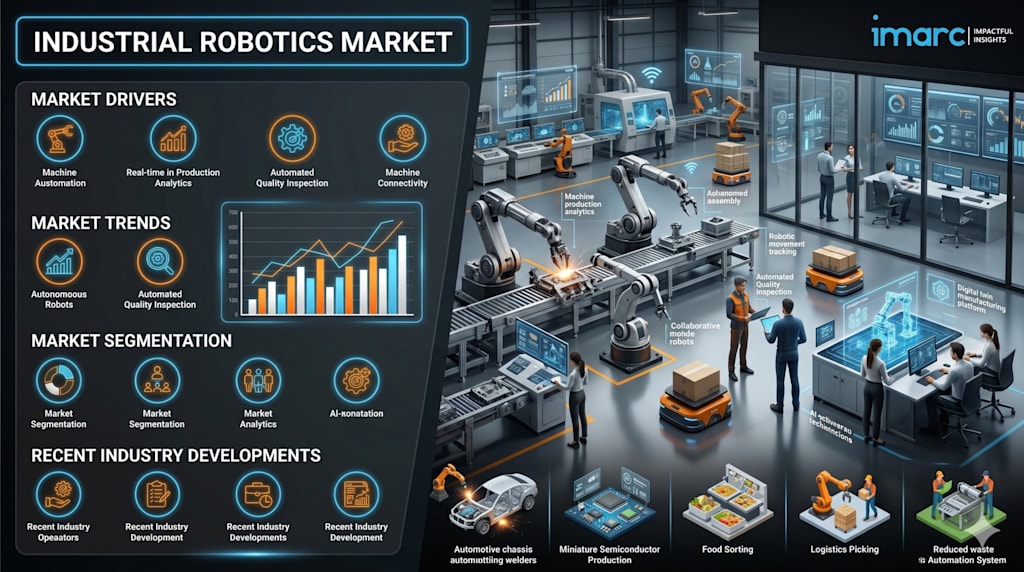
According to IMARC Group's latest research publication, The global industrial robotics market size reached USD 19.8 Billion in 2025. Looking forward, IMARC Group expects the market to reach USD 52.7 Billion by 2034, exhibiting a growth rate (CAGR) of 11.47% during 2026-2034, Bolstering growth of the automotive industry, the rising product adoption across the food and beverage industry, and ongoing product innovations and technological advancements represent some of the key factors driving the market growth.
How AI is Reshaping the Future of the Industrial Robotics Market
- AI-Powered Vision Systems and Quality Inspection: Machine learning algorithms integrated with high-resolution vision systems are enabling industrial robots to perform real-time defect detection, dimensional measurement, and surface quality assessment at production speeds that far exceed manual inspection capabilities. In automotive paint shops, AI-controlled robots now process each vehicle individually against objective quality parameters, ensuring consistent surface finish standards across every unit produced. BMW's deployment of end-to-end digitalized automated inspection systems in standard production operations demonstrates how AI vision technology reduces lead times, stabilizes operations, and eliminates subjective quality assessment variability that previously resulted in costly rework cycles.
- Collaborative Robot Intelligence and Human-Robot Interaction: AI is fundamentally transforming how industrial robots operate alongside human workers, enabling cobots to learn from demonstration, adapt to changing task requirements, and detect human proximity with sufficient precision to safely share workspace without physical barriers. Figure's commercial agreement with BMW Manufacturing to deploy autonomous humanoid robots in automobile production facilities exemplifies this shift, with AI-powered robots automating difficult, risky, and tedious tasks while allowing employees to concentrate on complex judgment-driven activities and continuous improvement initiatives. These intelligent collaborative systems improve both productivity and job satisfaction by redistributing physical burden away from workers while retaining human oversight for processes requiring contextual decision-making.
- Predictive Maintenance and Autonomous Diagnostics: Industrial robots equipped with embedded AI analytics continuously monitor motor temperatures, vibration signatures, joint torque loads, and cycle time deviations to predict component failures weeks before they cause production stoppages. Manufacturers deploying AI-driven predictive maintenance across robot fleets report unplanned downtime reductions of up to 30 to 50%, transforming maintenance from a reactive cost center into a proactively managed operational discipline. This capability is particularly valuable in high-volume automotive and electronics manufacturing environments where a single robot failure can halt entire production lines, creating cascading disruptions that cost manufacturers significantly more than the underlying mechanical repair.
- Autonomous Path Planning and Adaptive Programming: AI-powered motion planning algorithms allow industrial robots to autonomously calculate optimal movement paths, adjust trajectories in response to real-time sensor feedback, and reprogram themselves when part geometries or assembly sequences change. This adaptive capability dramatically reduces the engineering time required to deploy and reconfigure robots across production variants, enabling manufacturers to respond to product changes and custom orders without the weeks-long reprogramming cycles that previously made robotic automation impractical for high-mix, low-volume manufacturing. KUKA's KR FORTEC robot with a reach of 368.3 centimeters and a 240 kilogram payload capacity illustrates how enhanced mechanical capability combined with intelligent programming enables single robot platforms to serve diverse applications across handling and spot welding without specialized retooling.
Industrial Robotics Market Trends and Drivers
The accelerating adoption of Industry 4.0 principles across global manufacturing is the most powerful structural driver propelling industrial robotics demand, as organizations recognize that connected, automated, and data-driven production systems are prerequisites for remaining competitive in an era of rising input costs and intensifying quality expectations. Industrial robots serve as the physical execution layer of smart factory architectures, interfacing with sensors, enterprise resource planning systems, quality management platforms, and supply chain networks to enable closed-loop manufacturing where production parameters are continuously optimized based on real-time performance data.
The automotive industry's transition to electric vehicle production is creating a pronounced wave of new robotics investment as manufacturers retool existing facilities and construct new dedicated EV production lines requiring substantially different automation configurations from those designed for internal combustion engine vehicles. Volvo Cars' deployment of more than 1,300 ABB industrial robots across its Torslanda and Daqing facilities for spot welding, riveting, dispensing, and flow drilling operations for next-generation electric vehicle production illustrates the sheer scale of robotics investment embedded within individual automotive manufacturing programs.
The rising integration of collaborative robots across small and medium-sized manufacturing enterprises is broadening the industrial robotics addressable market beyond the large-scale automotive and electronics manufacturers that historically dominated robot purchasing. Cobots equipped with force-torque sensors, vision guidance, and intuitive programming interfaces allow companies without dedicated robotics engineering teams to deploy automation on assembly, inspection, and machine-tending tasks without extensive facility modification or safety infrastructure investment.
Leading Companies Operating in the Global Industrial Robotics Industry
- ABB Ltd.
- DAIHEN Corporation
- DENSO Corporation
- FANUC
- Kawasaki Heavy Industries Ltd.
- KUKA AG
- Mitsubishi Electric Corporation
- Nachi-Fujikoshi Corp.
- OMRON Corporation
- Panasonic Corporation
- Seiko Epson Corporation
- Universal Robots A/S (Teradyne Inc.)
- Yamaha Motor Co. Ltd.
- Yaskawa Electric Corporation
Industrial Robotics Market Report Segmentation
By Type:
- Articulated Robots
- Cartesian Robots
- SCARA Robots
- Cylindrical Robots
- Parallel Robots
- Others
Articulated robots dominate the market, as their multi-axis joint configurations provide the broadest range of motion across three-dimensional space, making them suitable for the widest variety of industrial applications from welding and painting to assembly and material handling across automotive, electronics, and general manufacturing environments.
By Function:
- Soldering and Welding
- Materials Handling
- Assembling and Disassembling
- Painting and Dispensing
- Milling, Cutting and Processing
- Others
Materials handling holds the largest share in the market, as the movement of components, parts, and finished goods between production stages represents one of the most universally applicable and labor-intensive functions across all manufacturing and logistics environments, making it the most frequently automated robotic application regardless of industry sector.
By End Use Industry:
- Automotive
- Electrical and Electronics
- Chemical, Rubber, and Plastics
- Machinery and Metals
- Food and Beverages
- Precision and Optics
- Pharmaceutical
- Others
Electrical and electronics accounts for the majority of the market share, driven by the extremely high precision requirements of PCB assembly, component placement, soldering inspection, and device testing that robotic automation addresses with a level of accuracy, repeatability, and speed that manual production methods are fundamentally unable to match at industrial volumes.
Regional Insights:
- North America (United States, Canada)
- Asia Pacific (China, Japan, India, South Korea, Australia, Indonesia, Others)
- Europe (Germany, France, United Kingdom, Italy, Spain, Russia, Others)
- Latin America (Brazil, Mexico, Others)
- Middle East and Africa
Asia Pacific exhibits a clear dominance in the market, underpinned by the region's concentration of global electronics and automotive manufacturing capacity, government-led industrial modernization programs, rising labor costs accelerating automation adoption, and the presence of both leading robot manufacturers and the world's largest robot-consuming industries within a single geographic region.
Recent News and Developments in the Industrial Robotics Market
- May 2024: ABB Robotics launched the IRB 7710 and IRB 7720 industrial robot series, comprising 16 new versions designed for a wide range of applications spanning automotive, logistics, foundry, machinery manufacturing, construction, and agricultural industries, expanding ABB's heavy-payload robot portfolio with enhanced reach and payload capabilities tailored for demanding industrial environments.
- May 2024: Comau introduced its new S-Family of compact but high-strength robots at Automate 2024, North America's leading automation exhibition, targeting manufacturers seeking space-efficient robotic solutions capable of delivering performance comparable to larger industrial robot platforms in constrained factory floor environments.
- April 2024: ESCATEC, a Penang-based electronic manufacturing services provider, deployed material handling robots across the factory floors of its Malaysian production plants, integrating robotic automation into its electronics contract manufacturing operations to improve throughput consistency, reduce manual handling errors, and enhance competitive positioning within the region's densely competitive EMS sector.
Note: If you require specific details, data, or insights that are not currently included in the scope of this report, we are happy to accommodate your request. As part of our customization service, we will gather and provide the additional information you need, tailored to your specific requirements. Please let us know your exact needs, and we will ensure the report is updated accordingly to meet your expectations.
About the Creator
Abhay Rajput
I am working in market research company that provides market and business research intelligence across the globe.
Enjoyed the story? Support the Creator.
Subscribe for free to receive all their stories in your feed.
Comments
There are no comments for this story
Be the first to respond and start the conversation.