
Industrial Laser Systems Market Trends: Automation Demand, Precision Manufacturing & Forecast to 2034
How increasing demand for precision manufacturing, automation integration, and high-speed processing is transforming production efficiency and product quality across industries in the industrial laser systems market

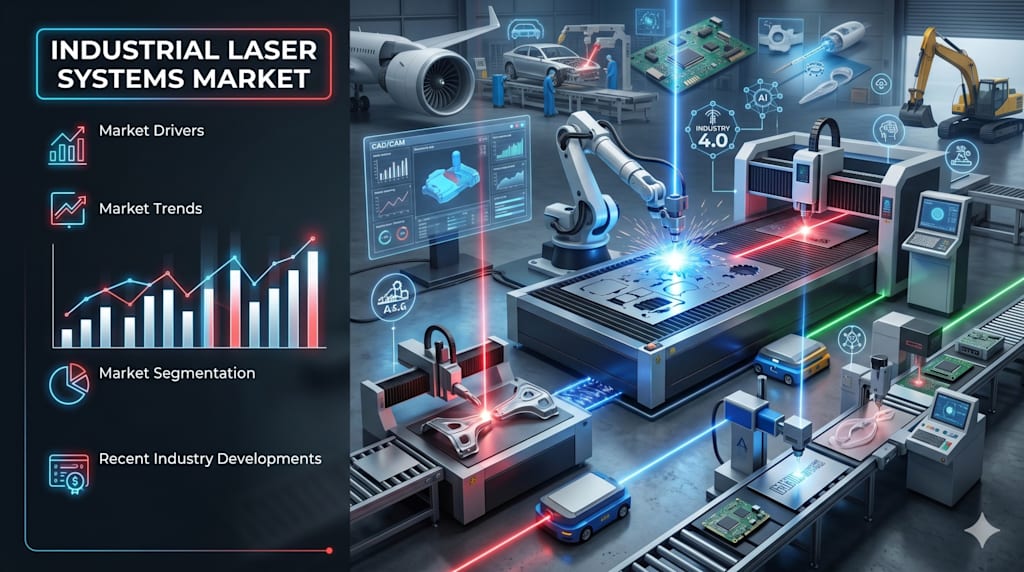
According to IMARC Group's latest research publication, the global Industrial Lasers Systems Market size reached USD 24.5 Billion in 2025. Looking forward, IMARC Group expects the market to reach USD 43.1 Billion by 2034, exhibiting strong growth momentum during 2026-2034. The increasing adoption of lasers for custom markings and engravings, the escalating demand for automation and high-end processing, and various technological advancements in additive manufacturing processes represent some of the key factors driving the market.
How AI is Reshaping the Future of the Industrial Lasers Systems Market
- Intelligent Process Optimization and Real-Time Adaptive Control: AI-powered control systems are transforming how industrial laser platforms operate across cutting, welding, marking, and drilling applications. By processing real-time sensor data from production lines, machine learning algorithms dynamically adjust laser parameters including power output, pulse frequency, beam focus, and scanning speed to maintain optimal processing conditions. This adaptive capability is particularly critical in semiconductor and electronics manufacturing, where microscopic accuracy requirements leave zero margin for deviation. Manufacturers integrating AI-driven adaptive control systems are reporting measurable reductions in material waste and rework rates, directly improving throughput consistency across high-volume production environments.
- Predictive Maintenance and Equipment Reliability Management: Industrial laser systems represent significant capital investments, and unplanned downtime creates cascading disruptions across precision manufacturing workflows. AI-enabled predictive maintenance platforms continuously monitor laser resonator health, beam delivery optics, cooling system performance, and power supply stability to detect anomalies before they escalate into failures. Machine learning models trained on historical equipment performance data can identify early degradation signatures in fiber laser components and CO2 laser tubes with significant lead time, allowing maintenance teams to schedule interventions during planned production windows. This shift from reactive to predictive maintenance is reducing operational costs while extending equipment service life for manufacturers across automotive, aerospace, and medical device sectors.
- Computer Vision-Integrated Quality Inspection and Defect Detection: AI-powered computer vision systems embedded within industrial laser processing stations are enabling automated inline quality inspection at speeds and precision levels that far exceed manual verification capabilities. These systems analyze surface finish quality, cut edge geometry, weld seam integrity, and marking legibility in real time, flagging deviations and triggering automatic process corrections before defective products advance further down the production line. In printed circuit board manufacturing, where laser drilling creates thousands of micro-vias per panel, AI-driven vision inspection is verifying positional accuracy and hole diameter conformity across every unit simultaneously, ensuring the microscopic precision that advanced electronics demand at commercial production volumes.
- Generative AI for Laser Path Programming and Design Optimization: Generative AI tools are accelerating the programming of laser processing paths for complex geometries in aerospace component fabrication, medical device manufacturing, and architectural metalwork. Instead of manually defining cutting trajectories and processing sequences, engineers can now input design parameters and material specifications into AI systems that automatically generate optimized laser programs accounting for thermal distortion, material grain orientation, and processing efficiency. This capability is dramatically reducing programming time for intricate applications like titanium aerospace structures and micro-machined surgical instruments, compressing product development cycles while maintaining the exacting tolerance requirements these industries demand.
Industrial Lasers Systems Industry Overview:
The industrial lasers systems market is experiencing strong growth momentum globally, underpinned by the accelerating integration of laser technology into advanced manufacturing processes across semiconductor fabrication, automotive production, aerospace component machining, and medical device manufacturing. Asia Pacific leads the global market and represents the largest regional share, driven by the extraordinary concentration of electronics, automotive, and consumer goods manufacturing across China, Japan, South Korea, and Taiwan. The region's rapid embrace of Industry 4.0 automation frameworks and smart factory investments is creating sustained demand for high-precision laser processing systems capable of operating continuously within automated production cells. China's manufacturing sector, supported by national industrial policy initiatives promoting domestic advanced manufacturing capability, is a particularly significant driver of fiber laser system adoption for metal cutting and welding applications.
In North America, defense procurement programs and aerospace manufacturing expansion are generating robust demand for laser systems capable of precision machining of advanced alloys and composite materials used in next-generation aircraft and defense platforms. Europe's strength in precision engineering, automotive manufacturing, and medical technology is sustaining consistent demand for laser marking, engraving, and micro-machining systems, with Germany, France, and the United Kingdom representing the region's most active markets. The medical sector across all major geographies is increasingly adopting ultrafast laser systems, including femtosecond and picosecond platforms, for micro-machining of implantable devices, ophthalmic surgical instruments, and drug delivery components where thermal damage to surrounding material must be eliminated entirely.
Industrial Lasers Systems Market Trends and Drivers
The escalating demand for automation and high-precision manufacturing processes across global industries is the primary structural driver of the industrial lasers systems market. In automotive manufacturing, the transition to electric vehicle platforms is reshaping laser welding and cutting requirements as manufacturers process lightweight aluminum battery enclosures, copper busbars, and hairpin motor windings that demand laser processing parameters fundamentally different from conventional steel body-in-white production. Aerospace and defense manufacturers are expanding their use of laser systems for precision machining of nickel superalloys, titanium structural components, and ceramic matrix composites used in next-generation turbine engines and hypersonic vehicle structures, where conventional machining methods cannot achieve the required tolerances or surface quality. In semiconductor and electronics manufacturing, the ongoing drive toward miniaturization is pushing laser system capabilities to their limits, with advanced packaging technologies requiring laser drilling of via holes at pitches measured in microns across panel formats that were unimaginable a decade ago.
The rapid expansion of fiber laser technology is simultaneously reshaping the competitive dynamics of the industrial lasers systems market across multiple application segments. Fiber lasers produce high-quality beams with excellent focusability, stability, and energy conversion efficiency, converting a large percentage of electrical input into usable laser output, making them significantly more cost-effective to operate than CO2 laser alternatives for many metal processing applications. Their compact form factor, absence of consumable gain media, and low maintenance requirements make them highly compatible with automated manufacturing environments where uptime reliability is paramount. The cutting application segment maintains the largest share across all end uses, supported by the extraordinary versatility of modern laser cutting systems across metals, plastics, composites, ceramics, and wood, serving industries from architectural fabrication and signage to precision medical device component production. Marking and engraving applications are growing in strategic importance as global supply chain traceability requirements and anti-counterfeiting regulations drive manufacturers across automotive, pharmaceutical, and electronics sectors to implement permanent laser-based identification on every component they produce.
Additive manufacturing integration and advanced beam delivery technology are opening new application frontiers for industrial laser systems beyond traditional subtractive processing. Selective laser melting and directed energy deposition systems are enabling aerospace and medical device manufacturers to produce complex geometries from high-performance alloys that cannot be fabricated through conventional machining, with laser systems at the heart of every build cycle. Advances in beam shaping optics, galvanometer scanning systems, and multi-axis beam delivery are enabling laser processors to tackle increasingly complex three-dimensional workpieces with the speed and precision that modern manufacturing economics demand. IPG Photonics Corporation has focused on advancing its YLR-U series of fiber lasers, delivering enhanced power and efficiency specifically for demanding industrial applications, while also progressing its beam delivery system technologies to enable superior processing control. Coherent Inc. has launched the HighLight FL-ARM fiber laser with improved multi-material processing capability and introduced the ExactWeld 230 P laser welding system delivering high-quality precision welding solutions across a broad range of industrial applications. TRUMPF has expanded its portfolio with the TruMark 6030 marking laser system and the TruDisk 1020 disk laser, offering improved performance and energy efficiency benchmarks for industrial marking and high-power processing applications respectively.
Leading Companies Operating in the Global Industrial Lasers Systems Industry:
- ACSYS Lasertechnik US Inc.
- Amonics Ltd.
- Coherent Inc.
- Han's Laser Technology Industry Group Co. Ltd.
- II-VI Incorporated
- IPG Photonics Corporation
- Jenoptik Laser GmbH
- Lumibird Group
- Newport Corporation (MKS Instruments Inc.)
- NKT Photonics A/S
- Toptica Photonics AG
- TRUMPF
Industrial Lasers Systems Market Report Segmentation:
By Type:
- Fiber Laser
- Solid State Laser
- CO2 Laser
- Others
Fiber lasers represent the largest type segment, owing to their superior beam quality, high electrical-to-optical conversion efficiency, low maintenance requirements, and exceptional compatibility with automated industrial processing environments across cutting, welding, and marking applications.
By Application:
- Cutting
- Welding
- Marking
- Drilling
- Others
Cutting holds the largest application segment share, driven by laser cutting's unparalleled precision across diverse material types including metals, plastics, ceramics, and composites, combined with its ability to execute intricate geometries that conventional cutting methods cannot achieve at comparable speeds or quality levels.
By End Use Industry:
- Semiconductor and Electronics
- Automotive
- Aerospace and Defense
- Medical
- Others
The semiconductor and electronics sector accounts for the largest end use industry share, reflecting the sector's fundamental dependence on laser-based wafer dicing, PCB drilling, micro-via formation, and component marking processes that underpin the production of every modern electronic device.
Regional Insights:
- North America (United States, Canada)
- Asia Pacific (China, Japan, India, South Korea, Australia, Indonesia, Others)
- Europe (Germany, France, United Kingdom, Italy, Spain, Russia, Others)
- Latin America (Brazil, Mexico, Others)
- Middle East and Africa
Asia Pacific leads the global industrial lasers systems market and accounts for the largest regional share, driven by the region's extraordinary manufacturing scale across electronics, automotive, and consumer goods sectors, combined with accelerating Industry 4.0 automation adoption and strong government-backed industrial modernization programs across China, Japan, South Korea, and Taiwan.
Recent News and Developments in the Industrial Lasers Systems Market
- 2024: IPG Photonics Corporation advanced its YLR-U series fiber laser product line, introducing enhanced power and efficiency configurations specifically engineered for demanding industrial processing applications. The company simultaneously progressed its beam delivery system technologies, enabling superior laser beam control and processing precision across cutting and welding applications served by its global manufacturing customer base.
- 2024: Coherent Inc. launched the HighLight FL-ARM fiber laser, delivering improved multi-material processing capabilities across a broad range of industrial substrates. The company also introduced the ExactWeld 230 P laser welding system, providing high-quality precision welding solutions designed to meet the exacting process standards of automotive, aerospace, and electronics manufacturing customers requiring consistent, defect-free weld seam performance.
Note: If you require specific details, data, or insights that are not currently included in the scope of this report, we are happy to accommodate your request. As part of our customization service, we will gather and provide the additional information you need, tailored to your specific requirements. Please let us know your exact needs, and we will ensure the report is updated accordingly to meet your expectations.
About the Creator
Abhay Rajput
I am working in market research company that provides market and business research intelligence across the globe.
Enjoyed the story? Support the Creator.
Subscribe for free to receive all their stories in your feed.
Comments
There are no comments for this story
Be the first to respond and start the conversation.