
Industrial Copilot Market: The Knowledge Gap Driving a USD 42B Opportunity
Workforce retirement, not productivity hype, is the real procurement trigger reshaping industrial AI adoption through 2035.

The Software That Tells the Plant What It Forgot It Knew
Somewhere in a German precision manufacturing facility, a technician who joined three months ago is diagnosing a CNC spindle fault that would have taken a twenty-year veteran forty minutes to trace. With an industrial copilot surfacing historical fault signatures and recommended corrective steps through a conversational interface, the same diagnosis takes eight. That gap is not a technology story.
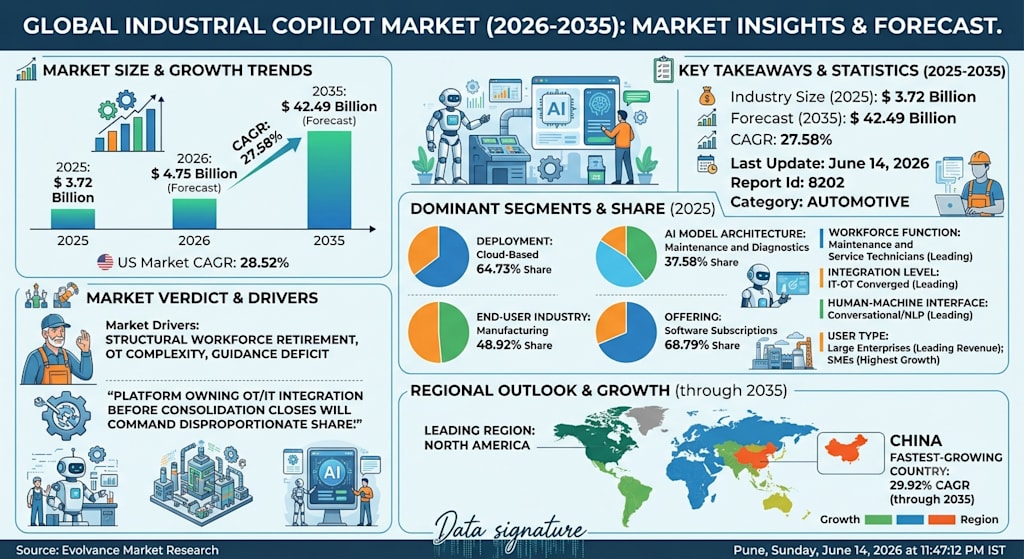
It is a workforce continuity story, and it is precisely why the industrial copilot market reached USD 3.72 billion in 2025, is projected to hit USD 42.49 billion by 2035 at a 27.58% CAGR, and is being treated as a procurement necessity rather than an optimization project by operators who have watched their most experienced people retire without adequate successors.
Manufacturing absorbs 48.92% of end-user spending, maintenance and diagnostics commands 37.58% of application revenue, software subscriptions account for 68.79% of total market revenue, cloud-based deployment holds 64.73% share, and China is growing at 29.92% CAGR through 2035. The full segmentation picture across deployment mode, AI model architecture, workforce function, and integration level is covered in this industrial copilot sector intelligence and market structure overview.
The Retirement Problem That No Training Program Solves
Most enterprises framing industrial AI as a productivity initiative are solving the wrong problem. The actual pressure is knowledge transfer at a pace that classroom training and documentation projects have structurally failed to match. The World Economic Forum projects that 44% of workers' core skills will shift by 2027 due to automation and AI, a number that does not account for the retirement wave already reducing headcount in precision machining, oil and gas field operations, and utilities. Industrial copilots address this by embedding expert-level decision support at the point of action, making the knowledge of the departing engineer available to the incoming operator without requiring either of them to be in the same room.
Siemens demonstrated this concretely. Its generative AI-powered maintenance copilot, integrating Senseye predictive maintenance and piloted across commercial accounts in early 2025, produced approximately 25% reductions in reactive maintenance time. That specific number matters because it clears the payback threshold that most plant-level investment committees require before approving multi-year platform commitments. A follow-on product at SPS 2025 in November 2025, the NX CAM Copilot, automated CNC programming tasks and cut programming time by up to 80% in discrete manufacturing environments. Peer-documented outcomes at this specificity are now substituting for internal pilots in procurement evaluations, compressing approval timelines across the sector.
Why Maintenance Won the Application Race First
The most commercially mature application category is not the most technically impressive one. Maintenance and diagnostics captured the largest application share because it carries the most legible ROI of any use case in the category. Equipment failure histories are the most consistently recorded data type in industrial environments, providing the training volume that model accuracy depends on. Finance teams can verify the return before deployment begins, which matters enormously when budget cycles are annual and IT integration projects routinely take twelve to eighteen months.
Process optimization and engineering copilot applications are attracting the most high-profile product investment from Siemens, Rockwell Automation, and ABB, but they operate on longer proof cycles and compound benefits that are harder to attribute to a single tool in a mixed-technology environment. Quality control and supply chain applications are expanding as ERP-copilot integration matures, but they are running two to three years behind maintenance in organizational acceptance. The procurement pattern here follows a predictable path: operators buy their first copilot deployment in maintenance because the risk is lowest and the payback is fastest, then use that institutional proof to authorize expansion into more complex workflow categories.
The OT Integration Problem That Kills Capable Products
Brownfield operational technology environments are the primary execution risk in this market, and most vendor roadmaps underestimate how disruptive they are in practice. Connecting AI platforms to facilities built around older PLC vintages, proprietary protocols including Modbus, PROFINET, and DNP3, and fragmented data historians from multiple vendors can extend deployment timelines by six to eighteen months on complex sites. That delay is not a technology limitation. It is an architecture mismatch between software designed for modern APIs and infrastructure built before APIs were a design consideration.
The practical consequence is that deployment quality bifurcates sharply between large enterprises with internal OT/IT integration teams and mid-market operators who purchased a platform without purchasing the operating model around it. Capgemini's 2025 World Quality Report found that a third of AI deployments reported minimal productivity gains, a figure that correlates directly with integration underfunding rather than model inadequacy. IEC 62443 security requirements add independent compliance overhead, and the EU AI Act's phased enforcement through 2026 is requiring European operators to retrofit explainability layers into systems originally built for performance, not auditability. Vendors without documented conformity programs are being excluded from European regulated sector evaluations before the capability conversation begins.
Siemens Has a Moat That Is Not About AI
The competitive framing most commonly applied to this market focuses on which vendor has the most capable foundation model. That misidentifies where the durable advantage actually sits. Siemens AG's Xcelerator platform, built on Microsoft Azure OpenAI Service, serves over 120,000 engineers as of 2025. That installed base generates proprietary usage data at a scale that enables continuous model fine-tuning on real industrial workflows, a feedback loop that pure-play AI entrants without equivalent OT customer relationships cannot replicate through R&D investment alone.
The industrial copilot market share is structuring around this dynamic at the Tier 1 level, where Siemens, Schneider Electric, ABB, and Rockwell Automation hold their positions through integration depth and OT customer relationships rather than algorithmic superiority. ABB's automation orders reached USD 9,928 million in 2025, up 33% year-over-year, confirming forward demand that directly supports copilot upsell across its installed base. Schneider Electric's April 2026 announcement at Hannover Messe, where its agentic manufacturing capabilities produced engineering time reductions of up to 50% and compressed production configuration changes from weeks to hours, is the kind of quantified commercial proof that will unlock agentic procurement discussions across the broader sector.
In the Tier 2 segment, the vendors gaining traction are those competing on workflow specificity rather than platform breadth. Augmentir leads in frontline worker enablement. Cognite's Data Fusion middleware handles OT/IT integration in mixed-vendor environments without requiring OT hardware changes. Palantir's AIP targets the enterprise data layer. These are not competing with Siemens directly. They are capturing the space where Siemens' generalist platform leaves workflow-specific gaps, and they are the acquisition targets that consolidation through 2030 will absorb.
What Greenfield Asia Pacific Changes About the Math
The brownfield integration problem that constrains European and North American deployments mostly does not exist in the wave of new factory construction happening across China and India. Made in China 2025-driven facility builds allow industrial copilots to be integrated at the architecture layer from day one, eliminating the middleware complexity that adds twelve months to comparable deployments in Germany or Ohio. China's 29.92% CAGR is partly a reflection of this structural advantage in addition to volume.
India's manufacturing expansion under the Make in India framework is generating equivalent greenfield conditions in automotive, pharmaceuticals, and electronics. For vendors, new facility projects in these markets represent the cleanest available test environments for agentic capability deployment, where audit trail requirements are lighter and the absence of legacy infrastructure removes the most common source of deployment failure. The operators who build agentic capability in Asia Pacific greenfield environments over the next three years will carry that institutional learning back into their brownfield remediation programs in Western markets, compressing what would otherwise be a multi-year learning curve.
As SME-targeted SaaS platforms mature their pre-configured industry template libraries, the organizational profile of the typical industrial copilot customer will shift considerably. Smaller manufacturers in food processing, metal fabrication, and contract electronics have historically lacked the internal IT resources to justify platform deployment, but template-driven deployments that eliminate custom integration requirements are changing that calculus. The vendors building those template libraries now, across the most common industrial configurations, are accumulating switching costs among SME customers before the competitive field has recognized the opportunity.
About the Creator
Suge kun
Research Analyst passionate about data & market insights. I turn complex information into clear, actionable strategies. Detail-driven & results-focused — helping businesses make smarter decisions. — Suge Kun
Enjoyed the story? Support the Creator.
Subscribe for free to receive all their stories in your feed.
Comments
There are no comments for this story
Be the first to respond and start the conversation.