
Industrial Circular Economy Digital Platforms Market: Compliance Is the Catalyst
A 19.1% CAGR built not on sustainability ambition but on the hard economics of EPR liability and EU enforcement deadlines.

Manufacturers Are Not Going Circular Because They Want To. They're Going Circular Because the Fines Are Real.
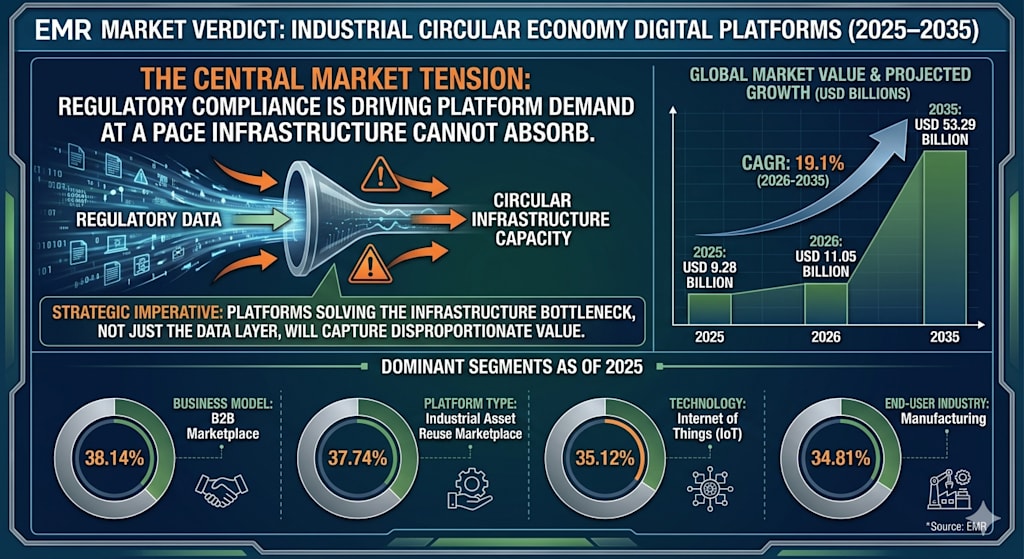
The EU's circular material use rate reached just 12.2% in 2024, a 0.1 percentage-point improvement year-on-year that took an entire continent's regulatory apparatus to produce. The metal ore circularity rate actually fell, dropping 1.2 percentage points to 23.4%. These Eurostat figures do not describe a transition succeeding on schedule. They describe a structural gap between regulatory ambition and industrial reality, and that gap is precisely what is driving the industrial circular economy digital platforms market from USD 9.28 billion in 2025 toward USD 53.29 billion in 2035 at a 19.1% CAGR.
North America leads with 38.4% of current revenue, B2B marketplace models hold 38.14% of business model share, industrial asset reuse platforms account for 37.74% of platform type revenue, IoT anchors 35.12% of technology spend, and manufacturing absorbs 34.81% of end-user industry revenue. The full segmentation architecture across business model, platform type, technology layer, application, and end-user is documented in this industrial circular economy digital platforms sector structure and forecast overview.
The August 2026 Cliff That Most Operators Are Not Ready For
The EU Packaging and Packaging Waste Regulation enters its application phase in August 2026. This is not a phased guidance framework with soft enforcement discretion.
Producers without compliant digital material-tracking infrastructure will be unable to demonstrate full-cost recovery compliance, which means certification-linked procurement becomes inaccessible and market access for non-compliant products in European markets is withdrawn. Budget conversations that were framed as ESG investments six months ago are now emergency compliance remediation projects in procurement departments across Germany, France, and the Netherlands.
The Extended Producer Responsibility mechanism behind this has a specific economic logic that changes the nature of the investment decision. EPR frameworks, now enforced across 67 or more countries, transfer post-consumer waste liability from municipalities to the manufacturers whose products generated the waste.
That transfer converts end-of-life costs from a socialized externality into a direct P&L line for the producing firm. A compliance-grade circular platform is no longer a sustainability project in that context. It is margin protection, which is the only framing that reliably shortens enterprise software procurement cycles.
The consequence is a demand pattern that looks unlike typical enterprise software adoption. Most software categories show gradual adoption curves driven by productivity ROI arguments. This market is producing near-vertical adoption curves among mid-market manufacturers who previously had no platform at all because their regulatory exposure was lower. The August 2026 enforcement date is the single most legible demand-certainty signal in this market for anyone evaluating near-term revenue trajectories.
What Kalundborg Figured Out That Everyone Else Is Still Modeling
The Kalundborg Symbiosis industrial ecosystem in Denmark is the oldest and most studied example of industrial symbiosis at operational scale. Its excess heat network alone carries potential supply to 50,000 households, and the ecosystem exchanges steam, water, organic materials, and mineral byproducts across a cluster of companies that would otherwise treat each other's outputs as waste disposal costs. The commercial logic is straightforward: one facility's process heat is another's energy input, and the platform connecting those exchanges creates value that neither participant could capture independently.
The practical limitation of Kalundborg as a model is geography. Its success depends on physical proximity between exchange partners, shared industrial infrastructure, and decades of relationship-building that reduced transaction friction. Digital platforms are attempting to recreate that exchange density across dispersed industrial networks where physical proximity does not exist and participants have no pre-existing trading relationships.
The platforms that are solving this successfully are doing it through AI-enabled matching that identifies compatible waste streams across distance, combined with logistics integration that makes the physical exchange feasible at commercial scale. Greyparrot's AI-powered robotic sorting acquisition by CP Group demonstrates the capability trajectory: higher material purity outputs unlock secondary material price premiums that make cross-facility exchange viable where it previously was not.
The IoT Connectivity That Makes Everything Else Possible
IoT holds 35.12% of technology revenue share for a reason that follows directly from what circular economy platforms actually need to do. Real-time material flow data, equipment utilization tracking, and waste stream characterization all require sensor networks that generate continuous operational data rather than periodic reporting. Without that data layer, platforms are operating on self-reported inputs that are too slow and too unreliable for dynamic material exchange matching or automated EPR compliance reporting.
The integration challenge this creates is substantial. Industrial operators with OT infrastructure built before IoT connectivity was a design consideration face the same brownfield complexity that complicated agentic AI manufacturing deployments.
Connecting legacy equipment to modern API-based platforms requires middleware investment, security architecture aligned with IEC 62443 standards, and data governance frameworks that most mid-market operators have not previously needed. The documented raw-material cost savings of 15 to 35% from circular procurement create the ROI justification for that investment, but the integration timeline, typically 12 to 18 months on complex brownfield sites, means operators who have not started are already behind the August 2026 compliance window.
Blockchain and distributed ledger technology holds a secondary position in the technology mix, primarily in supply chain traceability applications where multiple parties need a shared record that no single participant controls. Battery passport requirements under EU Battery Regulation Article 77, mandatory for industrial and EV batteries from February 2027, are driving the most concrete near-term blockchain deployment in this market. A battery passport is not a sustainability credential. It is a market-access document, and manufacturers without compliant digital passports cannot sell industrial batteries into EU markets after the enforcement date.
The Platform Fight Between Software Vendors and Waste Brokers
The incumbent competitive position in industrial material exchange belongs to traditional waste brokers, and they are losing it faster than their revenue figures currently suggest. Waste brokerage relationships are built on information asymmetry: the broker knows where buyers and sellers exist for specific waste streams, and that knowledge is the margin source. Digital platforms eliminate the information asymmetry and replace broker margin with platform fees, which are structurally lower because the platform scales without proportional headcount growth.
The industrial circular economy digital platforms market growth trajectory reflects this displacement in the B2B marketplace model's 38.14% dominance, which captures the highest share precisely because it directly substitutes for broker-mediated transactions.
Rubicon Technologies and Reworld (formerly Covanta) represent the transition from waste management operators to platform-enabled circular economy service providers, a shift that is partly voluntary strategic repositioning and partly defensive response to pure-play digital entrants who do not carry legacy asset overhead.
SAP's Responsible Design and Production module and Oracle's environmental and sustainability reporting tools represent the ERP-integration pathway through which large enterprises are embedding circular economy compliance into existing enterprise architecture rather than deploying standalone platforms.
For mid-market operators without SAP or Oracle relationships, Terrapass, Rubicon, and vertical-specific platforms targeting pharmaceutical, electronics, and automotive waste streams are competing for the same compliance budget through more accessible entry points.
Why the Construction Sector Is the Overlooked Opportunity
Manufacturing at 34.81% of end-user revenue is the expected dominant vertical, given its material intensity and its direct exposure to EPR mandates. Construction's position is less obvious but potentially more durable.
EU Waste Framework Directive targets require 70% of construction and demolition waste to be prepared for reuse or recycling, and the sector generates approximately 850 million tonnes of waste annually across the EU alone. The digital platform infrastructure connecting demolition waste to secondary material buyers is dramatically less developed than equivalent infrastructure in manufacturing, which means the competitive field is less consolidated and first-mover advantage is still structurally available.
The Building Information Modelling integration pathway, connecting construction project data to material exchange platforms at the design stage rather than the demolition stage, is where the most ambitious platform operators are positioning.
A construction project that specifies materials with documented end-of-life exchange value at design time creates circular economy value upstream rather than attempting to recover it from mixed demolition waste downstream. That upstream capture is worth substantially more per tonne, but it requires platform integration into procurement workflows that most construction firms have not yet modernized.
As the gap between regulatory ambition and measured circularity rates persists, the platforms that move fastest from data layer to physical infrastructure enablement will hold positions that pure compliance tools cannot threaten. Compliance generates the procurement event. Physical exchange capability generates the recurring revenue that retains the customer through every subsequent regulatory cycle.
About the Creator
Suge kun
Research Analyst passionate about data & market insights. I turn complex information into clear, actionable strategies. Detail-driven & results-focused — helping businesses make smarter decisions. — Suge Kun
Enjoyed the story? Support the Creator.
Subscribe for free to receive all their stories in your feed.
Comments
There are no comments for this story
Be the first to respond and start the conversation.