
Industrial 3D Printing Market: From USD 15 Billion to USD 140 Billion — How Additive Manufacturing Stopped Being a Prototype Tool and Became a Production Technology
Aerospace parts, medical implants, humanoid robot components — the industrial 3D printing market is growing at 24.61% annually and the applications are only getting more extraordinary

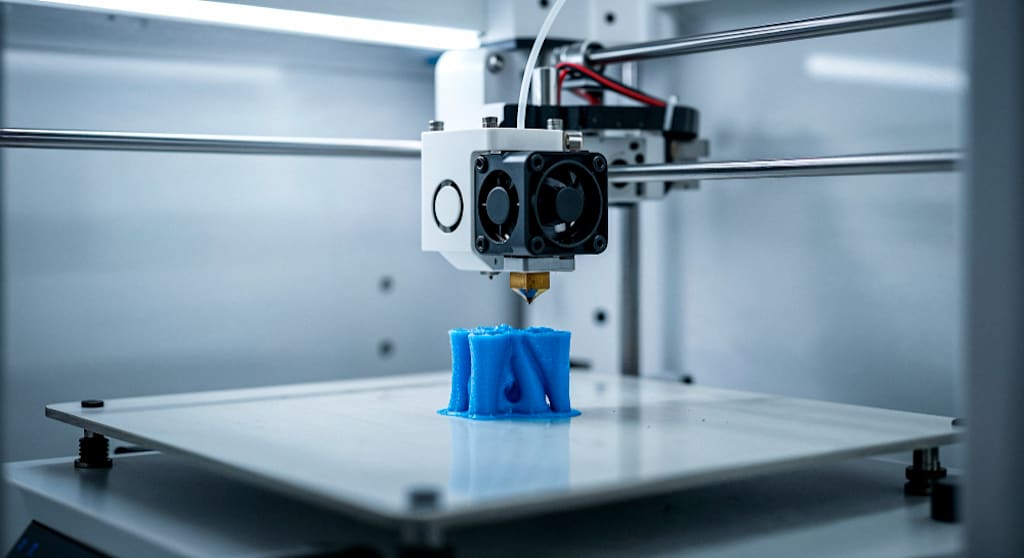
In 2024, Airbus printed a titanium bracket for the A350 fuselage that could not be manufactured any other way. The internal lattice structure — a complex geometric pattern that reduces weight by 30% while maintaining structural strength — is simply impossible to mill, cast, or forge. The only way to make it is to build it layer by layer from a digital file. That bracket is not a prototype. It is flying on commercial aircraft today, carrying real passengers, certified by aviation regulators who have spent years developing the frameworks to approve additively manufactured flight-critical components.
That is the moment this market crossed its most important threshold. Industrial 3D printing is no longer a tool for making prototypes faster and cheaper than traditional methods. It is a production technology — used to manufacture end-use parts that go into the most demanding applications on the planet.
The global industrial 3D printing market was valued at USD 15.58 billion in 2025 and is projected to reach USD 140.64 billion by 2035 — a CAGR of 24.61% that places it among the fastest-growing industrial technology markets anywhere. Hardware systems, metal powder bed fusion, and aerospace-grade functional parts lead demand across the forecast period. For engineers, procurement leaders, investors, and industry professionals who need the complete analytical picture — covering components, technologies, materials, end-user industries, applications, and regional forecasts through 2035 — the full research is available in the industrial 3D printing market report from Evolvance Market Research.
Read More: https://evolvancemarketresearch.com/reports/industrial-3d-printing-market/
Industrial 3D Printing Market Size and Growth
The financial signals from the sector's leading companies confirm the growth trajectory. Stratasys — one of the two largest industrial 3D printing companies globally — reported adjusted EBITDA of USD 19.3 million year-to-date through Q3 2025, up from USD 11.5 million the prior year. More striking is 3D Systems' reversal from a USD 221.9 million net loss to USD 49.4 million net income through September 2025 — a sector-wide profitability inflection that signals the industry has moved past the investment-heavy growth phase into sustainable commercial operations.
Stratasys received a USD 120 million strategic investment from Fortissimo Capital in February 2024 — a signal of growing institutional conviction in the sector's production-grade transition that validates the market trajectory with real capital commitment rather than analyst projection.
North America holds the leading regional position, with the United States market alone valued at USD 1.62 billion in 2025. Europe follows with strong aerospace and automotive manufacturing demand. Asia Pacific is growing fastest — driven by China's government-backed additive manufacturing programs and Japan's precision manufacturing heritage adapting to additive techniques for high-value component production.
Industrial 3D Printing Market Trends: Metal Is the Story
Metals account for 53.8% of industrial 3D printing material demand — and that figure tells you everything about where this market has evolved from and where it is going. In the early years of commercial 3D printing, the dominant material was polymer. Plastic parts were useful for visual prototypes and functional testing but could not go into flight-critical or load-bearing applications. Metal additive manufacturing changed that entirely.
Direct Metal Laser Sintering and Selective Laser Melting processes can now produce titanium, Inconel, stainless steel, and high-strength aluminum components with mechanical properties that meet or exceed cast and forged equivalents in many applications. The aerospace sector has been the primary driver of metal additive adoption — where the combination of complex geometry requirements, small production volumes, and extreme willingness-to-pay for weight reduction creates perfect conditions for additive manufacturing economics.
The automotive sector is following closely — particularly for electric vehicle component manufacturing where new designs unconstrained by traditional manufacturing methods are enabling battery enclosures, thermal management components, and structural parts that improve performance in ways conventional manufacturing cannot match. Healthcare is building the third major pillar of metal additive demand through patient-specific implants — hip replacements, spinal implants, and craniofacial reconstruction components designed from patient CT scan data and manufactured individually.
Polymers retain significance for prototyping and tooling applications where material costs and production speed outweigh the mechanical property advantages of metal. Ceramics and composites are emerging material categories finding specific high-value niches in thermal protection, electronics packaging, and structural applications where neither metal nor polymer delivers the required property combination.
Industrial 3D Printing Market Segments: From Prototyping to Serial Production
Prototyping represents 55.7% of application revenue — still the largest single use case, and the gateway through which most manufacturers first encounter industrial 3D printing. The economics of prototype production are compelling and immediate: eliminating tooling costs and compressing design iteration cycles from weeks to days delivers measurable value that every engineering team can quantify.
But functional parts and serial production are the fastest-growing application segments through 2035 — and they represent the market's most significant long-term value shift. When a manufacturer moves from using 3D printing to make prototypes to using it to make production parts, the volume, the criticality, and the willingness-to-pay all increase dramatically. That transition is the fundamental driver of the market's 24.61% annual growth rate.
Hardware leads the component segment with a 68.2% share — reflecting the capital investment cycle as manufacturers buy industrial-grade printer systems to build production capability in-house. Stereolithography holds the largest technology segment share at 32.6%, anchored by high-precision resin output for tooling and functional prototypes. AI-powered print assistants — which optimize build orientation, support structures, and process parameters automatically — are the fastest-growing software category as manufacturers seek to reduce the specialist expertise required to operate industrial systems effectively.
Industrial 3D Printing Market Applications: The Emerging Frontiers
The end-user landscape is expanding into territory that was not part of the industrial 3D printing conversation five years ago. Humanoid robotics is emerging as a significant new demand category — where the complex joint geometries, lightweight structural components, and low-volume production economics of humanoid robot manufacturing align almost perfectly with additive manufacturing's strengths. As humanoid robot production scales through the late 2020s, industrial 3D printing will be a critical enabling technology.
Low-altitude economy applications — drones for delivery, inspection, agriculture, and defense — represent another emerging category where additive manufacturing's ability to produce aerodynamically optimized structures at low volumes without tooling investment creates compelling economics. Military drone programs in particular are driving significant additive manufacturing investment as defense procurement increasingly values the supply chain resilience of on-demand localized production over traditional centralized manufacturing.
Cloud-based digital inventories — where companies replace physical spare part warehouses with digital files that can be printed on demand at any location globally — are transforming maintenance and aftermarket economics for aerospace, defense, and industrial equipment operators. The business model shift from selling hardware to selling digital files with on-demand production rights is one of the most significant commercial model innovations in the industrial sector in a generation.
Key Players in the Industrial 3D Printing Market
Stratasys and 3D Systems anchor the market as the two largest pure-play industrial 3D printing companies with the broadest technology and materials portfolios. EOS dominates the selective laser sintering segment with industrial powder bed fusion systems that have become the standard in aerospace and medical manufacturing. Desktop Metal is targeting mass production applications with its Production System binder jetting platform — designed for high-volume metal part production at costs that compete with casting.
GE Additive brings aerospace manufacturing credibility and capital depth to the market. HP's Multi Jet Fusion platform has captured significant share in polymer production applications. Markforged focuses on carbon fiber reinforced polymer and metal composite applications. The competitive landscape is consolidating through a wave of M&A and strategic investment — creating larger, more capable platforms that can serve the full manufacturing lifecycle from design to serial production.
The titanium bracket flying on the A350 is not the end of this story. It is the beginning of what production-grade additive manufacturing actually looks like at scale.
About the Creator
Suge kun
Research Analyst passionate about data & market insights. I turn complex information into clear, actionable strategies. Detail-driven & results-focused — helping businesses make smarter decisions. — Suge Kun
Enjoyed the story? Support the Creator.
Subscribe for free to receive all their stories in your feed.
Comments
There are no comments for this story
Be the first to respond and start the conversation.