
Indoor Farming Market Trends: Water Efficiency, Crop Diversification & Industry Forecast to 2034
How sustainable practices, water-efficient irrigation systems, and reduced pesticide usage are influencing investment trends and consumer demand in indoor farming

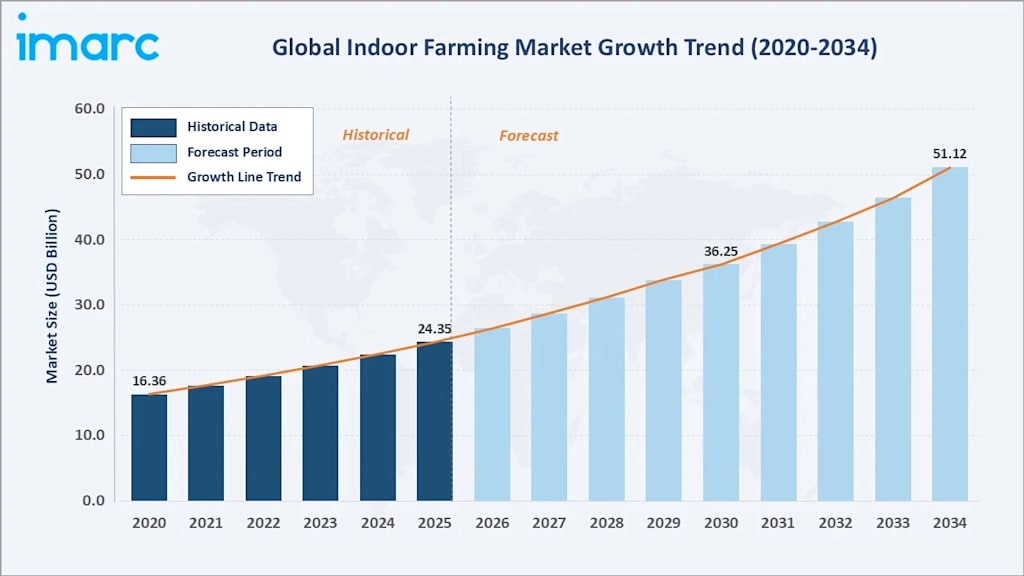
Indoor farming has evolved into a sophisticated global industry, transforming how we approach food security and urban agriculture. By utilizing controlled environments, farmers can now achieve up to 30 times higher yields per unit of land compared to traditional open-field methods. This efficiency is critical in regions facing extreme weather or land scarcity, where indoor facilities provide a reliable year-round harvest. According to IMARC Group’s latest data, the global indoor farming market size was valued at USD 24.35 Billion in 2025. Looking forward, IMARC Group estimates the market to reach USD 51.12 Billion by 2034, exhibiting a CAGR of 8.28% during 2026-2034.
Modern indoor farming leverages cutting-edge systems like hydroponics and aeroponics to grow fresh produce with significantly reduced resource consumption. For instance, these systems use up to 95% less water than conventional farming by recirculating nutrients directly to the plant roots. The industry is characterized by high-tech hardware, including LED grow lights and climate control sensors, which together represent over 65% of the market value. Major crop segments such as leafy greens, tomatoes, and herbs dominate production due to their short growth cycles and high profitability.
Download the Latest "Indoor Farming Market" Insights Report Today!
Indoor Farming Market Growth Drivers:
- Rising Need for Resource Efficiency and Water Conservation
The global agricultural sector is under immense pressure to reduce water usage, and indoor farming provides a high-impact solution. By utilizing closed-loop irrigation systems, indoor facilities can produce crops using 90% to 95% less water than traditional soil-based methods. This efficiency is a massive driver in arid regions where water scarcity is a constant threat to food security. Numerical data highlights that a single indoor facility can save millions of gallons of water annually, making it a cornerstone for sustainable development and climate-resilient food production strategies globally.
- Shrinking Arable Land and Rapid Urbanization
As cities expand, available fertile land for traditional farming is disappearing at an alarming rate. Indoor farming allows for high-density cultivation in repurposed urban spaces, such as warehouses or shipping containers, effectively bringing the farm to the consumer. This proximity eliminates the need for long-haul transportation, which often accounts for a significant portion of food waste and emissions. Research indicates that indoor vertical farms can produce significantly more food per square meter than outdoor plots, addressing the urgent demand of a global population expected to reach nearly 10 billion by 2050.
- Government Incentives and Financial Support Schemes
Public sector backing is playing a pivotal role in de-risking indoor farming investments. In 2025 and 2026, various governments introduced substantial subsidies to encourage high-tech agriculture. For example, India’s Agriculture Infrastructure Fund offers loans up to ₹2 crore with a 3% interest subsidy for hydroponic and greenhouse projects. Similarly, European and North American agencies provide grants focused on "AgriTech" to boost local food self-sufficiency. These financial frameworks lower the entry barrier for startups and cooperatives, fueling the deployment of advanced hardware and automation across the global market.
Indoor Farming Market Trends:
- Integration of AI and Autonomous Climate Control
The industry is shifting toward "no-hands farming," where artificial intelligence manages every aspect of the plant's life cycle. Modern facilities now use AI-driven sensors to monitor real-time data on CO2 levels, humidity, and nutrient density, adjusting environments automatically to optimize growth. In early 2025, major tech launches in Asia showcased 5,000-square-meter facilities that reduced energy costs by 30% through automated lighting and irrigation. This trend toward total automation helps operators achieve consistent quality and higher yields while minimizing the labor-intensive nature typically associated with traditional commercial farming practices.
- Expansion into High-Value and Functional Crops
While leafy greens have long been the staple of indoor farms, there is a visible trend toward diversifying into high-margin crops like berries, medicinal herbs, and exotic mushrooms. Berries, in particular, are emerging as a fast-growing segment due to their sensitivity to outdoor climates and high retail value. By 2026, many operators have pivoted their business models to focus on "functional foods" enriched with specific nutrients through tailored LED light spectrums. This specialization allows indoor growers to compete more effectively with traditional imports by offering superior freshness and enhanced nutritional profiles.
- Transition to Renewable Energy and Circular Models
To combat high operational costs associated with electricity, indoor farms are increasingly integrating on-site renewable energy sources like solar and wind power. New projects in 2026 are highlighting the use of 100% renewable energy to power massive vertical stacks, significantly improving the industry’s "green" credentials. Furthermore, circular economy practices are gaining traction, where waste heat from data centers or industrial plants is repurposed to maintain temperatures in nearby greenhouses. This synergy not only lowers energy bills but also aligns indoor farming with broader corporate sustainability goals and carbon-neutrality targets.
Recent News and Developments in Indoor Farming Market
- April 2026: A major rebound in global AgriTech funding was recorded, with total investments hitting record levels as venture capital shifts toward operationally disciplined and profitable indoor farming ventures.
- February 2026: Saudi Arabia successfully operationalized one of the world's largest indoor vertical farms in Riyadh, a 20,000-square-meter facility aimed at securing local produce supplies as part of the Saudi Vision 2030 initiative.
- November 2025: 80 Acres Farms and Soli Organic announced a landmark strategic merger, consolidating their technology and distribution networks to create a more resilient supply chain for organic indoor-grown produce.
Note: If you require specific details, data, or insights that are not currently included in the scope of this report, we are happy to accommodate your request. As part of our customization service, we will gather and provide the additional information you need, tailored to your specific requirements. Please let us know your exact needs, and we will ensure the report is updated accordingly to meet your expectations.
About the Creator
Andrew Sullivan
Hello, I’m Andrew Sullivan. I have over 9+ years of experience as a market research specialist.
Enjoyed the story? Support the Creator.
Subscribe for free to receive all their stories in your feed.
Comments
There are no comments for this story
Be the first to respond and start the conversation.