
India’s Online Food Delivery Boom: How Convenience, Technology, and Quick Commerce Are Reshaping the Way the Nation Eats
From 10-minute deliveries to AI-powered recommendations, India’s food delivery industry is evolving into one of the country’s most dynamic digital economies.

Few industries reflect India’s digital transformation as clearly as online food delivery. What began as a simple convenience service for urban consumers has rapidly evolved into a powerful ecosystem connecting restaurants, cloud kitchens, delivery partners, technology platforms, and millions of customers across the country.
Today, ordering food through a smartphone is no longer an occasional luxury. For many Indians, especially working professionals, students, and families in urban areas, it has become part of everyday life. Whether it is a morning coffee, a quick lunch during work hours, or a late-night snack, digital food delivery platforms have fundamentally changed consumer behavior.
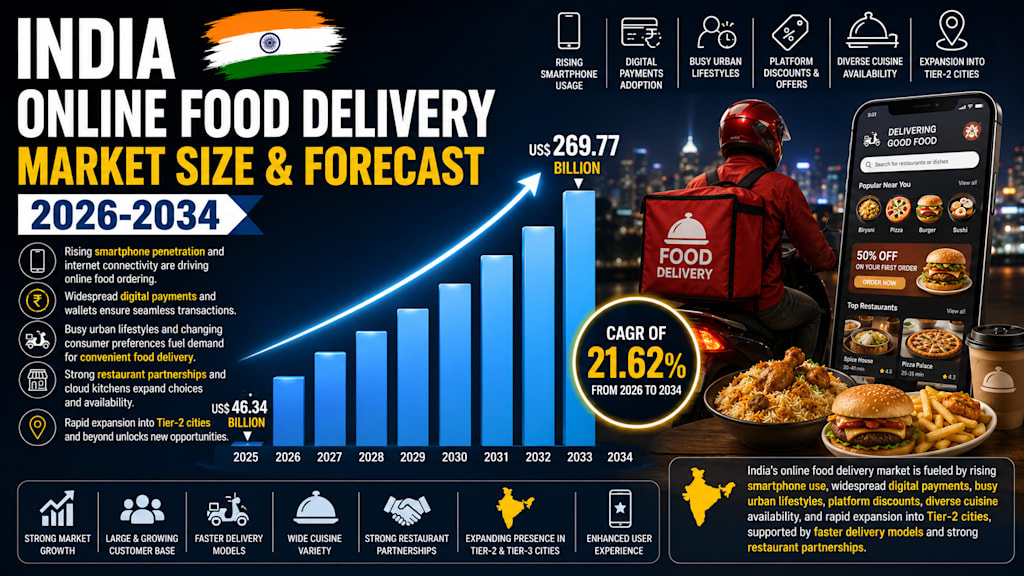
The numbers tell an impressive story. According to Renub Research, the India Online Food Delivery Market is projected to grow from US$ 46.34 billion in 2025 to an astonishing US$ 269.77 billion by 2034, expanding at a CAGR of 21.62% between 2026 and 2034. Such growth highlights not only the increasing demand for convenience but also the growing influence of technology in shaping modern consumption habits.
As competition intensifies and innovation accelerates, India’s online food delivery sector is becoming one of the most closely watched segments within the broader digital economy.
The Rise of Convenience as a Lifestyle Choice
The success of online food delivery platforms is deeply connected to changing lifestyles across India.
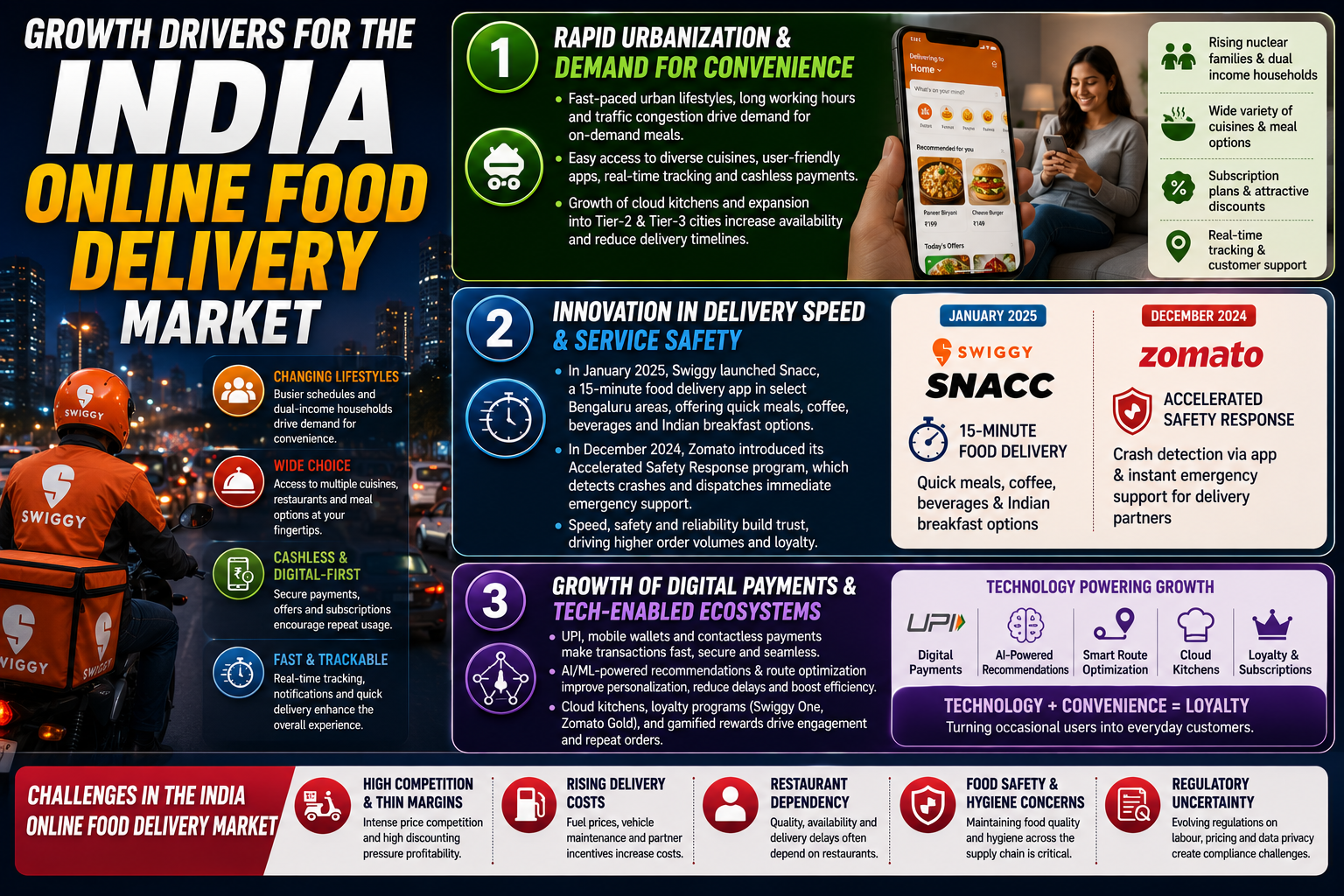
Urbanization continues to transform how people live and work. Longer commuting times, demanding schedules, and the rise of dual-income households leave many consumers with less time for meal preparation. In response, food delivery platforms offer an attractive solution: access to thousands of meal options with just a few taps on a smartphone.
Consumers are no longer limited to nearby restaurants. Instead, they can browse cuisines from across the city, compare prices, track deliveries in real time, and pay digitally without leaving their homes.
Convenience has become a lifestyle expectation rather than a premium service.
This shift is particularly evident among younger consumers who value flexibility, speed, and personalization. Students, working professionals, and nuclear families increasingly rely on delivery platforms to satisfy daily dining needs.
At the same time, affordability remains a powerful factor. Discount campaigns, loyalty programs, cashback offers, and subscription services encourage repeat usage and strengthen customer retention.
As a result, online food delivery is no longer competing solely with traditional dining. It is becoming a direct alternative to home cooking for many consumers.
Technology at the Heart of Growth
Behind every successful food delivery order lies a sophisticated technological infrastructure.
Modern food delivery platforms leverage artificial intelligence, machine learning, predictive analytics, and route optimization systems to improve efficiency and customer experience.
AI-powered recommendation engines analyze user behavior, purchase history, preferred cuisines, and spending patterns to provide highly personalized suggestions. These recommendations increase engagement while helping restaurants reach the right audience.
Machine learning also plays a critical role in logistics management. Delivery routes are continuously optimized to reduce travel time, improve delivery accuracy, and minimize operational costs.
Real-time tracking has become another key feature that consumers now expect. The ability to monitor an order from preparation to doorstep delivery enhances transparency and trust.
Additionally, data-driven decision-making helps platforms identify high-demand locations, optimize restaurant partnerships, and determine where new cloud kitchens should be established.
In many ways, food delivery companies are now technology companies as much as they are logistics businesses.
Digital Payments Fueling Adoption
India’s fintech revolution has provided a significant boost to online food delivery.
The widespread adoption of Unified Payments Interface (UPI), mobile wallets, debit cards, and contactless payment methods has made transactions faster and more convenient than ever before.
Consumers no longer need to worry about carrying cash or dealing with payment friction during checkout. The ordering process has become nearly seamless.
This digital payment ecosystem supports higher order frequency by removing barriers that once discouraged online purchases.
Furthermore, secure payment systems increase consumer confidence and encourage first-time users to engage with food delivery platforms.
The combination of digital payments and smartphone penetration has created a powerful foundation for sustained market expansion.
As internet connectivity improves across India, especially in smaller cities, food delivery services are becoming accessible to entirely new customer segments.
The Cloud Kitchen Revolution
One of the most significant developments within the industry has been the rise of cloud kitchens.
Unlike traditional restaurants, cloud kitchens operate exclusively for delivery. They do not require expensive dining spaces or high-visibility retail locations.
This model offers several advantages.
First, it significantly reduces operational costs.
Second, it enables restaurant brands to expand quickly into new markets without major infrastructure investments.
Third, it allows entrepreneurs to experiment with specialized cuisines and niche food concepts.
Cloud kitchens rely heavily on delivery platforms for visibility and customer acquisition. In return, delivery platforms gain access to a broader range of menu options and greater order volumes.
The relationship has become mutually beneficial and increasingly important to the industry's growth trajectory.
As consumer demand for variety continues to rise, cloud kitchens are expected to remain a major contributor to market expansion.
Quick Commerce Is Changing Expectations
Perhaps the most dramatic shift in recent years has been the emergence of quick commerce within food delivery.
Consumers who once considered 45-minute delivery acceptable are now expecting meals within 10 to 15 minutes.
This demand for speed is pushing companies to rethink logistics, inventory management, and operational efficiency.
Swiggy’s introduction of services such as Snacc and the expansion of Bolt demonstrate the growing emphasis on ultra-fast delivery models. Likewise, Blinkit’s launch of Bistro signals increasing competition in the quick-food segment.
These innovations are redefining customer expectations.
Speed is no longer viewed as a bonus feature. It is becoming a competitive necessity.
Companies that can consistently deliver meals, snacks, beverages, and breakfast items within minutes gain a substantial advantage in customer acquisition and retention.
However, achieving such speed requires significant investment in infrastructure, technology, and delivery networks.
The race for faster delivery is likely to remain one of the industry's defining themes over the next decade.
Safety and Trust as Competitive Advantages
While speed attracts customers, trust keeps them coming back.
Food delivery companies increasingly recognize the importance of safety, reliability, and customer protection.
Recent initiatives such as Zomato’s Accelerated Safety Response program demonstrate how technology can enhance user and delivery-partner safety.
Automated emergency detection systems, rapid support mechanisms, and real-time monitoring help build confidence among stakeholders.
Safety measures extend beyond delivery operations.
Platforms are also investing in better packaging standards, hygiene protocols, restaurant quality monitoring, and customer support services.
Consumers today expect not only fast deliveries but also reliable and safe experiences.
Companies that successfully combine speed with trust are likely to emerge as long-term market leaders.
Beyond Metro Cities: The Tier-2 Opportunity
Although metropolitan areas remain the industry's largest revenue generators, future growth increasingly depends on smaller cities.
Tier-2 and Tier-3 markets are experiencing rapid digital adoption driven by improved internet connectivity, affordable smartphones, and growing disposable incomes.
Consumers in these regions are becoming more comfortable with app-based services and digital payments.
Food delivery platforms have responded by expanding service coverage, onboarding local restaurants, and tailoring offerings to regional tastes.
This expansion presents enormous opportunities.
Smaller cities collectively represent millions of potential customers who were previously underserved by organized food delivery networks.
As awareness grows and infrastructure improves, these markets are expected to contribute significantly to overall industry growth.
The democratization of digital services is helping transform food delivery from a metropolitan phenomenon into a nationwide consumption trend.
Regional Powerhouses Driving Growth
Several states continue to play a leading role in shaping the online food delivery landscape.
Maharashtra remains one of the strongest markets, supported by cities such as Mumbai, Pune, and Nagpur. High disposable incomes, dense urban populations, and a thriving food culture generate substantial order volumes.
Karnataka, led by Bengaluru, stands out as a hub for innovation. The city's technology-driven population and startup ecosystem make it an ideal testing ground for new delivery concepts, AI-driven services, and ultra-fast delivery models.
Tamil Nadu also represents a major growth center. Chennai, Coimbatore, and Madurai demonstrate strong demand for both traditional South Indian cuisine and international food offerings. High smartphone penetration and widespread UPI usage further strengthen market adoption.
Together, these states illustrate the diversity and scale of India’s food delivery opportunity.
Challenges That Cannot Be Ignored
Despite its impressive growth prospects, the industry faces several challenges.
Profitability remains a major concern.
Delivery logistics, driver incentives, discounts, customer acquisition campaigns, and technology investments create substantial operational costs. Many platforms continue to operate on thin margins while competing aggressively for market share.
Fuel prices and fluctuating demand patterns add further complexity.
Quality control presents another challenge.
Since platforms depend heavily on restaurant partners, maintaining consistent food quality can be difficult. Packaging issues, preparation delays, and service inconsistencies can negatively impact customer experiences even when platforms are not directly responsible.
Regulatory considerations also require attention.
Food safety standards, labor regulations, gig-worker protections, and data privacy requirements are becoming increasingly important as the industry matures.
Successfully navigating these challenges will be essential for sustainable long-term growth.
What the Future Holds
The future of India’s online food delivery industry appears remarkably promising.
Technology will continue driving innovation through artificial intelligence, predictive analytics, automation, and enhanced personalization. Delivery times are likely to become even shorter as quick-commerce infrastructure expands.
Cloud kitchens will continue multiplying, offering consumers greater variety while supporting entrepreneurial growth.
Digital payments will become even more deeply integrated into the customer journey.
Most importantly, food delivery services will continue expanding beyond major urban centers, bringing convenience to millions of new users across the country.
The market’s projected growth to nearly US$ 270 billion by 2034 underscores the scale of this transformation.
What was once considered a niche digital service has become a cornerstone of India’s modern consumer economy.
Final Thoughts
India’s online food delivery market is no longer simply about ordering meals. It represents the convergence of technology, logistics, digital payments, consumer behavior, and entrepreneurship.
The industry has evolved from convenience to necessity, from urban trend to nationwide movement.
As companies compete to deliver faster, smarter, and more personalized experiences, consumers stand to benefit from greater choice, improved service quality, and unprecedented convenience.
With strong market fundamentals, continuous innovation, and expanding digital adoption, India’s food delivery sector is positioned to remain one of the country’s most exciting growth stories throughout the coming decade.
For businesses, investors, and consumers alike, the future of food delivery in India is arriving faster than ever—and it may already be at the doorstep.
About the Creator
Enjoyed the story? Support the Creator.
Subscribe for free to receive all their stories in your feed.
Comments
There are no comments for this story
Be the first to respond and start the conversation.