
India Power Market Statistics 2026-2034: Trends, Outlook, Growth and Forecast
India's energy market is booming as growing cities, busy factories, and modern households use more electricity every day.

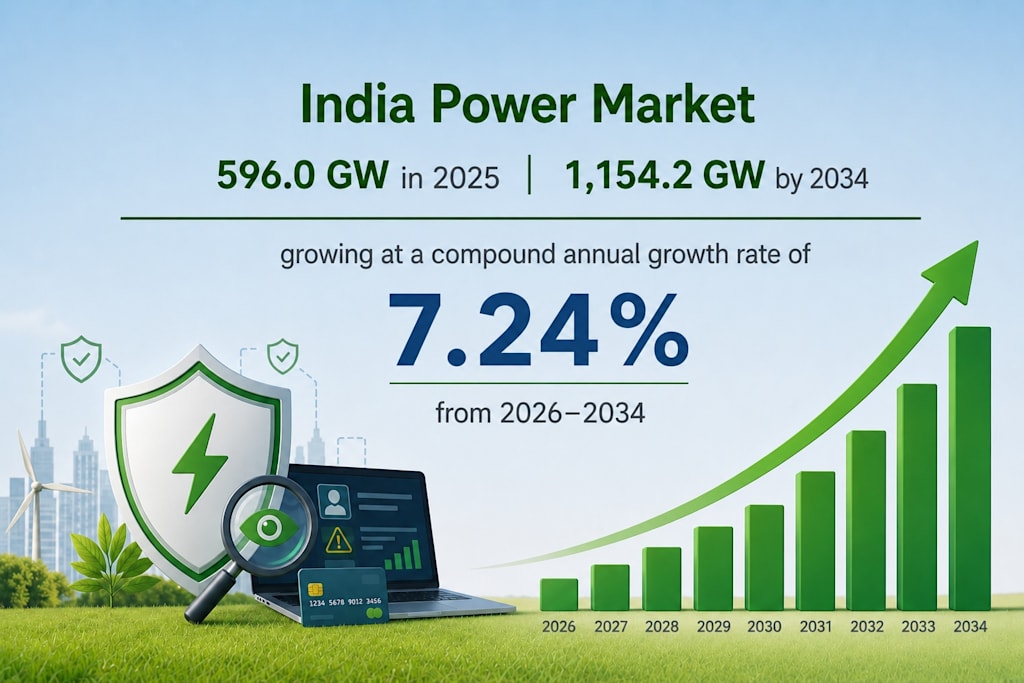
According to IMARC Group's latest market report, the India power market is experiencing notable growth, driven by the increasing electricity demand from rapid industrialization, urbanization, and rising per capita usage. Accelerated renewable energy deployment, supportive government policies targeting non-fossil fuel capacity expansion, and large-scale infrastructure modernization are reshaping the energy landscape.
The India power market size reached 596.0 GW in 2025 and is projected to reach 1,154.2 GW by 2034, growing at a compound annual growth rate of 7.24% from 2026-2034. Thermal dominates the power source segment with a share of 54.6% in 2025, utilities represent the largest end-user segment with a market share of 62.3% in 2025, and West India leads regionally with a 31.4% share. The growing investments in transmission networks, energy storage systems, and grid digitalization are enhancing supply reliability and operational efficiency, thus contributing to the India power market share.
Why the Market Is Growing so Rapidly?
Rapid Urbanization and Industrialization
India's rapid urbanization and industrialization are impelling the growth in the power market, as the demand for energy rises across residential, commercial, and industrial sectors. With urban areas expanding and industrial activities intensifying, there is an increase in the need for a reliable and uninterrupted electricity supply. The development of infrastructure, such as smart cities and industrial zones, requires enhanced energy capacity to support residential needs, manufacturing, transportation, and services. According to World Bank data, India's urban population accounted for approximately 36.87% of the total population in 2024. This increasing rate of urbanization is driving investments into generation, transmission, and distribution systems, further propelling the growth of the Indian power market.
Government Policies and Initiatives
The Indian government's policies and initiatives play a significant role in shaping the power market. Various programs and efforts towards renewable energy capacity expansion are contributing to a rise in energy demand. Policies promoting affordable electricity access, along with the focus on sustainable energy, are contributing to the diversification of the country's energy mix. In 2026, the Ministry of Power introduced the Draft National Electricity Policy 2026, which outlines ambitious goals for sustainable energy. The policy targets 2,000 kWh per capita electricity usage by 2030 and aims to align with India's climate commitments, marking a significant shift from the previous policy established in 2005. These efforts highlight the government's commitment to transforming the power sector while ensuring a greener, more reliable energy future for the nation.
Renewable Energy Adoption
The growing focus on renewable energy adoption is driving the Indian power market's transformation. With an increasing shift towards clean energy sources like solar, wind, and hydroelectric power, the renewable energy segment is becoming an essential component of the energy mix. The government's ambitious targets to increase renewable energy capacity contribute to the expansion of solar and wind farms, enabling India to reduce its dependence on fossil fuels. In 2026, India launched Phases 3 and 4 of the Green Energy Corridor to integrate 150 GW of renewable energy into the national grid. This initiative supports India's goal of achieving 500 GW of non-fossil fuel power by 2030. The expansion aims to enhance grid capacity and stability amid growing renewable generation.
What Are the Latest Emerging Trends in India's Power Market?
Technological Advancements in Power Generation
Technological innovation is playing a major role in improving power generation efficiency in India through smart grids, energy storage systems, and the digitalization of power plants. These advancements reduce operational costs, enhance resource utilization, and support more reliable electricity production. In 2025, the Ministry of Power announced the launch of the India Energy Stack (IES), a national digital infrastructure initiative designed to enable real time data sharing, smart utility operations, and better user access, with a 12 month pilot testing the Utility Intelligence Platform for improved grid efficiency. Continued progress in combined cycle plants and hybrid renewable systems is making generation more adaptable and cost effective.
Foreign Investments and Private Sector Participation
Foreign investment and private sector participation are propelling the growth of India power market by providing capital, technology, and operational expertise. Liberalized policies and eased foreign direct investment (FDI) norms are attracting international and domestic investors across generation, transmission, and distribution segments. According to IBEF, the power sector accounted for about 2.7% of total FDI inflows through June 2025, with cumulative inflows of INR 1,21,734.99 Crore, while the non-conventional energy segment alone received INR 1,69,772.12 Crore between April 2000 and June 2025. These investments are supporting new capacity additions, renewable deployment, grid upgrades, and competitive market development nationwide.
Integration of Smart Grids and Grid Modernization
Smart grids are strengthening India's power infrastructure by enabling real time monitoring, improved demand response, and efficient distribution management. These systems enhance grid resilience, reduce outages, and facilitate the integration of decentralized renewable energy sources, supporting a more reliable electricity network. In 2025, Vodafone Idea announced plans to deploy 12 million smart meters across India over three years under the National Smart Grid Mission, with the meters managed through its IoT Smart Central platform to reduce losses and improve efficiency. The growing automation of grid operations is expected to meet rising electricity demand while advancing sustainability and operational performance nationwide.
India Power Market Segmentation
By Power Source: Thermal (54.6%, leading segment) — driven by India's extensive coal reserves, established generation infrastructure, and critical role in providing baseload electricity to meet the country's rapidly growing energy requirements; Nuclear; Renewables — fastest-growing segment supported by the government's target of 500 GW of non-fossil fuel capacity by 2030.
Thermal dominates with a market share of 54.6% of the total India power market in 2025. Thermal holds the biggest market share owing to its established infrastructure base and dependable large scale generation capacity. Coal based plants account for the majority of installed capacity, supplying consistent electricity to meet baseload demand across industrial and urban centers. India's domestic coal availability and extensive network of thermal stations enable steady output throughout the year. Reflecting this priority, in 2025 Prime Minister Narendra Modi launched thermal power projects in Kanpur worth over Rs 47,000 crore, including the 660 MW Panki and Ghatampur expansions, adding 3,081 MW to Uttar Pradesh's capacity.
By End User: Utilities (62.3%, leading segment) — reflecting the dominance of state-owned distribution companies and central generating stations in managing bulk power procurement, transmission, and distribution across India's vast electricity network; Commercial and Industrial; Residential.
Utilities lead with a market share of 62.3% of the total India power market in 2025. Utilities represent the largest segment due to their central role in electricity generation, transmission, and distribution across the country. State owned and private utility companies account for the largest share of power procurement and usage, supplying electricity to residential, commercial, and industrial segments. Rapid urbanization, rising household electrification, and expansion of smart city projects continue to increase the demand handled by utilities. Long term power purchase agreements and regulated tariff structures provide stable demand and predictable revenue streams, while upgrades in distribution networks, smart metering, and reduction of transmission losses are increasing operational efficiency.
By Region: West India (31.4%, leading segment) — supported by Gujarat's substantial thermal and renewable capacity, Maharashtra's industrial electricity demand, and the region's advanced grid infrastructure enabling large-scale power generation; North India; South India; East India.
West India exhibits a clear dominance with a 31.4% share of the total India power market in 2025. West India leads the market driven by its strong industrial base, high electricity usage, and advanced infrastructure across states such as Maharashtra and Gujarat. Major manufacturing hubs, petrochemical complexes, and commercial centers in Mumbai, Pune, Surat, and Ahmedabad generate sustained power demand throughout the year. In 2025, Ingka Investments, the investment arm of Ingka Group (IKEA), launched its first renewable energy project in India, a 210 MWp solar installation in Bikaner, Rajasthan, expected to generate 380 GWh annually. Ports, logistics corridors, data centers, metro rail projects, and commercial real estate growth further reinforce rising regional electricity demand.
Recent Developments
In September 2025, Adani Green commissioned 408.1 MW of renewable energy projects in Khavda, Gujarat, raising its operational capacity to 16,486.1 MW. The company aimed for a 17 GW milestone, with future projects set for continued growth. These projects were operationalized following relevant clearances.
In August 2025, India launched the first 660 MW unit of the Ghatampur Thermal Power Project in Kanpur Nagar, Uttar Pradesh. The project, costing INR 21,780.94 Crore, included three supercritical units, with the remaining two units expected by FY 2025-2026. The power purchase agreements cover supply to Uttar Pradesh and Assam.
About the Creator
chetan kalyan
Market research specialist focused on consumer behavior, industry trends, and strategic insights. Passionate about helping businesses make informed decisions through data analysis and research-driven solutions.
Enjoyed the story? Support the Creator.
Subscribe for free to receive all their stories in your feed.
Comments
There are no comments for this story
Be the first to respond and start the conversation.