
India Network as a Service (NaaS) Market Outlook 2026–2034: Technology Adoption, Demand Analysis and Forecast
More Indian companies are ditching expensive, old-school tech setups. Instead, they are choosing cloud-managed network subscriptions to save money and stay flexible.

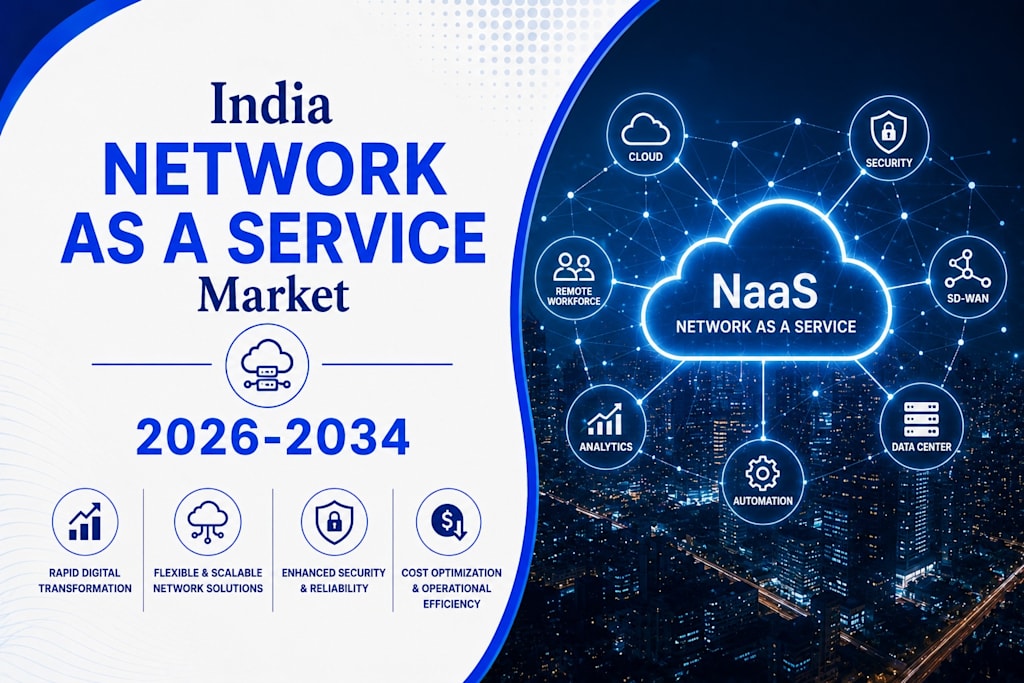
India's Network as a Service Market Is Gaining Strong Momentum
India's network as a service (NaaS) market stands as one of Asia's most rapidly advancing cloud networking segments, anchored by the country's accelerating digital transformation, expanding 5G infrastructure, and rising enterprise demand for subscription-based, cloud-managed connectivity solutions. The market was valued at USD 2.11 Billion in 2025 and is projected to reach USD 16.81 Billion by 2034, growing at a compound annual growth rate (CAGR) of 25.90% during 2026–2034.
The growth is driven by the rapid proliferation of hybrid work models and multi-cloud deployments, government-led broadband connectivity initiatives, and increasing AI integration in network operations enabling enterprises to replace capital-intensive legacy infrastructure with scalable, on-demand networking capabilities.
India's 5G rollout has fundamentally reshaped enterprise connectivity requirements, with telecom service providers installing 4.69 Lakh 5G base transceiver stations nationwide as of February 2025, creating a robust connectivity backbone that accelerates NaaS deployment. The Government of India's Digital India programme and BharatNet initiative are further extending high-speed internet connectivity across urban and rural areas, broadening the enterprise addressable market for cloud-managed networking solutions.
In June 2024, Cisco introduced the Meraki India Region, a dedicated cloud service under its global Meraki platform focused on data privacy and localization, strengthening the SD-WAN and SASE ecosystem domestically. In March 2025, Jio Platforms, together with AMD, Cisco, and Nokia, announced plans to build an Open Telecom AI Platform at Mobile World Congress 2025, aimed at driving AI-powered autonomous network operations and intelligent automation for telecom operators globally.
Market Snapshot
• Market Size (2025): USD 2.11 Billion
• Forecast Value (2034): USD 16.81 Billion
• CAGR (2026–2034): 25.90%
• Leading Type: WAN-as-a-Service (70% share)
• Leading Application: Cloud-based Services (28% share)
• Leading End Use Industry: IT and Telecom (24% share)
• Leading Region: North India (30% share)
• Segments Covered: LAN-as-a-Service and WAN-as-a-Service; Cloud-based Services, Bandwidth on Demand, Integrated Network Security-as-a-Service, Wide Area Network, and Virtual Private Network applications; serving Healthcare, BFSI, Retail and E-Commerce, IT and Telecom, Manufacturing, Transportation and Logistics, and Public Sector industries across North India, West and Central India, South India, and East and Northeast India
Why Is the India Network as a Service Market Growing?
• Accelerating Digital Transformation and Cloud Adoption Across Enterprises:
India's enterprise landscape is undergoing a profound digital shift, with organizations across industries prioritizing cloud migration, AI integration, and data-driven operations as core strategic imperatives. This transition is creating strong demand for flexible, subscription-based networking models that eliminate the expense and complexity of maintaining conventional hardware infrastructure. Cloud-managed NaaS platforms offering application-aware routing, centralized policy enforcement, and on-demand scalability are increasingly replacing legacy MPLS and VPN configurations. India's IT spending is projected to reach USD 161.5 Billion in 2025, reflecting an 11.1% year-on-year increase driven by investments in cloud computing, cybersecurity, and AI. As hybrid and multi-cloud strategies gain traction, agile networking solutions that seamlessly connect public and private cloud platforms with on-premises environments are becoming an enterprise imperative.
• Government-Led Connectivity Initiatives and 5G Infrastructure Expansion:
Government-led initiatives such as Digital India and BharatNet are extending high-speed internet connectivity across urban and rural areas, establishing a future-ready network foundation that underpins enterprise NaaS adoption. As 5G deployment accelerates, businesses require flexible network architectures to support edge computing, IoT deployments, ultra-low latency applications, and real-time data processing — capabilities accessible through NaaS without significant upfront hardware investment. Telecom operators are simultaneously leveraging NaaS to monetize 5G infrastructure through network slicing and enterprise-grade connectivity offerings, creating aligned incentives for further market expansion. With telecom service providers having installed 4.69 Lakh 5G base transceiver stations nationwide as of February 2025, the connectivity backbone essential for scalable NaaS deployment is firmly in place.
What Are the Latest Emerging Trends in India's Network as a Service Market?
• Convergence of SD-WAN and SASE Frameworks:
Indian enterprises are increasingly converging SD-WAN with Secure Access Service Edge (SASE) architectures to unify networking and security under a single cloud-delivered framework. This convergence simplifies branch connectivity, reduces latency for cloud applications, and strengthens zero-trust enforcement across distributed environments. The adoption of integrated SD-WAN and SASE solutions is accelerating NaaS adoption, as organizations prioritize simplified, secure connectivity across hybrid work environments. Cisco's launch of the dedicated Meraki India Region in June 2024, focused on data privacy and localization, exemplifies the growing commitment of global technology vendors to building India-specific cloud networking infrastructure.
• Rising Adoption of AI-Driven Network Operations:
AI is reshaping network management in India, as enterprises adopt AI-powered tools for predictive maintenance, anomaly detection, and automated traffic optimization. AI-driven networking reduces operational costs and improves uptime by enabling self-healing networks that proactively address performance issues. The announcement of the Open Telecom AI Platform by Jio Platforms in partnership with AMD, Cisco, and Nokia at Mobile World Congress 2025 reflects the growing emphasis on embedding intelligence into network infrastructure at scale. AI-driven network automation, SASE, and SD-WAN are converging in IT and telecom operations, reinforcing the sector's leadership in NaaS adoption.
• Expansion of Edge Computing and Private 5G Networks:
Edge computing is gaining prominence across Indian industries, with localized processing capabilities deployed to support latency-sensitive applications including telemedicine, real-time analytics, and Industrial IoT. India's edge data center capacity is projected to triple from 60–70 MW in 2024 to 200–210 MW by 2027, driven by the proliferation of emerging technologies. The expansion of private 5G networks in manufacturing and logistics is further amplifying demand for edge-optimized NaaS solutions, with hospitals and smart factories leveraging edge appliances to ensure real-time data synchronization with cloud systems.
What Opportunities Lie Ahead for India's Network as a Service Market?
India's NaaS market is poised for sustained and accelerated growth through 2034, supported by deepening cloud adoption, expanding 5G infrastructure, rising enterprise demand for software-defined connectivity, and India's broadband subscriber base having exceeded 1 Billion in November 2025. The market is projected to reach USD 16.81 Billion by 2034, driven by government digital infrastructure investments, growing domestic manufacturing by hyperscalers, and the proliferation of hybrid work and multi-cloud strategies across enterprise, BFSI, and public sector verticals.
Companies and investors that develop AI-powered, cloud-native NaaS platforms with integrated SD-WAN and SASE capabilities, build partnerships with telecom operators to leverage 5G network slicing opportunities, design cost-efficient subscription models for mid-sized enterprises across tier-2 and tier-3 cities, and forge integrations with India's expanding edge computing and private 5G ecosystems are well-positioned to outperform in India's rapidly evolving network as a service landscape through 2034.
How Is India's Network as a Service Market Segmented?
Type Insights:
• LAN-as-a-Service
• WAN-as-a-Service
WAN-as-a-service dominates the market with a 70% share in 2025, underpinned by rapid enterprise migration from traditional MPLS-based wide area networks to cloud-managed, software-defined connectivity. Enterprises in banking, manufacturing, and IT are implementing WAN-as-a-service for application-aware routing, centralized policy management, and seamless multi-cloud access while reducing operating costs. The growth of hybrid work environments, rising dependence on SaaS applications, and the need to incorporate zero-trust security frameworks further solidify segment leadership.
Application Insights:
• Cloud-based Services
• Bandwidth on Demand
• Integrated Network Security-as-a-Service
• Wide Area Network
• Virtual Private Network
Cloud-based services lead with a 28% share in 2025, driven by the mass migration of enterprise workloads to public and hybrid cloud environments. India's public cloud market was valued at USD 27.38 Billion in 2024, reflecting the accelerating adoption that directly fuels demand for cloud-integrated NaaS offerings. Enterprises in BFSI, healthcare, and retail are prioritizing cloud-based NaaS to ensure low-latency access to mission-critical applications while maintaining consistent security standards across dispersed cloud environments.
End Use Industry Insights:
• IT and Telecom
• BFSI
• Healthcare
• Retail and E-Commerce
• Manufacturing
• Transportation and Logistics
• Public Sector
IT and telecom lead with a 24% share in 2025, reflecting the sector's fundamental requirement for robust, scalable, and automated networking infrastructure to support digital service delivery and distributed operations. Telecom operators are leveraging NaaS to monetize 5G infrastructure through network slicing, while IT service providers adopt subscription-based models to optimize cloud-native application access and manage distributed workforce connectivity.
Region Insights:
• North India
• West and Central India
• South India
• East and Northeast India
North India represents the largest region with a 30% share in 2025, anchored by the concentration of government establishments, IT parks, and corporate headquarters in NCR, Noida, and Gurgaon. Expanding fiber connectivity, 5G rollout in major cities, smart city projects, and e-governance initiatives across Delhi, Uttar Pradesh, and Rajasthan are driving strong public and private sector demand for cloud-managed networking. In March 2025, Neon Cloud commenced operations in India with a data center in Gurgaon, further reinforcing the region's infrastructure leadership.
India Network as a Service Market Key Players
The report offers an in-depth examination of the competitive landscape, including market structure, key player positioning, leading strategies for success, a competitive dashboard, and a company evaluation quadrant. Key players are driving the market by expanding cloud-managed networking portfolios, enhancing SD-WAN and SASE capabilities, forming strategic partnerships with hyperscalers, and investing in AI-driven network automation to strengthen market share and accelerate enterprise adoption.
India Network as a Service Market Recent Developments
March 2025: Jio Platforms, together with AMD, Cisco, and Nokia, announced plans to build an Open Telecom AI Platform at Mobile World Congress 2025, aimed at driving AI-powered autonomous network operations and intelligent automation for telecom operators globally.
March 2025: Neon Cloud commenced operations in India with a data center in Gurgaon, offering block storage, object storage, secure backups, virtual private cloud, cloud firewall, and load balancing services.
Frequently Asked Questions
• How big is the India network as a service market?
The India network as a service market was valued at USD 2.11 Billion in 2025.
• What is the projected growth rate of the India network as a service market?
The market is expected to grow at a CAGR of 25.90% from 2026–2034 to reach USD 16.81 Billion by 2034, driven by accelerating cloud adoption, 5G infrastructure expansion, government-led connectivity initiatives, and rising enterprise demand for scalable, software-defined networking solutions.
• Which type holds the largest share of the India network as a service market?
WAN-as-a-service leads the type segment with a 70% share in 2025, driven by enterprise migration from MPLS networks to cloud-managed SD-WAN solutions, subscription-based pricing accessibility for mid-sized businesses, and the growing requirement for zero-trust wide area connectivity across hybrid work environments.
• What are the key factors driving market growth?
Key drivers include accelerating enterprise digital transformation and multi-cloud adoption creating demand for flexible NaaS platforms; government-led 5G and broadband connectivity initiatives expanding the network foundation for NaaS deployment; rising enterprise demand for cost-efficient, operational expenditure-based networking models replacing capital-heavy legacy infrastructure; the convergence of SD-WAN and SASE frameworks simplifying cloud-delivered security and connectivity; and expanding edge computing and private 5G adoption creating new NaaS integration opportunities across manufacturing, healthcare, and logistics.
• What are the major challenges facing the India network as a service market?
Major challenges include data security and privacy concerns in multi-cloud environments creating hesitation among risk-averse enterprises in banking, healthcare, and government; a shortage of skilled networking professionals capable of managing advanced SD-WAN, SASE, and AI-driven network solutions; legacy infrastructure integration complexity and high migration costs for enterprises operating traditional MPLS and hardware-based network architectures; interoperability challenges between legacy systems and modern NaaS platforms slowing adoption in certain verticals; and evolving data localization mandates increasing compliance complexity for organizations outsourcing network control to third-party cloud providers.
Source: IMARC Group
About the Creator
chetan kalyan
Market research specialist focused on consumer behavior, industry trends, and strategic insights. Passionate about helping businesses make informed decisions through data analysis and research-driven solutions.
Enjoyed the story? Support the Creator.
Subscribe for free to receive all their stories in your feed.
Comments
There are no comments for this story
Be the first to respond and start the conversation.