
India Hypermarket Market Set for Strong Growth as Urban Consumers Embrace One-Stop Shopping
Organized Retail Expands Across India with Rising Incomes, Better Infrastructure, and Lifestyle Changes

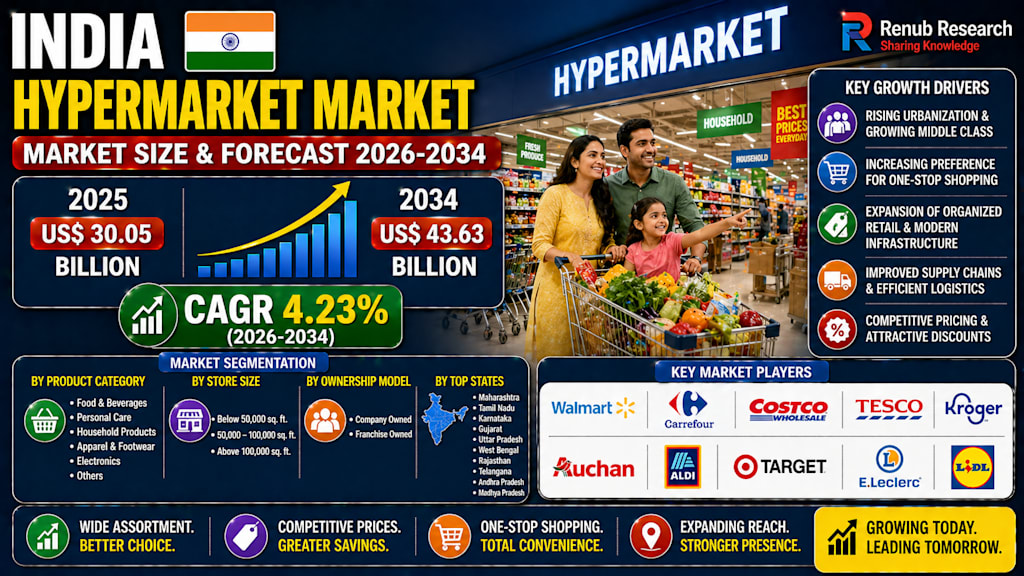
India’s retail landscape is undergoing a powerful transformation, and hypermarkets are emerging as one of the biggest beneficiaries of this shift. Once considered a format mainly popular in global markets, hypermarkets are now steadily becoming part of India’s evolving shopping culture. With urbanization accelerating, middle-class incomes rising, and consumers demanding convenience, these large-format stores are attracting shoppers looking for value, variety, and a modern retail experience.
According to Renub Research, the India Hypermarket Market is projected to rise from US$ 30.05 Billion in 2025 to US$ 43.63 Billion by 2034, growing at a CAGR of 4.23% during 2026–2034. This steady growth reflects a structural shift in consumer behavior as more Indians prefer organized retail over fragmented traditional shopping channels.
Hypermarkets combine the best features of supermarkets and department stores under one roof. From groceries and electronics to apparel, household products, and personal care items, they offer shoppers the convenience of buying everything in one trip. As India’s cities expand and lifestyles become busier, this model is becoming increasingly relevant.

Why Hypermarkets Are Gaining Popularity in India
Indian consumers are no longer shopping solely based on proximity. Increasingly, they are making decisions based on convenience, product range, pricing transparency, hygiene, and quality assurance. Hypermarkets meet all these needs.
Unlike small neighborhood stores, hypermarkets provide spacious layouts, self-service shopping, promotions, and access to branded as well as private-label products. For families, they have also become weekend shopping destinations where convenience meets entertainment.
The demand is particularly strong among middle-income households, working professionals, and younger consumers who value efficiency. Many shoppers prefer buying monthly household supplies in bulk, making hypermarkets a practical option.
At the same time, improved roads, better public transport, mall development, and expanding commercial zones have made these stores more accessible than ever before.
Urbanization Is Changing Shopping Habits
India’s urban population continues to grow rapidly, and this is one of the strongest growth drivers for the hypermarket industry. As cities become more crowded and fast-paced, consumers seek organized spaces where shopping can be completed quickly and efficiently.
Nuclear families and dual-income households especially appreciate one-stop retail models. Rather than visiting multiple small shops for groceries, clothing, and home products, consumers can complete purchases in a single visit.
Modern hypermarkets also offer features that traditional formats often lack, such as parking facilities, digital billing systems, product variety, clean store environments, and longer operating hours. These factors are turning hypermarkets into preferred retail destinations in metro and tier-II cities alike.
Rising Incomes Boost Consumer Spending
India’s growing middle class is another major reason behind the market’s expansion. As disposable incomes rise, consumers are spending more on branded foods, packaged goods, electronics, home appliances, and lifestyle products.
Renub Research notes that India’s per capita disposable income increased from US$ 2.11 thousand in 2019 to US$ 2.54 thousand in 2023, and it is expected to reach US$ 4.34 thousand by 2029. This increase in purchasing power is helping consumers move beyond essential spending toward aspirational consumption.
Hypermarkets are well-positioned to benefit because they offer value pricing, discounts, loyalty programs, and bulk-buy deals. This appeals to both price-sensitive shoppers and aspirational consumers looking for quality products at better prices.
Organized Retail and Better Supply Chains Support Growth
The transition from unorganized retail to organized formats is strengthening the hypermarket sector. Modern warehousing, cold chains, centralized sourcing, and digital inventory systems allow hypermarkets to manage operations efficiently.
These improvements are especially important for food and grocery categories, where freshness and stock availability matter most. Better supply chains also reduce waste, improve consistency, and allow retailers to offer competitive prices.
Private sector investments and retail infrastructure growth are adding momentum. In September 2023, Lulu Group International launched its first hypermarket and one of the largest malls in Hyderabad, signaling strong confidence in India’s long-term retail opportunity.
Food and Grocery Remains the Backbone
Among all product categories, food and grocery remains the largest contributor to hypermarket revenue in India. Daily essentials create recurring footfall, making this segment critical for store profitability.
Consumers increasingly prefer buying packaged foods, fresh produce, cleaning products, and household necessities from organized stores due to better hygiene standards and pricing transparency.
The grocery segment also creates cross-selling opportunities. Once shoppers enter for essentials, they often purchase clothing, electronics, beauty products, or kitchenware during the same visit.
Fast Growth in Appliances and Apparel
Home appliances are becoming a strong category as Indian households upgrade lifestyles. Products such as refrigerators, washing machines, mixers, and smart appliances are seeing rising demand.
Hypermarkets often attract customers through financing offers, promotional bundles, and visible product comparisons.
Meanwhile, apparel and accessories continue to perform well in value-driven segments. Many shoppers make impulse clothing purchases while visiting for groceries. Affordable private labels and seasonal collections give hypermarkets an edge in mass-market fashion.
Maharashtra Leads the Market
Among Indian states, Maharashtra stands out as one of the largest hypermarket markets. Cities such as Mumbai, Pune, and Nagpur combine high purchasing power, dense urban populations, and strong retail infrastructure.
Consumers in Maharashtra are highly receptive to modern retail formats offering convenience and wide assortments. Food and grocery dominates, but categories like electronics, apparel, and home goods also perform strongly due to aspirational buying patterns.
Uttar Pradesh and Eastern India Offer Future Potential
Uttar Pradesh presents major long-term growth opportunities because of its large population and expanding tier-II and tier-III cities such as Lucknow, Kanpur, Noida, Ghaziabad, and Varanasi.
As incomes rise and infrastructure improves, organized retail is gaining acceptance. Value pricing and essential goods remain key growth strategies in this market.
Meanwhile, West Bengal is witnessing gradual adoption of hypermarkets in cities like Kolkata, Durgapur, Asansol, and Siliguri. Although traditional neighborhood markets remain strong, younger consumers are shifting toward organized shopping experiences.
Challenges the Industry Must Overcome
Despite strong prospects, the sector faces real challenges.
Traditional kirana stores remain deeply embedded in Indian neighborhoods. Their proximity, flexible credit, and personalized service continue to attract millions of shoppers.
At the same time, e-commerce platforms are intensifying competition through fast delivery, deep discounts, and broad product selections.
Hypermarkets also face high operating costs, including rent, staffing, utilities, logistics, and inventory management. Regulations vary across states, creating compliance complexity for expansion plans.
To succeed, retailers must build omnichannel models that combine physical store advantages with digital convenience.
The Road Ahead
India’s hypermarket market is not just growing—it is evolving. Future winners will likely be chains that balance low prices, customer experience, digital integration, and efficient supply chains.
Retailers that expand into emerging cities, strengthen private-label offerings, and use technology for inventory and loyalty programs are expected to gain the most market share.
As Indian consumers continue shifting toward organized shopping, hypermarkets are positioned to become an even more important part of the nation’s retail ecosystem.
Final Thoughts
India’s hypermarket industry reflects broader economic and social change. Rising incomes, urban lifestyles, and consumer demand for convenience are reshaping how India shops. With the market expected to grow from US$ 30.05 Billion in 2025 to US$ 43.63 Billion by 2034, the future looks promising.
About the Creator
Enjoyed the story? Support the Creator.
Subscribe for free to receive all their stories in your feed.
Comments
There are no comments for this story
Be the first to respond and start the conversation.