
India Biometrics Market Set for Strong Growth as Digital Identity and Security Demands Accelerate
From Aadhaar Expansion to AI-Powered Authentication, Biometrics Is Transforming India's Digital Future

Introduction
India's digital transformation journey is creating unprecedented opportunities for biometric technologies. As government agencies, financial institutions, healthcare providers, and enterprises seek secure and seamless authentication methods, biometric systems have emerged as a cornerstone of modern identity management.
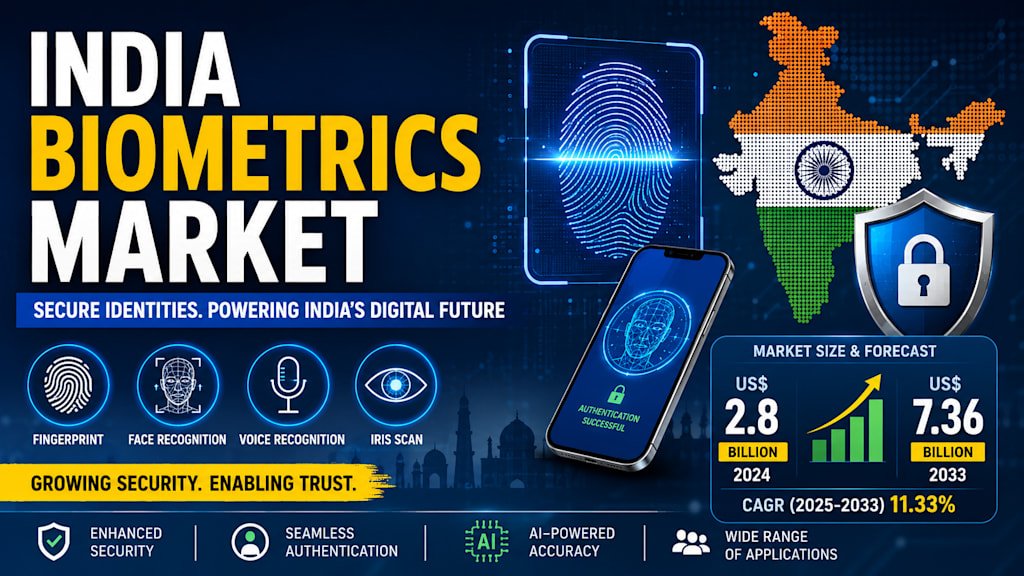
According to Renub Research, the India Biometrics Market is projected to grow from US$ 2.8 Billion in 2024 to US$ 7.36 Billion by 2033, expanding at a CAGR of 11.33% between 2025 and 2033. This remarkable growth reflects the increasing reliance on biometric authentication across public and private sectors.
From unlocking smartphones and accessing banking applications to verifying identities at airports and government facilities, biometrics is becoming an essential part of everyday life. The technology's ability to provide secure, convenient, and accurate identity verification is driving widespread adoption across India.
Understanding Biometrics and Its Growing Importance
Biometrics refers to the identification and authentication of individuals based on unique biological or behavioral characteristics. These characteristics include fingerprints, facial features, iris patterns, voice recognition, and hand geometry.
Unlike passwords or PINs that can be forgotten, stolen, or shared, biometric traits are unique to each individual. This makes biometrics one of the most reliable methods of identity verification available today.
India's rapid digitalization, combined with rising cybersecurity concerns, has accelerated the adoption of biometric solutions. As organizations seek stronger protection against fraud and identity theft, biometric authentication provides a powerful security layer that traditional methods often cannot match.
Aadhaar and Government Initiatives Fuel Market Expansion
One of the most significant drivers of India's biometric market has been the implementation of Aadhaar, the world's largest biometric identification system.
The Aadhaar program has demonstrated the scalability and effectiveness of biometric authentication for large populations. Millions of citizens use Aadhaar-linked biometric verification to access government services, subsidies, banking facilities, and welfare programs.
Government efforts to digitize public services continue to create opportunities for biometric solution providers. Identity verification is becoming increasingly important in areas such as:
Public welfare distribution
Passport verification
Voter identification
Tax administration
Law enforcement
Border security
These initiatives have significantly increased awareness and acceptance of biometric technologies throughout the country.
Rising Security Threats Create Demand for Strong Authentication
Cybercrime and identity fraud are becoming increasingly sophisticated. As digital transactions continue to rise, organizations face growing pressure to secure customer data and financial information.
Traditional security methods such as passwords and one-time passwords (OTPs) have limitations. Passwords can be compromised, while OTP-based systems are vulnerable to phishing attacks and SIM-swapping fraud.
Biometric authentication addresses many of these challenges by requiring unique physical characteristics that are difficult to replicate.
Banks, financial institutions, and fintech companies are increasingly deploying biometric technologies to:
Prevent identity theft
Reduce financial fraud
Secure digital payments
Enhance customer trust
Meet regulatory compliance requirements
As security concerns continue to intensify, biometric solutions are expected to become a standard component of digital security frameworks.
Smartphone Adoption Drives Consumer Biometrics Growth
India is one of the world's largest smartphone markets, and modern devices increasingly include biometric authentication capabilities.
Fingerprint sensors and facial recognition technologies have become standard features in smartphones across multiple price segments. Consumers are now accustomed to using biometrics for:
Device unlocking
Mobile payments
Banking applications
Social media access
Secure app authentication
Popular digital platforms continue integrating biometric security features to improve user privacy and convenience.
The widespread availability of biometric-enabled smartphones is introducing millions of users to the technology, creating favorable conditions for broader adoption across other industries.
Artificial Intelligence Enhances Biometric Accuracy
Artificial Intelligence (AI) and Machine Learning (ML) are significantly improving biometric system performance.
Modern biometric solutions can now process vast amounts of data, recognize patterns more accurately, and reduce authentication errors. AI-powered systems continuously learn and adapt, improving performance over time.
Key benefits include:
Faster identification processes
Enhanced facial recognition accuracy
Better fraud detection capabilities
Improved voice recognition performance
Reduced false acceptance rates
Lower false rejection rates
The integration of AI is enabling biometric systems to operate effectively even in challenging environments, such as poor lighting conditions or noisy surroundings.
Multi-Modal Biometrics Gains Momentum
Organizations increasingly prefer multi-modal biometric systems that combine multiple authentication methods.
Rather than relying on a single biometric identifier, these systems use combinations such as:
Face and fingerprint recognition
Iris and facial authentication
Voice and facial verification
Fingerprint and iris scanning
This approach improves accuracy and security while minimizing authentication failures.
Multi-modal biometrics is particularly valuable in high-security environments where strong identity verification is essential. Government agencies, defense organizations, and financial institutions are among the leading adopters of these advanced solutions.
Banking and Financial Services Lead Adoption
The banking and finance sector represents one of the largest end-users of biometric technologies in India.
As digital banking continues to expand, financial institutions are investing heavily in secure authentication mechanisms. Biometrics offers a convenient and reliable method for verifying customer identities during account access, fund transfers, and digital transactions.
Applications include:
Customer onboarding
Know Your Customer (KYC) verification
ATM authentication
Mobile banking security
Digital payment authorization
Biometric authentication helps reduce fraud while improving the customer experience, making it an attractive solution for financial institutions.
Healthcare Sector Embraces Biometric Solutions
India's healthcare industry is increasingly adopting biometric technologies to improve patient identification and administrative efficiency.
Accurate patient identification is critical for ensuring proper treatment and reducing medical errors. Biometric systems help healthcare providers maintain accurate records while protecting sensitive patient information.
Healthcare applications include:
Patient registration
Medical record access
Staff attendance tracking
Prescription verification
Hospital access control
As healthcare digitization advances, biometric adoption is expected to grow significantly across hospitals and healthcare facilities.
Transportation and Travel Applications Expand
Biometric technologies are transforming the transportation and travel sectors by streamlining identity verification processes.
Airports, railway stations, and border checkpoints are increasingly deploying biometric systems to improve efficiency and enhance security.
Benefits include:
Faster passenger processing
Reduced waiting times
Enhanced security screening
Contactless verification experiences
Improved operational efficiency
As India's transportation infrastructure modernizes, biometrics will likely play an increasingly important role in passenger management systems.
Market Challenges Remain
Despite strong growth prospects, the India biometrics market faces several challenges.
Privacy and Data Protection Concerns
Biometric data is highly sensitive because it is directly linked to an individual's identity. Concerns regarding data collection, storage, and usage continue to influence public perception.
Unauthorized access to biometric databases could potentially lead to identity theft and privacy violations. Therefore, organizations must implement robust security measures, encryption technologies, and transparent data governance policies.
Accuracy and Reliability Issues
Environmental conditions and physical factors can affect biometric system performance.
Fingerprint recognition may encounter difficulties with damaged fingerprints, while facial recognition systems can be influenced by lighting conditions or changes in appearance.
False positives and false negatives remain concerns for some applications, emphasizing the need for continuous technological improvements and system optimization.
Market Segmentation Overview
By Technology
Face Recognition
Fingerprint Recognition
Voice Recognition
Hand Geometry
Iris Recognition
Others
By Functionality
Non-Contact
Contact
Combined
By Component
Hardware
Software
By End User
Government
Defense Services
Banking and Finance
Consumer Electronics
Healthcare
Commercial Safety and Security
Transport, Visa, and Logistics
Others
Among these segments, fingerprint recognition continues to maintain a strong position due to affordability and widespread adoption. However, facial recognition is rapidly gaining popularity because of its convenience and contactless capabilities.
Competitive Landscape
The Indian biometrics market is highly competitive, with both domestic and international players investing in innovation and expansion.
Major market participants include:
IDEMIA
SecuGen India Pvt. Ltd.
NEC Technologies India Pvt. Ltd.
4G Identity Solutions Pvt. Ltd.
HID Corporation
eSSL Security
3M India Ltd.
Honeywell International Inc.
These companies continue to focus on research and development, strategic partnerships, and advanced biometric solutions to strengthen their market positions.
10 Recent Developments in the Biometrics Industry
1. IDEMIA Expanded Digital Identity Solutions
The company continued strengthening its biometric identity and border management offerings through AI-powered verification technologies.
2. NEC Advanced Facial Recognition Systems
NEC enhanced its facial recognition capabilities, improving identification accuracy and security performance.
3. HID Increased Focus on Mobile Credentials
The company expanded biometric-enabled access control solutions integrated with mobile identity technologies.
4. Honeywell Enhanced Security Platforms
Honeywell continued investing in advanced security infrastructure incorporating biometric authentication capabilities.
5. eSSL Expanded Workforce Management Solutions
The company strengthened its biometric attendance and workforce management product portfolio.
6. SecuGen Improved Fingerprint Recognition Technologies
SecuGen introduced enhancements focused on faster authentication and greater accuracy.
7. Growing Adoption of Contactless Biometrics
Organizations accelerated implementation of contactless biometric solutions following increased demand for hygienic authentication methods.
8. AI Integration Across Biometric Platforms
Industry leaders increasingly integrated artificial intelligence to improve recognition accuracy and fraud detection.
9. Multi-Modal Authentication Expansion
Vendors expanded solutions combining fingerprint, facial recognition, and iris scanning technologies.
10. Increased Investment in Cloud-Based Biometrics
Companies introduced cloud-enabled biometric platforms designed to support large-scale deployments and remote authentication.
Future Outlook
The future of India's biometrics market appears exceptionally promising. Growing digitalization, increasing cybersecurity concerns, expanding smartphone penetration, and supportive government initiatives will continue driving adoption.
Emerging technologies such as artificial intelligence, machine learning, and cloud computing are expected to make biometric systems more intelligent, scalable, and secure.
As businesses and government organizations seek stronger identity verification solutions, biometrics will remain central to India's digital transformation strategy.
Final Thoughts
India's biometrics market is entering a period of sustained expansion fueled by technological innovation, security requirements, and the country's rapidly evolving digital economy. With the market forecast to grow from US$ 2.8 billion in 2024 to US$ 7.36 billion by 2033, opportunities for technology providers, investors, and end-users continue to expand.
From government programs and banking applications to healthcare services and consumer electronics, biometric technologies are reshaping how identities are verified and protected. As accuracy improves and privacy frameworks mature, biometrics is poised to become one of the most influential technologies powering India's secure digital future.
About the Creator
Enjoyed the story? Support the Creator.
Subscribe for free to receive all their stories in your feed.
Comments
There are no comments for this story
Be the first to respond and start the conversation.