
In-Mold Labels Market Strengthens with Investments in Automation
How advancements in printing technologies, automation systems, and smart manufacturing practices are transforming production capabilities within the in-mold labels market

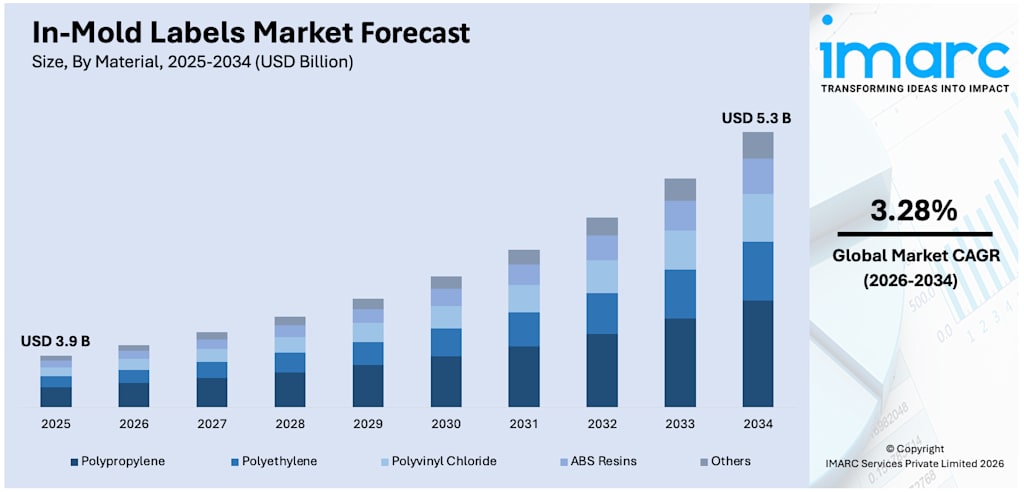
The rising demand for aesthetically appealing packaging, increasing focus on product presentation, and the growing consumer preference for sustainable packaging are driving in-mold labels demand, supported by clean-label trends, product innovation, and expanding retail and online distribution channels. According to IMARC Group’s latest data, The global in-mold labels market size was valued at USD 3.9 Billion in 2025. Looking forward, IMARC Group estimates the market to reach USD 5.3 Billion by 2034, exhibiting a CAGR of 3.28% from 2026-2034.
In-mold labels now represent a multi-billion-dollar global market exceeding USD 3.9 billion and exhibiting steady year-on-year expansion. Demand is driven by rising health consciousness, busy lifestyles that favour on-the-go nutrition, and increased interest in plant-based, low-sugar and clean-label products. Retail innovation and e-commerce, private-label launches, and product reformulation for protein, fiber and functional ingredients are further accelerating uptake. Major segments include fruit, nut and seed snacks, protein bars, baked/roasted savory options and ready-to-eat refrigerated items, with consumers prioritizing portability, transparent labeling and specific dietary claims.
In-Mold Labels Market Growth Drivers:
- Rising Demand for Sustainable Packaging
Environmental sustainability has become a primary focus across the packaging landscape, driving companies away from standard adhesive decals toward more eco-friendly alternatives. In-mold labeling addresses this regulatory and consumer pressure by eliminating the traditional release liner films entirely, directly reducing the volume of production scrap. Because the label material matches the underlying container substrate, often polypropylene, the finished product can be placed directly into standard recycling systems as a single, homogenous piece. This direct recyclability helps global manufacturers optimize material usage, fulfill municipal circular economy mandates, and curb raw resource consumption.
- Rising Need for High-Impact Brand Differentiation
Fast-moving consumer goods sectors face intense shelf-space competition, leading brand managers to prioritize high-definition, photorealistic container imagery to win consumer attention. In-mold labeling techniques embed graphics directly into the container walls during the manufacturing process, preventing the peeling, warping, or bubbling commonly associated with pressure-sensitive labels. This seamless integration ensures the brand's layout remains pristine despite rough freight handling or long-distance logistics. Providing high visual precision allows enterprises to showcase elaborate artwork and bold color palettes that convey premium value, establishing clear differentiation on crowded retail shelves.
Download Expert Insights on the "In-Mold Labels Market" Today
- Superior Product Durability and Environmental Resistance
Industrial, personal care, and grocery products frequently endure challenging environments, ranging from cold chain storage freezers to humid, damp bathrooms and chemical exposures. Traditional adhesive-backed stickers routinely peel or smudge under high humidity or when coming into contact with spilled oils and harsh ingredients. In-mold labels resolve this issue by fusing permanently with the hot plastic container as it cools, forming a durable, unified bond. This robust structural integration preserves barcode readability, consumer safety disclosures, and overall package integrity throughout the entire lifespan of the consumer good.
In-Mold Labels Market Trends:
- Acceleration of Advanced 3D and Flexible Film Technologies
The packaging manufacturing sector is heavily adopting specialized 3D in-mold labeling configurations alongside advanced polymer films to accommodate complex, deeply contoured container designs. Modern film reformulations provide superior formability, allowing the decorative layer to stretch deeply into custom molds without suffering visual distortion or tearing along acute edges. This technical capability permits engineers to utilize elaborate structural shapes and texturized finishes on premium consumer packaging. By minimizing defects during high-speed molding cycles, these technological enhancements allow industrial plants to achieve tighter manufacturing tolerances and expand design flexibility.
- Dominance of Injection-Molded Formats in High-Volume Sectors
The injection molding production process remains the leading format for structural label applications, particularly in creating rigid plastic tubs, buckets, and personal care containers. This production system delivers excellent placement consistency, injecting hot resin directly against the positioned film to secure a flawless, tamper-evident outer layer. Industrial facilities rely heavily on automated injection machinery to handle immense production runs with minimal human intervention, maximizing hourly output. This operational predictability makes the technology highly appealing for high-volume consumer goods, dairy spreads, and commercial paint containers where consistency is mandatory.
- Widespread Adoption of Polypropylene Raw Materials
Polypropylene has established itself as the dominant raw material across the labeling industry due to its intrinsic cost-effectiveness and versatile chemical properties. This specific polymer matches the structural base of the vast majority of rigid consumer packaging, which ensures a perfect physical fusion during the thermal molding process. Its balance of stiffness, moisture defense, and heat resistance prevents structural degradation when exposed to intense molding temperatures. Choosing this material allows manufacturers to streamline raw inventory supply chains, control baseline production expenses, and supply high-quality, lightweight packaging options.
Recent News and Developments in In-Mold Labels Market
- August 2025: A major regional labeling converter announced a massive equipment expansion across its primary manufacturing plants, installing high-speed automation systems to fulfill escalating corporate orders for structural, linerless in-mold label configurations.
- September 2025: A global plastics manufacturer successfully deployed a new line of ultra-thin polypropylene labeling films designed specifically to lower overall carbon footprints while maintaining high-definition graphical performance during long molding cycles.
- September 2025: A global plastics manufacturer successfully deployed a new line of ultra-thin polypropylene labeling films designed specifically to lower overall carbon footprints while maintaining high-definition graphical performance during long molding cycles.
Note: If you require specific details, data, or insights that are not currently included in the scope of this report, we are happy to accommodate your request. As part of our customization service, we will gather and provide the additional information you need, tailored to your specific requirements. Please let us know your exact needs, and we will ensure the report is updated accordingly to meet your expectations.
About the Creator
Andrew Sullivan
Hello, I’m Andrew Sullivan. I have over 9+ years of experience as a market research specialist.
Enjoyed the story? Support the Creator.
Subscribe for free to receive all their stories in your feed.
Comments
There are no comments for this story
Be the first to respond and start the conversation.