
In-app Advertising Market Witnesses Strong Growth with AI Tools
How AI-driven targeting, personalized campaigns, and rising smartphone usage are transforming engagement strategies and revenue generation in the in-app advertising market

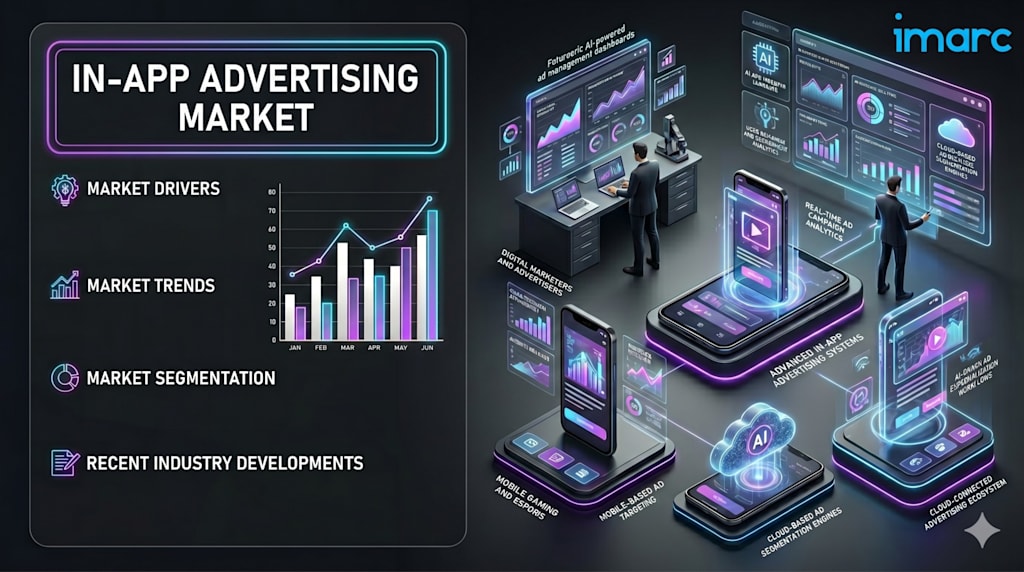
According to IMARC Group's latest research publication, The global in-app advertising market size was valued at USD 222.8 Billion in 2025. Looking forward, IMARC Group estimates the market to reach USD 836.7 Billion by 2034, exhibiting a CAGR of 15.84% from 2026-2034.
How In-App Advertising is Reshaping the Future of Digital Marketing
- AI-Powered Personalization at Scale: Artificial intelligence and machine learning are fundamentally transforming how brands connect with mobile users. Advertisers can now access granular user data including demographics, behavioral patterns, location signals, and real-time interaction history to deliver hyper-personalized ad experiences. Industry data shows that 8 out of 10 marketers report measurable improvements in brand awareness when running in-app campaigns, underscoring the commercial impact of precision targeting over traditional broadcast models.
- Platforms like Google AdMob and Meta Audience Network have moved well beyond basic interest targeting, deploying neural network-based bidding systems that continuously optimize campaign performance in real time without human intervention.
- AI-driven creative optimization tools now automatically test hundreds of ad variations simultaneously, identifying the highest-converting copy, visuals, and call-to-action formats for specific user cohorts within hours rather than weeks.
- This intelligence layer is particularly valuable for mobile gaming and entertainment categories, where user attention is intensely competitive and ad fatigue sets in rapidly without personalization-driven relevance.
- Programmatic Advertising and Automated Media Buying: The shift from manual ad placements to fully automated, real-time programmatic ecosystems has dramatically increased market efficiency and spend accountability. Programmatic advertising accounted for 81.9% of total digital advertising expenditure in the United States alone, establishing it as the operational backbone of modern in-app advertising infrastructure.
In-App Advertising Industry Overview
The in-app advertising sector sits at the intersection of mobile technology, data science, and consumer behavior, making it one of the most structurally dynamic segments within the global digital media industry. The market is fundamentally shaped by three interlocking forces: the continuous expansion of smartphone ownership across emerging markets, the growing sophistication of mobile applications as daily utility platforms, and the increasing willingness of brands to shift advertising budgets from traditional media channels toward performance-measurable mobile channels.
Asia Pacific commands the dominant regional position, holding a market share of over 37.6%, driven by China, India, and Southeast Asian markets where mobile-first internet adoption has bypassed desktop computing as the primary digital access point for hundreds of millions of consumers. Countries across the region are witnessing rapid deployment of 5G networks, with GSMA projecting that the Asia Pacific mobile economy will surpass USD 1 Trillion in contribution by the end of the decade, creating a structural acceleration effect for mobile advertising investment.
North America, despite being a more mature market, continues to innovate at the infrastructure level, with the United States leading global adoption of AI-driven ad targeting, programmatic automation, and cross-platform measurement frameworks. Media consumption by U.S. adults reached approximately 666 minutes per day, with a significant and growing share of that time spent within mobile applications, giving advertisers a scale and frequency of consumer access that no other channel can replicate.
Europe is experiencing accelerating demand as well, with the European Commission reporting household internet penetration at 94% across the EU, and markets like the Netherlands and Luxembourg reaching 99% connectivity. This near-universal access, combined with rising mobile app usage for commerce, entertainment, and social interaction, is generating a larger and more engaged audience base for in-app advertisers across the continent.
Latin America presents a compelling growth frontier, where mobile technologies and services collectively represented 8% of GDP and generated USD 520 Billion in economic value according to GSMA data. The rapid rollout of 4G and emerging 5G infrastructure across Brazil, Mexico, and Colombia is enabling richer, more interactive ad formats that were previously unavailable at scale across the region.
In-App Advertising Market Trends and Drivers
The explosive adoption of messaging applications as primary communication platforms is generating significant advertising opportunity within one of mobile users' most frequently accessed app categories. Messaging currently leads all application segments in in-app advertising activity, as platforms provide advertisers with a uniquely personal and high-engagement context for reaching consumers with sponsored content, branded stickers, and interactive promotional formats.
Gaming applications represent another high-value vertical, with the global mobile gaming audience continuing to expand across all age demographics. The model of rewarded advertising, where users voluntarily engage with ads in exchange for in-game benefits, has created a consent-based advertising environment that delivers exceptional completion rates and positive brand sentiment, making it one of the most effective formats available to performance marketers.
The rise of cloud kitchen and delivery-centric food service operators is generating new in-app advertising demand from restaurant and FMCG brands targeting meal-occasion moments. Mobile food delivery platforms and quick-service restaurant apps serve as high-intent advertising environments where brands can reach consumers at the precise moment of purchase decision, driving both awareness and direct transactional outcomes within a single app session.
Retail media networks built on top of major e-commerce applications are emerging as powerful new in-app advertising channels, allowing consumer goods brands to advertise directly within shopping apps at the point of consideration and purchase. This convergence of advertising and commerce within a single app environment is compressing the traditional marketing funnel and enabling more direct attribution of advertising spend to actual sales outcomes.
Leading Companies Operating in the Global In-App Advertising Industry
- Amobee Inc. (Singapore Telecommunications Limited)
- Apple Inc.
- BYYD Inc.
- Chartboost Inc.
- Facebook Inc.
- Flurry Inc. (Verizon Media)
- Google AdMob (Google Inc.)
- InMobi (InMobi Pte Ltd.)
- MoPub Inc. (Twitter)
- One by AOL (AOL)
- Tapjoy Inc.
- Tune Inc.
In-App Advertising Market Report Segmentation
By Advertising Type:
- Banner Ads
- Interstitial Ads
- Rich Media Ads
- Video Ads
- Others
Banner ads lead the market with approximately 38.7% of market share, owing to their cost-effectiveness and ease of integration across diverse app environments.
By Platform:
- Android
- iOS
- Others
Android dominates with around 67.8% of market share, reflecting its extensive global device footprint and open-source flexibility that allows advertisers to implement diverse targeting and format configurations.
By Application:
- Messaging
- Entertainment
- Gaming
- Online Shopping
- Payment and Ticketing
- Others
Messaging leads across application segments, offering advertisers access to highly engaged users in a personal, high-frequency communication context.
Regional Insights:
- North America (United States, Canada)
- Asia Pacific (China, Japan, India, South Korea, Australia, Indonesia, Others)
- Europe (Germany, France, United Kingdom, Italy, Spain, Russia, Others)
- Latin America (Brazil, Mexico, Others)
- Middle East and Africa
Asia Pacific exhibits the strongest regional dominance with over 37.6% of global market share, driven by massive population scale, rapid mobile infrastructure upgrades, and a mobile-first consumer culture across its largest economies.
Recent News and Developments in the In-App Advertising Market
- January 2025: T-Mobile officially signed a definitive agreement to acquire Vistar Media, a leading technology solutions provider for digital-out-of-home advertising. The deal signals growing strategic convergence between mobile carrier infrastructure and advertising technology, positioning T-Mobile to offer brands a more integrated path from mobile in-app to physical location-based advertising.
- November 2024: Meta announced plans to introduce advertising within Threads, its text-based social platform, beginning in early 2025. This expansion enables brands to extend existing Meta ad campaigns into a new in-app environment with minimal additional configuration, broadening the reach of in-app advertising across Meta's interconnected platform ecosystem.
- November 2024: MobileFuse partnered with ID5 to integrate the ID5 identity solution into its targeting infrastructure, enhancing audience targeting precision and campaign efficiency while strengthening compliance with evolving privacy regulations. The collaboration specifically aims to reduce cost-per-acquisition, cost-per-click, and cost-per-thousand impression metrics for advertisers operating across privacy-first environments.
Note: If you require specific details, data, or insights that are not currently included in the scope of this report, we are happy to accommodate your request. As part of our customization service, we will gather and provide the additional information you need, tailored to your specific requirements. Please let us know your exact needs, and we will ensure the report is updated accordingly to meet your expectations.
About the Creator
Abhay Rajput
I am working in market research company that provides market and business research intelligence across the globe.
Enjoyed the story? Support the Creator.
Subscribe for free to receive all their stories in your feed.
Comments
There are no comments for this story
Be the first to respond and start the conversation.