
Image Sensors Market Forecast: 3D Sensing, Edge AI Cameras & Forecast to 2034
How automotive vision systems, real-time analytics, and autonomous technology trends are transforming the global image sensors market outlook worldwide.

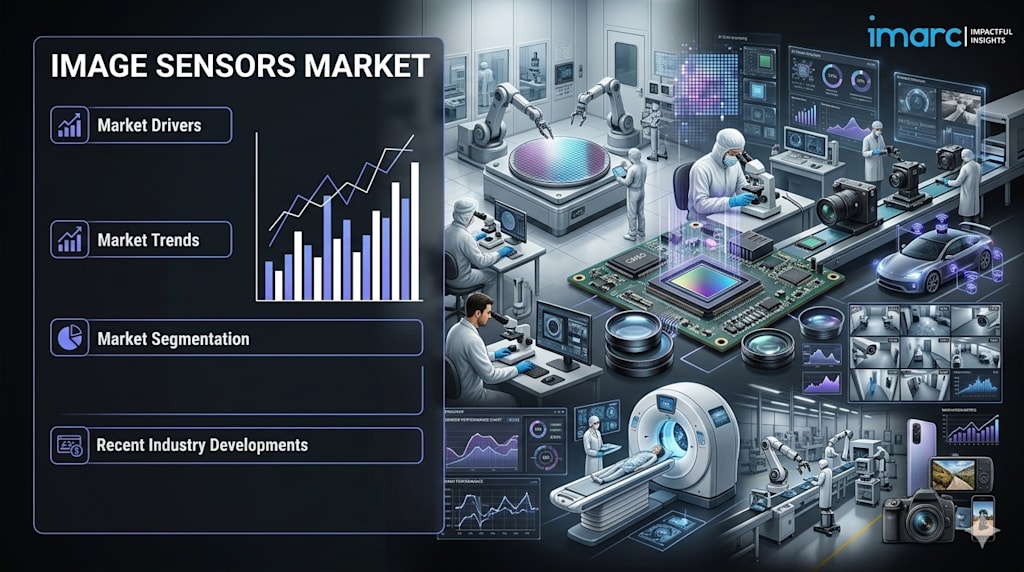
Rising demand for high-resolution imaging, rapid advancements in consumer electronics, and the widespread adoption of autonomous vehicle technologies are driving image sensor demand, supported by machine vision integration, CMOS innovation, and expanding applications across healthcare, security, and industrial sectors. According to IMARC Group's latest data, the global image sensors market size was valued at USD 30.7 Billion in 2025. Looking forward, IMARC Group estimates the market to reach USD 59.2 Billion by 2034, exhibiting a growth rate (CAGR) of 7.36% during 2026-2034. Asia Pacific currently dominates the market, holding a leading share in 2025.
The Image Sensors Market has established itself as a multi-billion-dollar global industry with steady year-on-year expansion. Demand is driven by the rapid proliferation of multi-camera smartphones, increasing automotive safety mandates requiring advanced driver assistance systems, and growing industrial automation under Industry 4.0 frameworks. CMOS technology has emerged as the dominant sensor type due to its energy efficiency and scalability, while 3D image sensors are gaining traction in facial recognition, robotics, and augmented reality. Major segments include consumer electronics, automotive and transportation, healthcare, security and surveillance, and aerospace and defense, with end users prioritizing high resolution, low-light performance, and real-time processing capabilities.
Image Sensors Market Growth Drivers:
Advancements in Consumer Electronics and Smartphone Camera Technology
The relentless consumer demand for superior smartphone photography continues to be a primary growth engine for the Image Sensors Market. Manufacturers consistently push for higher megapixel counts, optical image stabilization, phase detection autofocus, and improved low-light sensitivity. Flagship devices from leading brands now integrate five to six image sensors per unit, substantially increasing per-device sensor consumption. The dominance of CMOS technology in this segment is driven by its compatibility with compact form factors and low power requirements. Major players including Sony Corporation, Samsung Electronics, and OmniVision Technologies invest heavily in pixel miniaturization and stacked sensor architectures to remain competitive, as consumer expectations for imaging performance continue to rise with each product cycle.
Growing Automotive Safety Requirements and Autonomous Vehicle Development
Image sensors are foundational to the development of autonomous vehicles and advanced driver assistance systems (ADAS). Applications including adaptive cruise control, lane departure warning, pedestrian detection, and 360-degree parking assistance all depend on high-resolution, real-time image data. Fully autonomous vehicles require sensors capable of reliable operation across varying lighting conditions such as rain, fog, nighttime, and direct sunlight, driving demand for thermal and infrared sensor variants alongside standard visible-spectrum cameras. Automotive safety regulations in key markets, including mandatory ADAS fitment requirements being phased in across the European Union and the United States, are creating sustained demand floors. This regulatory pressure, combined with ongoing investment from automotive OEMs and technology firms, is accelerating the pace of sensor specification advancement.
Rising Adoption of Machine Vision in Industrial Applications
The global shift toward Industry 4.0 is generating strong and consistent demand for high-speed, precision image sensors across manufacturing, logistics, and quality assurance environments. Machine vision systems rely on image sensors for automated inspection, defect detection, robotic guidance, and real-time production monitoring. These sensors enable millisecond-level decision-making on production lines, directly improving output quality and reducing operational costs. The integration of IoT connectivity into industrial imaging devices is further expanding their role as data collection nodes within smart factory ecosystems. As industries accelerate automation and deploy connected device technologies, image sensors are becoming indispensable to both operational efficiency and predictive maintenance strategies across global manufacturing sectors.
Image Sensors Market Trends:
Dominance of CMOS Technology and the Shift Toward 3D Sensing
CMOS image sensors continue to capture the largest technology share in the market due to their superior energy efficiency, high-speed readout, and broad compatibility across consumer, industrial, and medical applications. The shift toward stacked CMOS architectures is enabling manufacturers to pack greater processing capability into increasingly compact sensor footprints. Simultaneously, 3D image sensors are gaining significant traction across facial recognition systems, augmented reality headsets, autonomous navigation, and precision robotics. Unlike traditional 2D sensors, 3D variants capture depth information in real time, unlocking new application possibilities across sectors. This dual momentum, the entrenchment of CMOS in existing markets and the rise of 3D sensing in emerging ones, is shaping the mid-term growth architecture of the overall Image Sensors Market.
Expansion into Healthcare and Medical Imaging Applications
Healthcare has emerged as a high-value and fast-growing end-use segment within the Image Sensors Market. Flexible and ultra-compact image sensors are increasingly deployed in minimally invasive surgical tools such as endoscopes and laparoscopic cameras, where their small size and low-light sensitivity are critical. Wearable health monitoring devices also incorporate image sensors for continuous vital sign tracking, skin diagnostics, and optical pulse measurement directly from the body surface. The growing preference for precision diagnostics and the global push toward preventive healthcare are reinforcing this demand. OmniVision Technologies, for instance, launched a new medical-grade image sensor series specifically designed for endoscopic applications, emphasizing low-light performance and compact design suited to surgical environments.
Policy Support and Semiconductor Investment Driving Supply Chain Resilience
Government investment programs are reinforcing the structural foundations of the Image Sensors Market by funding domestic semiconductor manufacturing and reducing reliance on concentrated supply chains. The U.S. CHIPS and Science Act committed over USD 52 Billion toward semiconductor manufacturing and research, with advanced image sensor fabrication recognized as an eligible category for federal incentives. The European Chips Act targets doubling Europe's share of global semiconductor output to 20%, encompassing automotive-grade sensor components. In India, the Semicon India Programme with an outlay of approximately INR 76,000 Crore aims to develop domestic semiconductor and display manufacturing infrastructure. Collectively, these policy frameworks are building new regional supply corridors and creating a more resilient and geographically diversified global production base for image sensor components.
Recent News and Developments in the Image Sensors Market
March 2025: Sony Corporation announced a significant capacity expansion at its Kumamoto, Japan image sensor production facility, targeting higher output volumes of stacked CMOS sensors to meet surging demand from automotive and industrial customers globally.
January 2025: Samsung Electronics unveiled its latest 200-megapixel ISOCELL image sensor series featuring advanced multi-frame AI-integrated processing, designed for next-generation flagship smartphones across North American and European markets.
November 2024: OmniVision Technologies launched a new line of medical-grade image sensors purpose-built for minimally invasive endoscopic and surgical procedures, with emphasis on ultra-compact dimensions and enhanced low-light imaging performance.
September 2024: STMicroelectronics announced a collaboration with a major European automotive manufacturer to co-develop CMOS image sensors compliant with ISO 26262 functional safety standards, targeting Level 3 autonomous driving system integration.
June 2024: The U.S. Department of Commerce expanded eligibility criteria under the CHIPS Act incentive program to explicitly include advanced image sensor manufacturing as a qualifying category for federal grant applications, broadening access for domestic sensor producers.
Note: If you require specific details, data, or insights that are not currently included in the scope of this report, we are happy to accommodate your request. As part of our customization service, we will gather and provide the additional information you need, tailored to your specific requirements. Please let us know your exact needs, and we will ensure the report is updated accordingly to meet your expectations.
About the Creator
Suhaira Yusuf
I specialize in Consumer Insights, focusing on transforming detailed market data into strategic business solutions that accelerate growth and improve customer engagement.
Enjoyed the story? Support the Creator.
Subscribe for free to receive all their stories in your feed.
Comments
There are no comments for this story
Be the first to respond and start the conversation.