
Hyper-Personalized Technology Market: The AI Engine Behind Every "Recommended for You" — and a USD 303 Billion Industry Just Getting Started
From Netflix recommendations to real-time bank offers — the global hyper-personalized technology market is growing at 25.63% annually and every industry is now a target

You have seen it thousands of times without thinking about what is actually happening. You open a streaming app and the homepage looks different from your friend's. You visit a retail website and the products displayed match something you were thinking about buying. You check your banking app and there is a loan offer at a rate tailored specifically to your financial profile. You get an email with your name in the subject line — not just your name, but a reference to something you actually did on the website three days ago.
This is not coincidence. It is not clever guesswork. It is hyper-personalized technology — AI systems running continuous real-time analysis of your behavior, preferences, and predicted needs to deliver experiences that feel individually crafted rather than mass-produced. And it is one of the fastest-growing technology markets on the planet right now.
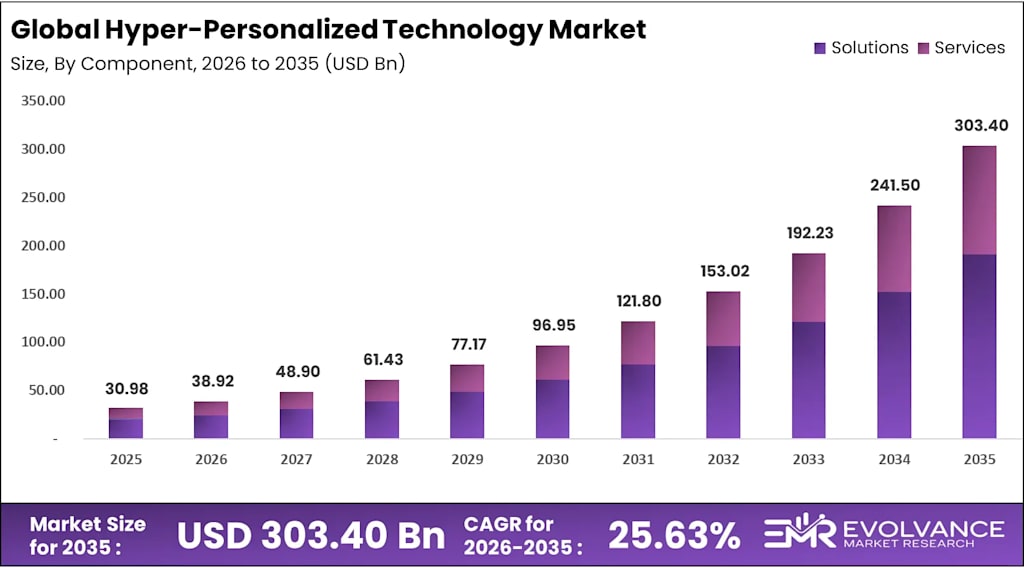
The global hyper-personalized technology market was valued at USD 30.98 billion in 2025 and is projected to reach USD 303.40 billion by 2035, growing at a CAGR of 25.63%. Enterprise adoption of AI-driven personalization engines is accelerating as measurable revenue returns make the investment case impossible for CMOs and CTOs to ignore. Saks Global recorded a 7% revenue increase and 10% higher conversion after launching hyper-personalized homepage experiences — a result that ends the "nice to have" conversation and starts the "how fast can we deploy" one. For technology leaders, investors, and enterprise decision-makers who need the complete analytical picture — covering components, technologies, applications, end-use verticals, and regional forecasts through 2035 — the full research is available in the hyper-personalized technology market report from Evolvance Market Research.
Hyper-Personalized Technology Market Size and Growth
North America leads all regions with a 36.8% revenue share valued at USD 11.45 billion in 2025 — driven by the highest concentration of enterprise technology adopters, the most mature digital commerce infrastructure, and a regulatory environment that, while tightening on data privacy, has not yet created the barriers to AI personalization deployment that are emerging in Europe.
The adoption velocity data from emerging markets tells a particularly compelling story. SAP's Value of AI Report found that Indian businesses invested USD 31 million in AI in 2025 — above the global average of USD 26.7 million — with 93% of Indian organizations expecting positive returns within three years. IBM's AI Outlook found 60% of APAC organizations anticipating AI benefits within two to five years. SAP data shows AI supported 23% of business tasks in India in 2025, rising to an expected 41% within two years. These are not experimental adoption signals. They are the leading indicators of mainstream enterprise deployment at scale across the world's fastest-growing digital economies.
Accenture and Google Cloud reported deploying over 450 AI agents across industries in 2025 — a deployment pace that confirms enterprise buyers have moved from evaluating hyper-personalization technology to actively operationalizing it across customer-facing workflows.
Hyper-Personalized Technology Market Trends: AI and ML Lead Everything
AI and Machine Learning leads the technology segment with a 28.9% revenue share — and the reason is fundamental rather than fashionable. Hyper-personalization at the individual level is simply not possible without machine learning. The data volumes involved — billions of behavioral signals across millions of users updated in real time — cannot be processed, modeled, or acted upon by any human team or rule-based system. AI is not an enhancement to hyper-personalization technology. It is the enabling condition without which the category does not exist.
Deep learning is the specific AI architecture driving the most significant capability advances — particularly in natural language understanding and behavioral prediction. Large language models integrated into personalization platforms are enabling AI systems to interpret the semantic meaning of customer interactions rather than just their categorical classification. When a customer service conversation contains subtle signals about purchase intent, a deep learning-powered personalization engine can act on those signals in real time in ways that keyword-matching approaches completely miss.
Predictive analytics is the technology layer that converts behavioral history into forward-looking opportunity identification — anticipating what a customer needs before they have explicitly expressed it. The financial services sector has pioneered the use of predictive personalization for credit offer timing, where the difference between presenting a relevant offer at the right moment and presenting it three months too early or too late is measurable in conversion rate percentage points that translate directly to billions in revenue at scale.
Hyper-Personalized Technology Market Segments: Retail Leads but Healthcare Is Watching
Retail and e-commerce holds the largest revenue share among all end-use verticals — and the competitive dynamics of online retail make this structural rather than coincidental. In a world where a customer is one click away from a competitor at all times, the difference between a generic product page and one that dynamically surfaces the most relevant products for that specific visitor based on their browsing history, purchase history, and real-time session behavior is the difference between a sale and a bounce.
Product and content recommendation holds the highest application revenue share — the most mature and widely deployed form of hyper-personalization technology, representing everything from Netflix's content recommendation engine to Amazon's product suggestion system. These recommendation systems are the proof-of-concept that converted enterprise skeptics into buyers by demonstrating measurable lift in engagement and revenue at scale before any other personalization application had achieved comparable validation.
Marketing and advertising personalization is the fastest-growing application segment — driven by the deprecation of third-party cookies and the subsequent shift toward first-party data strategies that make owned behavioral data more strategically valuable than it has ever been. Brands that built robust first-party data collection and AI personalization capability before third-party cookies disappeared are now competing with a structural advantage over those that did not.
Healthcare and life sciences is the end-use vertical to watch for the next wave of hyper-personalization adoption. Personalized patient communication, individualized treatment adherence programs, and AI-driven clinical decision support tailored to individual patient profiles represent applications where the stakes — measurable health outcomes — make the ROI case more compelling than almost any commercial application.
Hyper-Personalized Technology Market: The Privacy Tension
The hyper-personalized technology market carries a structural tension that no amount of AI sophistication can resolve: the more data a system uses to personalize, the more it raises questions about privacy, consent, and the appropriate limits of behavioral surveillance in commercial contexts.
GDPR in Europe, CCPA in California, and the expanding web of national and state-level data privacy regulations are not peripheral compliance concerns for this market. They are the primary constraints on how personalization systems can be built, what data they can use, and how long they can retain behavioral signals. The brands and technology vendors that build privacy-first personalization architectures — delivering individual relevance through consented first-party data rather than third-party tracking — are building the only sustainable long-term competitive position in this category.
The shift from third-party to first-party data is not just a regulatory accommodation. It is a business model improvement — brands that earn explicit customer consent to use behavioral data for personalization purposes build relationships with fundamentally higher trust levels than those that rely on tracking users across the web without explicit awareness.
Key Players in the Hyper-Personalized Technology Market
Salesforce's Marketing Cloud and Data Cloud platform anchors the enterprise personalization stack for the majority of Fortune 500 companies — combining customer data platform capabilities, journey orchestration, and AI-driven content generation in a single integrated system. Adobe Experience Platform competes directly at the enterprise tier with real-time customer profile management and activation capabilities that integrate deeply with Adobe's creative and analytics tools.
Google's suite of personalization products — from recommendations AI to Vertex AI for enterprise deployment — gives it a position across both the consumer internet and enterprise software personalization markets simultaneously. Amazon Personalize makes AWS-native real-time recommendation capability accessible to mid-market organizations that cannot build proprietary recommendation systems. SAP's AI-powered CX suite serves the enterprise ERP customer base with personalization capabilities integrated directly into commerce and service workflows.
The recommendation engine that decided what you should watch tonight was just the beginning. By 2035, the USD 303 billion market built on knowing you better than you know yourself will touch every industry, every customer interaction, and every digital experience on the planet.
About the Creator
Suge kun
Research Analyst passionate about data & market insights. I turn complex information into clear, actionable strategies. Detail-driven & results-focused — helping businesses make smarter decisions. — Suge Kun
Enjoyed the story? Support the Creator.
Subscribe for free to receive all their stories in your feed.
Comments
There are no comments for this story
Be the first to respond and start the conversation.