
Hydrogen’s High-Stakes Growth Story: Why the Global Market Could Top $544 Billion by 2035
Governments, industrial giants, and clean-energy investors are racing to scale hydrogen production, but demand certainty may determine who succeeds.

Hydrogen is no longer viewed as a distant clean-energy experiment. It is becoming a central part of industrial decarbonization plans, energy security strategies, and long-term infrastructure investment around the world. From steel manufacturing and fertilizer production to shipping and heavy transport, industries that are difficult to electrify are increasingly turning to hydrogen as a lower-carbon alternative.
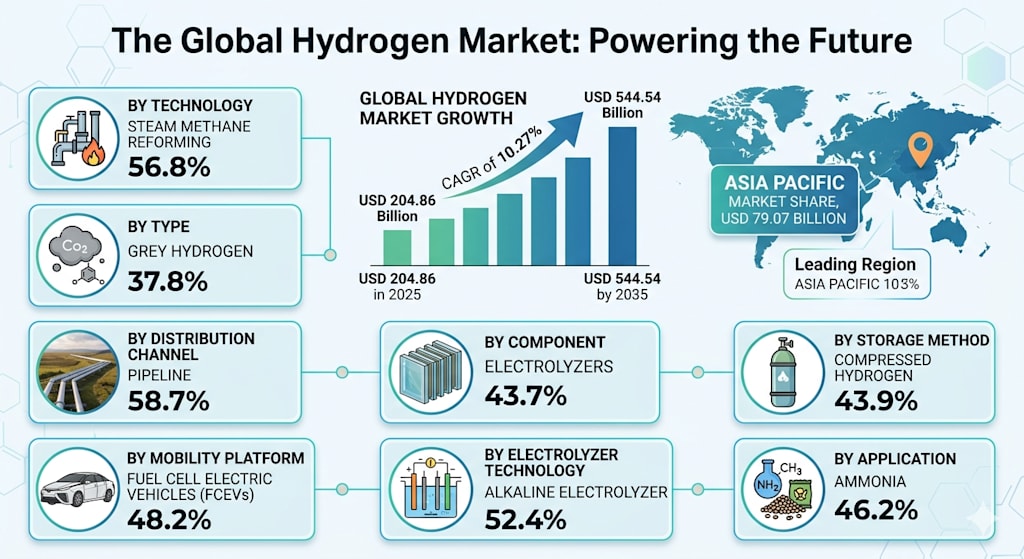
The global Hydrogen Market is projected to grow from USD 204.86 billion in 2025 to approximately USD 544.54 billion by 2035, expanding at a compound annual growth rate (CAGR) of 10.27%. While the momentum is strong, the market is evolving unevenly. Governments are pouring billions into production hubs and transport infrastructure, yet developers still face one major obstacle: securing reliable long-term buyers.
What makes the sector especially interesting today is that it is no longer driven purely by climate ambition. Hydrogen is now tied directly to industrial competitiveness, energy independence, and global trade positioning. Countries that move early could shape the supply chains of the next energy economy.
Market Highlights
- Asia Pacific leads with 38.6% market share, valued at USD 79.07 Billion.
- Steam Methane Reforming dominates By Technology with 56.8% share.
- Grey Hydrogen leads By Type with 37.8%.
- Pipeline holds 58.7% of By Distribution Channel.
- Captive Generation leads By Deployment at 64.3%.
- Electrolyzers dominate By Component at 43.7%.
- Compressed Hydrogen leads By Storage Method at 43.9%.
- Fuel Cell Electric Vehicles lead By Mobility Platform at 48.2%.
- Alkaline Electrolyzer leads By Electrolyzer Technology at 52.4%.
- Ammonia leads By Application with 46.2% share.
Why Hydrogen Is Becoming a Strategic Industrial Fuel
Hydrogen has been used for decades in industries such as oil refining and ammonia production. Traditionally, most hydrogen has been produced using fossil fuels, particularly through steam methane reforming. That process remains dominant because it is relatively inexpensive and supported by mature infrastructure.
However, the pressure to reduce emissions is reshaping the market. Governments and large corporations are increasingly demanding cleaner production methods, especially green hydrogen generated through renewable-powered electrolysis. This shift is creating a split market where legacy production systems continue operating at scale while newer low-carbon projects rapidly expand.
Industrial buyers are also changing the way they purchase hydrogen. Instead of relying solely on fossil-based supply contracts, many companies are now entering long-term agreements tied to renewable hydrogen production. These agreements help producers secure financing while giving buyers more predictable access to low-carbon fuel supplies.
Still, the transition is not happening overnight. Grey hydrogen, produced without carbon capture, remains the largest segment because of its lower cost. For many manufacturers, affordability still outweighs sustainability targets, especially in regions where renewable energy infrastructure is not yet fully developed.
Government Spending Is Reshaping the Industry
Public funding has become one of the strongest forces driving hydrogen development. Governments are no longer limiting support to research and pilot projects. Instead, they are financing large-scale infrastructure designed to support entire hydrogen ecosystems.
The United States has committed billions through the Bipartisan Infrastructure Law, including funding for regional hydrogen hubs that connect producers, transport systems, and industrial users. In Europe, subsidy auctions and long-term support mechanisms are helping companies move projects from planning into construction.
Germany offers one of the clearest examples of this policy-driven transformation. The country approved a national hydrogen core network covering thousands of kilometers of pipeline infrastructure while also backing financing programs worth tens of billions of euros. These investments are intended to create certainty for industrial buyers who need reliable transport systems before committing to large-scale hydrogen purchases.
The European Union is taking a similar approach by offering fixed premium payments for renewable hydrogen production over multi-year periods. This model reduces financial risk for developers and mirrors the type of support structures that helped scale offshore wind energy in previous decades.
The growing competition for subsidies also reveals how quickly the sector is maturing. Developers are no longer competing only on technology. They are competing on execution speed, financing capability, and their ability to secure commercial customers.
Asia Pacific Leads the Global Expansion
Asia Pacific currently holds the largest share of the market, accounting for 38.6% of global value. The region’s dominance is closely linked to its industrial scale. Countries such as China, Japan, South Korea, and India already have extensive demand for hydrogen across refining, chemicals, and heavy manufacturing.
China remains a major force because of its enormous industrial base and existing hydrogen production capacity. Japan and South Korea, meanwhile, have spent years developing national hydrogen strategies focused on mobility and energy security.
India is rapidly emerging as an important growth market as well. Government-backed renewable hydrogen initiatives and investment in domestic electrolyzer manufacturing are helping position the country as a future production hub. The country’s approach mirrors the policy strategies that previously accelerated solar energy adoption.
Outside Asia, Europe remains the most aggressive subsidy market, while North America is leveraging large-scale federal investment to accelerate clean hydrogen infrastructure. Latin America and the Middle East are also becoming increasingly important because of their access to low-cost renewable energy resources that could support export-oriented hydrogen production.
This regional competition matters because hydrogen is expected to become a globally traded commodity. Countries with abundant renewable energy and export infrastructure may eventually supply industrial economies that lack the space or resources to produce enough clean hydrogen domestically
Electrolyzers Are Emerging as the Industry’s Core Technology
One of the most important developments in recent years has been the rapid scaling of electrolyzer manufacturing. Electrolyzers use electricity to split water into hydrogen and oxygen, making them central to green hydrogen production.
Large projects are becoming the new benchmark for commercial viability. Facilities with capacities above 200 megawatts are increasingly viewed as the standard for industrial-scale production rather than experimental deployments.
This expansion is helping reduce equipment costs, which has historically been one of the biggest barriers to adoption. Manufacturers are now targeting substantial cost reductions through larger production volumes, improved efficiency, and more compact system designs.
Among the various electrolyzer technologies, alkaline systems currently dominate because they are relatively affordable and well-established. Proton exchange membrane (PEM) electrolyzers are also gaining traction because they can respond quickly to fluctuations in renewable power generation.
The race to improve electrolyzer economics is critical because production costs will determine how quickly green hydrogen can compete with fossil-based alternatives without subsidies.
Transport, Storage, and Infrastructure Remain Key Challenges
Producing hydrogen is only part of the equation. Moving and storing it efficiently is equally important.
Pipelines currently dominate hydrogen distribution because they offer the lowest delivery cost for large industrial users. Several countries are now converting existing natural gas infrastructure into hydrogen-compatible networks, significantly reducing construction costs and speeding up deployment timelines.
Storage presents another challenge. Compressed hydrogen remains the most widely used method because it relies on proven industrial equipment and established engineering standards. However, underground storage systems using salt caverns and depleted gas fields are expected to become increasingly important for balancing seasonal demand fluctuations.
Hydrogen mobility is another area attracting significant investment. Fuel cell electric vehicles are gaining attention in sectors where batteries face limitations, particularly long-haul trucking, buses, rail systems, and maritime transport. Fast refueling times and longer operating ranges make hydrogen attractive for heavy-duty applications where downtime can be costly.
Despite the optimism, infrastructure development is still uneven. Many proposed projects depend on transport networks and storage systems that have not yet been fully built. Without coordinated infrastructure investment, production growth alone may not translate into widespread commercial adoption.
The Market’s Biggest Risk Is Demand Certainty
Although technology costs are falling and policy support is increasing, the market still faces one major issue: uncertain demand.
Several high-profile project delays and cancellations have highlighted the gap between announced hydrogen ambitions and actual purchasing commitments. Some industrial buyers remain hesitant to pay a premium for low-carbon hydrogen, especially when economic conditions are uncertain.
This hesitation has forced developers to rethink project timelines and financing assumptions. Investors increasingly want proof of long-term customer demand before committing capital to billion-dollar facilities.
Hydrogen’s future still looks promising, but the market is moving from excitement to execution. Governments have opened the door with subsidies and infrastructure plans. Technology providers are improving production economics. Industrial users are beginning to adapt their procurement strategies.
The companies and countries that succeed will be the ones that can connect all those pieces into a functioning commercial ecosystem.
About the Creator
Yash Mule
SEO Specialist with 10+ years of experience at Evolvance Market Research. Expert in technical SEO, content strategy, and data-driven optimization, with a proven track record of significantly increasing organic traffic and search rankings.
Enjoyed the story? Support the Creator.
Subscribe for free to receive all their stories in your feed.
Comments
There are no comments for this story
Be the first to respond and start the conversation.