
Hydrogen Hubs: Building the Backbone of the Global Clean Energy Economy
As governments and industries invest billions in clean hydrogen infrastructure, integrated hydrogen hubs are emerging as a critical pillar of the energy transition.

The global transition toward cleaner energy sources is accelerating, and hydrogen is increasingly being viewed as one of the most promising solutions for reducing emissions in hard-to-decarbonize industries. At the center of this transformation are hydrogen hubs—large-scale, interconnected ecosystems that bring together hydrogen production, storage, transportation, and end-use facilities within a single geographic region.
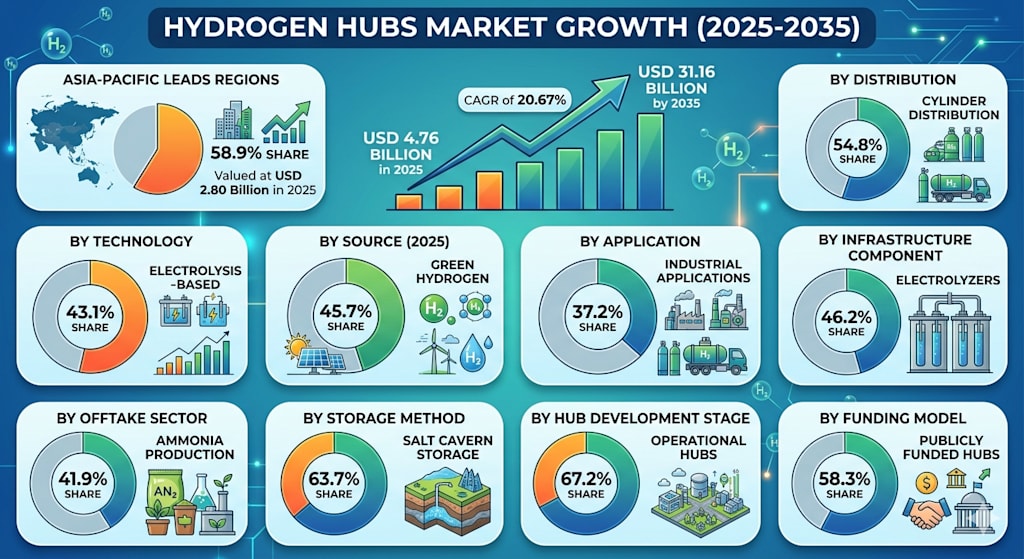
Industry forecasts suggest strong long-term growth, with the Hydrogen Hubs Market expected to expand from USD 4.76 billion in 2025 to approximately USD 31.16 billion by 2035. That growth reflects rising government support, increasing industrial demand, and growing confidence among buyers willing to commit to long-term supply agreements before many projects are fully operational.
These integrated networks are changing the economics of hydrogen deployment. Rather than relying on isolated production projects, hydrogen hubs create shared infrastructure that can serve multiple industries simultaneously. This model lowers costs, reduces investment risk, and helps establish reliable supply chains for emerging hydrogen markets.
Market Highlights
- Asia-Pacific leads all regions with a 58.9% share, valued at USD 2.80 Billion in 2025.
- Green Hydrogen dominates the By Source segment with a 45.7% share in 2025.
- Electrolysis-Based technology holds a 43.1% share in the By Technology segment.
- Industrial Applications leads the By Application segment with a 37.2% share.
- Cylinder distribution holds a 54.8% share in the By Distribution Channel segment.
- Electrolyzers dominate the By Infrastructure Component segment with a 46.2% share.
- Ammonia Production leads the By Offtake Sector segment with a 41.9% share.
- Salt Cavern Storage dominates the By Storage Method segment with a 63.7% share.
- Operational Hubs lead the By Hub Development Stage segment with a 67.2% share.
- Publicly Funded Hubs dominate the By Funding Model segment with a 58.3% share.
Why Hydrogen Hubs Matter
Hydrogen has long been used in industries such as refining, chemicals, and fertilizer production. However, traditional hydrogen production has largely relied on fossil fuels, resulting in significant carbon emissions. Hydrogen hubs offer a pathway toward cleaner production methods while simultaneously solving many of the infrastructure challenges that have limited broader adoption.
The concept is relatively straightforward. Instead of building standalone facilities, developers establish centralized production sites connected to storage systems, transportation networks, and multiple customers. By sharing infrastructure across different users, costs can be spread over larger volumes, making projects more economically viable.
This approach is particularly important because hydrogen infrastructure is capital-intensive. Pipelines, storage facilities, compression systems, and production plants require substantial investment. A hub structure allows these costs to be distributed among several industries rather than borne by a single buyer.
Government support has played a decisive role in accelerating development. Large funding programs in the United States, Europe, and Asia have significantly improved project economics, helping move many proposals from planning stages into active construction.
The Rise of Green Hydrogen
Among the various production methods, green hydrogen has emerged as the preferred long-term solution. Produced through electrolysis powered by renewable energy, green hydrogen generates little to no direct carbon emissions during production.
In 2025, green hydrogen accounted for the largest share of hydrogen hub production sources. This leadership is largely driven by climate policies and industrial decarbonization targets. Companies in sectors such as steelmaking, chemicals, and ammonia production increasingly view green hydrogen as an essential tool for achieving net-zero commitments.
Blue hydrogen, which combines natural gas-based production with carbon capture technologies, continues to serve as an important bridge solution. For many regions, it offers a practical way to scale hydrogen supply while renewable-powered production capacity expands.
Meanwhile, traditional grey hydrogen remains present in existing industrial facilities but is expected to gradually lose market share as cleaner alternatives become more competitive and regulatory pressures increase.
A major factor supporting green hydrogen growth is the rapid expansion of electrolyzer manufacturing. Governments and private companies are investing heavily in production capacity, aiming to lower costs and reduce equipment shortages that have historically slowed project deployment.
Industrial Demand Is Driving Early Growth
One of the most important characteristics of hydrogen hubs is that they are being built around real, existing demand.
Industrial applications currently represent the largest use case for hub-produced hydrogen. Industries such as ammonia manufacturing, refining, chemicals production, and steelmaking already consume large volumes of hydrogen and are actively seeking cleaner alternatives.
This existing demand creates a strong foundation for investment. Developers can secure long-term offtake agreements with established industrial customers, providing the revenue certainty needed to attract financing.
Ammonia production stands out as the leading offtake sector. Beyond its role in fertilizers, ammonia is increasingly viewed as an efficient carrier for transporting hydrogen internationally. Because global ammonia shipping infrastructure already exists, many developers see ammonia exports as one of the fastest ways to commercialize large-scale hydrogen production.
Steel manufacturing is another sector generating significant interest. Hydrogen-based steel production offers one of the most promising pathways for reducing emissions from one of the world's most carbon-intensive industries. As steel producers commit to decarbonization strategies, demand for reliable hydrogen supplies is expected to increase substantially.
Beyond industry, transportation and power generation are emerging as future growth segments. While economics remain challenging in some cases, continued technological improvements could make hydrogen a more competitive option for fuel cell vehicles, shipping fuels, and grid-balancing applications.
Infrastructure: The Foundation of Every Hub
The success of any hydrogen hub depends on infrastructure. Production facilities alone are not enough; hydrogen must also be stored, transported, and delivered efficiently to end users.
Electrolyzers currently represent the most significant infrastructure component within new projects. These systems use electricity to split water into hydrogen and oxygen, enabling renewable-powered hydrogen production. As governments prioritize clean hydrogen development, electrolyzer deployment has become a central focus of investment programs worldwide.
Storage is another critical consideration. Salt cavern storage has emerged as the preferred solution where geological conditions permit. These underground formations can store large volumes of hydrogen at relatively low cost, providing flexibility and supply security.
Where salt caverns are unavailable, compressed hydrogen storage serves as an alternative, particularly for operational balancing and local distribution needs.
Transportation infrastructure is evolving as well. While cylinder distribution remains the most common delivery method for smaller users, pipelines are increasingly viewed as the long-term solution for large industrial clusters. Dedicated hydrogen pipeline networks and repurposed natural gas infrastructure are expected to play an important role in connecting production centers with major demand hubs.
Together, these infrastructure investments create the physical backbone needed to support large-scale hydrogen adoption.
Regional Leaders Shaping the Market
Asia-Pacific currently leads global hydrogen hub development, accounting for the largest regional share of activity. Strong industrial demand, energy security priorities, and supportive government policies have positioned countries such as China, Japan, South Korea, India, and Australia at the forefront of deployment.
North America has emerged as one of the most aggressive investors in hydrogen infrastructure. The United States has committed billions of dollars through regional hub programs designed to stimulate domestic production, manufacturing, and job creation. These initiatives are expected to attract substantial private-sector investment over the coming decade.
Europe is advancing through a combination of funding programs, competitive auctions, and cross-border infrastructure projects. The region's emphasis on industrial decarbonization and energy independence has created a favorable environment for large-scale hydrogen investments.
These regional strategies highlight the increasingly global nature of the hydrogen economy.
Challenges and Opportunities Ahead
Despite strong momentum, significant challenges remain. The largest obstacle is securing sufficient long-term demand to justify large capital investments. Many proposed projects have yet to reach final investment decisions because developers and buyers are still negotiating commercial terms.
Cost uncertainty also remains a concern. Although renewable energy and electrolyzer costs are declining, many projects still depend on government support mechanisms to achieve competitive economics.
However, several developments are improving the outlook. Competitive auction systems, revenue-support programs, and public-private partnerships are helping reduce risk for investors. At the same time, growing corporate decarbonization commitments are creating stronger demand signals across multiple industries.
Conclusion
Hydrogen hubs are rapidly evolving from policy concepts into real-world infrastructure projects capable of transforming industrial energy systems. By combining production, storage, transportation, and end-use demand within integrated networks, these hubs address many of the economic and logistical challenges that have historically limited hydrogen adoption.
With substantial government backing, growing industrial demand, and accelerating private investment, hydrogen hubs are laying the foundation for a cleaner and more interconnected energy future. While challenges remain, the pace of development suggests that these integrated ecosystems will play a central role in global decarbonization efforts over the coming decades.
About the Creator
Yash Mule
SEO Specialist with 10+ years of experience at Evolvance Market Research. Expert in technical SEO, content strategy, and data-driven optimization, with a proven track record of significantly increasing organic traffic and search rankings.
Enjoyed the story? Support the Creator.
Subscribe for free to receive all their stories in your feed.
Comments
There are no comments for this story
Be the first to respond and start the conversation.