
Hydrogen Generation Market: Powering the Next Phase of the Global Energy Transition
How innovation, policy support, and industrial demand are reshaping one of the world's fastest-evolving energy markets.

The global energy landscape is undergoing a profound transformation, and hydrogen has emerged as one of the most talked-about elements in that transition. Once viewed primarily as an industrial gas used behind the scenes in chemical manufacturing and refining, hydrogen is now increasingly recognized as a versatile energy carrier with the potential to support decarbonization across multiple sectors.
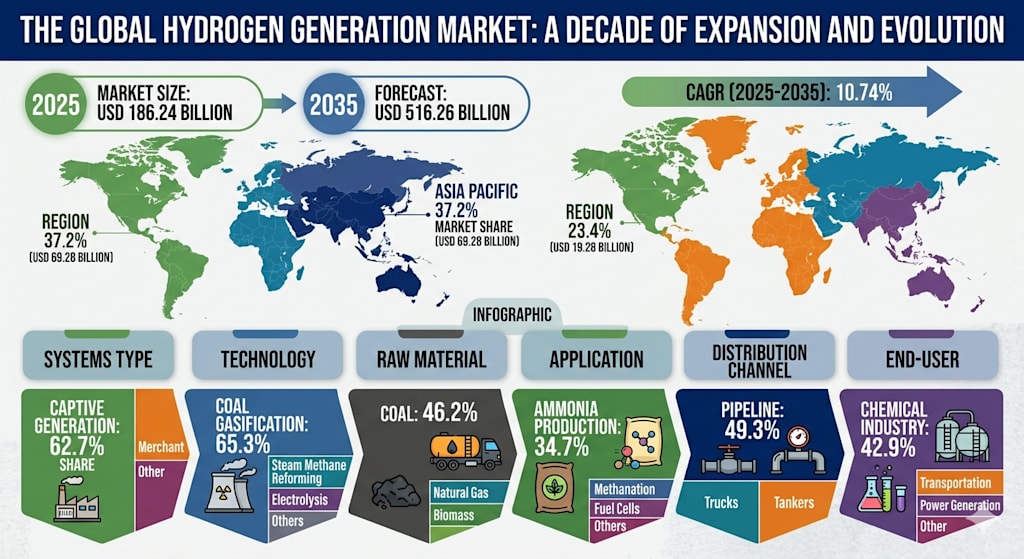
The Hydrogen Generation Market reflects this shift in priorities. According to current projections, the market is expected to grow from USD 186.24 billion in 2025 to approximately USD 516.26 billion by 2035, expanding at a compound annual growth rate of 10.74%. Behind these impressive numbers lies a story of technological innovation, evolving regulations, industrial necessity, and a growing urgency to reduce carbon emissions.
Understanding the forces shaping this market provides valuable insight into where the global energy economy may be headed next.
Market Highlights
- Asia Pacific leads all regions with a 37.2% market share, valued at USD 69.28 Billion.
- By Systems Type, Captive Generation dominates with a 62.7% share.
- By Technology, Coal Gasification leads at 65.3%.
- By Raw Material, Coal holds 46.2%.
- By Application, Ammonia Production commands 34.7%.
- By Distribution Channel, Pipeline leads at 49.3%.
- By End-User, Chemical Industry holds 42.9%.
From Industrial Essential to Strategic Energy Resource
Hydrogen has long been indispensable to industries such as fertilizer production, petroleum refining, and chemical manufacturing. In many of these applications, it is not simply an optional input but a fundamental requirement for production processes.
What has changed in recent years is the perception of hydrogen's broader potential. Governments and businesses increasingly view it as a solution capable of supporting cleaner transportation systems, enabling lower-emission steel production, balancing renewable power grids, and creating new pathways for industrial decarbonization.
This evolution has elevated hydrogen from a niche industrial commodity to a strategic economic asset. Organizations are no longer relying solely on short-term purchases. Instead, many are entering long-term supply agreements designed to secure future access as demand expands.
The transition, however, is not without challenges. Existing production systems remain heavily dependent on fossil fuel feedstocks, while cleaner alternatives continue to face cost and infrastructure hurdles.
The Technologies Driving Production
Hydrogen can be generated through several different methods, each carrying distinct advantages and trade-offs.
Coal gasification currently accounts for the largest share of production worldwide. This dominance is closely linked to countries with abundant coal reserves and extensive legacy infrastructure. In regions where coal remains inexpensive and readily available, producers often find it difficult to justify switching technologies despite growing environmental concerns.
Steam methane reforming also plays a major role, particularly in Western markets supported by mature natural gas networks. Many industry observers view this approach as a transitional pathway, especially when paired with carbon capture technologies designed to reduce emissions.
Electrolysis has emerged as the most closely watched growth segment. By using electricity to split water into hydrogen and oxygen, electrolysis offers the possibility of producing low-emission hydrogen when powered by renewable energy sources.
As manufacturing capacity for electrolyzers expands and production costs gradually decline, this technology could significantly reshape future market dynamics. Many stakeholders believe electrolysis represents one of the most promising routes toward large-scale clean hydrogen production.
Industrial Demand Remains the Market's Foundation
Despite excitement surrounding future applications, traditional industries continue to account for the majority of hydrogen consumption.
Ammonia production remains the single largest application segment. Since ammonia serves as a critical ingredient in fertilizer manufacturing, hydrogen demand in this area is closely tied to global food production and agricultural stability. Governments often prioritize fertilizer supply chains due to their direct connection to food security.
The chemical industry similarly depends on hydrogen as an irreplaceable feedstock in numerous manufacturing processes. Unlike discretionary purchases that fluctuate with consumer trends, these industries require steady supplies regardless of short-term market conditions.
Emerging sectors are beginning to contribute additional momentum. Steelmakers are exploring hydrogen-based production methods to reduce emissions from one of the world's most carbon-intensive industries. Meanwhile, transportation initiatives involving fuel cell systems continue to expand, particularly in specialized applications where battery technologies face limitations.
Power generation also presents intriguing opportunities. Hydrogen's potential role in energy storage and grid balancing could help renewable energy systems address intermittency challenges more effectively.
Policy Support Is Accelerating Investment
Government action has become one of the strongest catalysts for market growth.
National hydrogen strategies have multiplied rapidly across the globe, reflecting a coordinated effort to position hydrogen within broader climate and industrial policies. Public funding, tax incentives, and infrastructure initiatives are helping reduce investment risks that previously discouraged large-scale development.
In the United States, production incentives tied to emissions performance have provided developers with greater clarity and stronger economic justification for pursuing projects. Expanded support covering storage applications has also signaled recognition that successful hydrogen ecosystems require investment across the entire value chain.
Europe has adopted similarly ambitious goals, combining domestic production targets with plans to import substantial volumes of renewable hydrogen. These commitments are driving procurement activity, encouraging infrastructure development, and creating new opportunities for technology providers.
Such policy frameworks are transforming hydrogen from an aspirational concept into a market increasingly supported by enforceable targets and financial mechanisms.
Regional Competition Shapes the Global Landscape
Geography plays a significant role in determining how the market evolves.
Asia Pacific currently leads global activity, supported by large-scale industrial demand, established production capabilities, and strong manufacturing capacity. China, in particular, has developed a substantial advantage in electrolyzer production, allowing it to influence equipment supply chains worldwide.
North America is experiencing accelerating momentum through a combination of regulatory certainty and direct financial support. Major projects continue to advance as developers gain confidence in the long-term investment environment.
Europe's strategy emphasizes both energy security and climate leadership. Ambitious import plans, infrastructure investments, and national commitments position the region as a major driver of future demand.
Meanwhile, Latin America and the Middle East possess attractive renewable resources that could enable competitive hydrogen exports. Countries with abundant solar and wind potential are increasingly viewed as future suppliers to international markets seeking cleaner energy alternatives.
As regions pursue different strategies, the market is becoming both globally interconnected and intensely competitive.
Barriers That Cannot Be Ignored
Optimism surrounding hydrogen's future must be balanced with realism.
Many announced projects remain in early development stages, facing obstacles related to financing, permitting, offtake agreements, and final investment approvals. Translating ambitious announcements into operational facilities continues to prove difficult.
Infrastructure limitations represent another challenge. Production facilities require transportation networks, storage solutions, and end-user connections capable of supporting reliable supply chains.
Resource constraints also deserve attention. Water availability has emerged as an important consideration for electrolysis projects, particularly in regions already experiencing stress on freshwater supplies.
Regulatory complexity adds another layer of difficulty. Compliance requirements designed to ensure environmental integrity can increase administrative burdens and project timelines.
These barriers do not diminish hydrogen's potential, but they underscore the importance of execution alongside ambition.
Conclusion: Building Momentum for a Hydrogen Economy
The Hydrogen Generation Market stands at a pivotal moment. Strong industrial demand, accelerating technological innovation, and unprecedented policy support are creating conditions for sustained expansion over the coming decade.
At the same time, the path forward requires navigating infrastructure gaps, regulatory demands, and the practical realities of project development. Success will depend not only on bold visions but also on disciplined implementation and collaboration across industries and governments.
Hydrogen is unlikely to serve as a universal solution to every energy challenge. Yet its growing role across manufacturing, transportation, and power systems suggests it will become an increasingly important component of the global energy mix.
As investments mature and technologies continue to evolve, the market's next chapter may ultimately define how nations balance economic growth with the urgent pursuit of a lower-carbon future.
About the Creator
Yash Mule
SEO Specialist with 10+ years of experience at Evolvance Market Research. Expert in technical SEO, content strategy, and data-driven optimization, with a proven track record of significantly increasing organic traffic and search rankings.
Enjoyed the story? Support the Creator.
Subscribe for free to receive all their stories in your feed.
Comments
There are no comments for this story
Be the first to respond and start the conversation.