
Hydrogen Electrolyzer Market: The Technology at the Heart of the Clean Hydrogen Revolution
Why the future of low-emission hydrogen depends as much on economics and execution as it does on innovation.

The race toward a lower-carbon economy has placed hydrogen firmly in the global spotlight. Yet while much of the conversation focuses on hydrogen itself, the real engine behind its clean production lies in a less familiar technology: electrolyzers. These systems use electricity to split water into hydrogen and oxygen, creating a pathway to produce hydrogen without relying heavily on fossil fuels.
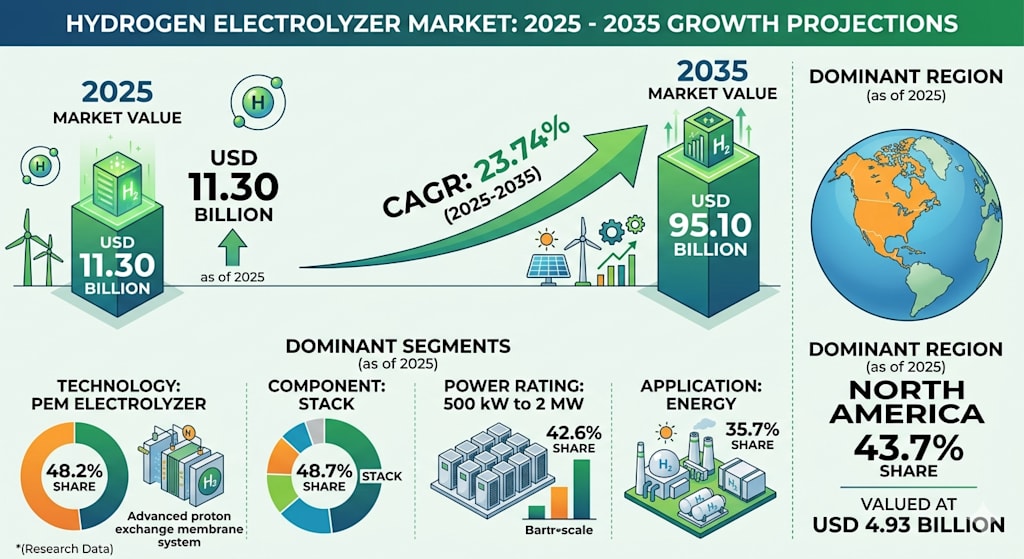
The Hydrogen Electrolyzer Market is projected to expand dramatically over the next decade, growing from USD 11.30 billion in 2025 to USD 95.10 billion by 2035. On paper, the numbers tell a compelling story of rapid growth. But beneath the headlines lies a more nuanced reality. The market is shaped by manufacturing capacity, project financing, industrial demand, and government policy just as much as technological progress.
Understanding these dynamics is essential for anyone seeking to grasp where the clean hydrogen economy is truly headed.
Market Highlights
- Technology: PEM electrolyzer at 48.2% share as of 2025.
- Component: Stack at 48.7% share as of 2025.
- Power Rating: 500 kW to 2 MW systems at 42.6% share as of 2025.
- Application: Energy at 35.7% share as of 2025.
- North America at 43.7%, valued at USD 4.93 billion as of 2025.
A Market Defined by Potential and Practicality
Electrolyzers occupy a unique position in the energy transition. They are often described as enabling technologies because they make it possible to generate hydrogen using renewable or nuclear electricity. This capability positions them at the intersection of clean energy production and industrial decarbonization.
However, enthusiasm alone does not build projects. Many announced initiatives remain in early planning stages because developers still need financing, long-term customers, and regulatory clarity before construction can begin.
This distinction matters. Manufacturing capacity may suggest an industry ready for explosive expansion, but actual deployment depends on projects reaching final investment decisions. The gap between ambition and execution continues to define the sector.
Despite these hurdles, the long-term opportunity remains substantial. Industries that already consume large quantities of hydrogen are under increasing pressure to reduce emissions, creating a clear incentive to explore cleaner production methods.
Why Industrial Demand Is Leading the Way
Contrary to popular perception, the strongest demand for electrolyzers is not being driven by futuristic concepts or experimental applications. Instead, it originates from industries that already rely heavily on hydrogen every day.
Fertilizer producers represent one of the clearest examples. Ammonia manufacturing requires significant hydrogen inputs, making the sector a natural candidate for low-emission alternatives. Because demand already exists, producers face minimal uncertainty regarding future consumption.
Petroleum refiners also use hydrogen extensively for processing fuels and complying with environmental standards. As regulatory expectations evolve, many operators are evaluating cleaner hydrogen sources to support their transition strategies.
Steel manufacturing is another emerging area of interest. Traditional steelmaking generates substantial emissions, prompting companies to investigate hydrogen-based production methods capable of reducing their environmental footprint.
These industrial applications offer something investors value highly: predictable demand. Projects supported by established buyers are generally viewed as less risky than those dependent on creating entirely new markets.
Technology Choices Shape Competitive Advantage
Not all electrolyzers operate in the same way. Different technologies offer distinct strengths depending on the intended application.
Proton Exchange Membrane, or PEM, systems currently command the largest share of the market. Their popularity stems from their flexibility. PEM electrolyzers respond quickly to fluctuations in renewable energy generation, making them particularly well suited for integration with wind and solar facilities.
They also produce high-purity hydrogen and require relatively compact installation footprints. These advantages have helped establish PEM systems as a preferred choice in many emerging projects.
Alkaline electrolyzers, meanwhile, maintain a strong position due to their lower costs. For industrial operations requiring steady production rather than rapid responsiveness, alkaline systems often provide an economically attractive solution.
Other technologies, including solid oxide and anion exchange membrane systems, continue to attract research attention. Although they currently represent smaller segments, they could play increasingly important roles as innovation advances and commercial readiness improves.
Ultimately, no single technology will dominate every application. Success will depend on matching technical capabilities with operational requirements and economic realities.
Policy Support Is Turning Ambition Into Action
Government intervention has become one of the strongest catalysts for market development.
Across North America and Europe, policymakers have introduced incentives designed to improve project economics and accelerate deployment. Financial mechanisms that reward low-emission hydrogen production have transformed previously uncertain ventures into more attractive investment opportunities.
In the United States, generous production incentives have helped narrow the cost gap between conventional and cleaner hydrogen pathways. Direct funding programs have further strengthened confidence among developers and equipment suppliers.
Europe has adopted a different but equally influential approach. Competitive auction mechanisms provide revenue certainty, enabling project developers to secure financing more easily. This structure has encouraged projects to progress beyond planning stages and into execution.
Asia is pursuing its own strategy through manufacturing expansion. China's large-scale production capabilities have significantly lowered equipment costs, while India is investing heavily to establish domestic manufacturing capacity and reduce dependence on imports.
These varied approaches illustrate a broader truth: public policy continues to shape where projects move forward and where investment flows.
The Challenges That Could Slow Momentum
Despite the optimism surrounding clean hydrogen, significant obstacles remain.
Cost remains the most obvious concern. Producing hydrogen through electrolysis generally costs more than conventional methods in many regions. Electricity prices play a decisive role, and projects located in areas with expensive power often struggle to compete economically.
Another challenge involves converting announcements into reality. Thousands of megawatts of proposed capacity have been publicized globally, yet only a fraction has advanced to construction or operation.
Supply chain considerations add further complexity. Certain electrolyzer technologies rely on specialized materials that face availability constraints. Scaling production without creating new bottlenecks will require continued innovation and diversification.
Water access also deserves attention. Electrolysis depends on water resources, and a considerable number of planned projects are located in regions experiencing water stress. Addressing these concerns may require investments in desalination, wastewater treatment, and integrated resource planning.
These issues are not insurmountable, but they highlight the importance of realistic expectations and careful project execution.
A Market Moving From Vision to Delivery
Perhaps the most significant shift occurring today is the transition from concept to implementation.
The early years of the clean hydrogen movement were dominated by ambitious announcements and exploratory studies. Increasingly, however, the conversation is becoming more grounded in contracts, financing arrangements, and engineering milestones.
Companies are focusing less on theoretical market potential and more on securing long-term customers. Industrial buyers are negotiating supply agreements that provide developers with the revenue certainty needed to move forward.
Equipment manufacturers, meanwhile, are emphasizing service capabilities, operational reliability, and lifecycle performance rather than simply promoting efficiency figures.
This maturation signals an important evolution. The winners in the years ahead are likely to be organizations capable of delivering projects on schedule, managing costs effectively, and building trusted relationships across the value chain.
Conclusion: Building the Foundations of a Hydrogen Future
The Hydrogen Electrolyzer Market represents far more than a promising technological trend. It reflects a broader transformation in how industries, governments, and investors approach the challenge of decarbonization.
While obstacles related to cost, infrastructure, and project execution persist, the underlying drivers remain strong. Established industrial demand, supportive policies, expanding manufacturing capabilities, and continued innovation are collectively creating momentum that extends well beyond short-term market cycles.
The path ahead will not be perfectly linear. Some projects will be delayed, business models will evolve, and competition will intensify. Yet the growing emphasis on practical implementation suggests the industry is entering a more mature phase.
Electrolyzers may not capture headlines as often as hydrogen itself, but they are quietly becoming one of the most important technologies enabling the transition to a cleaner energy future. Their success could determine not only the pace of hydrogen adoption but also how effectively the world balances industrial growth with environmental responsibility in the decades to come.
About the Creator
Yash Mule
SEO Specialist with 10+ years of experience at Evolvance Market Research. Expert in technical SEO, content strategy, and data-driven optimization, with a proven track record of significantly increasing organic traffic and search rankings.
Enjoyed the story? Support the Creator.
Subscribe for free to receive all their stories in your feed.
Comments
There are no comments for this story
Be the first to respond and start the conversation.