
Hybrid Electric Vehicle Market: Regulatory Push, Fuel Savings & Expansion Opportunities
How demand for low-emission vehicles, technological integration, and regulatory frameworks are fostering innovation in hybrid electric vehicle production and adoption

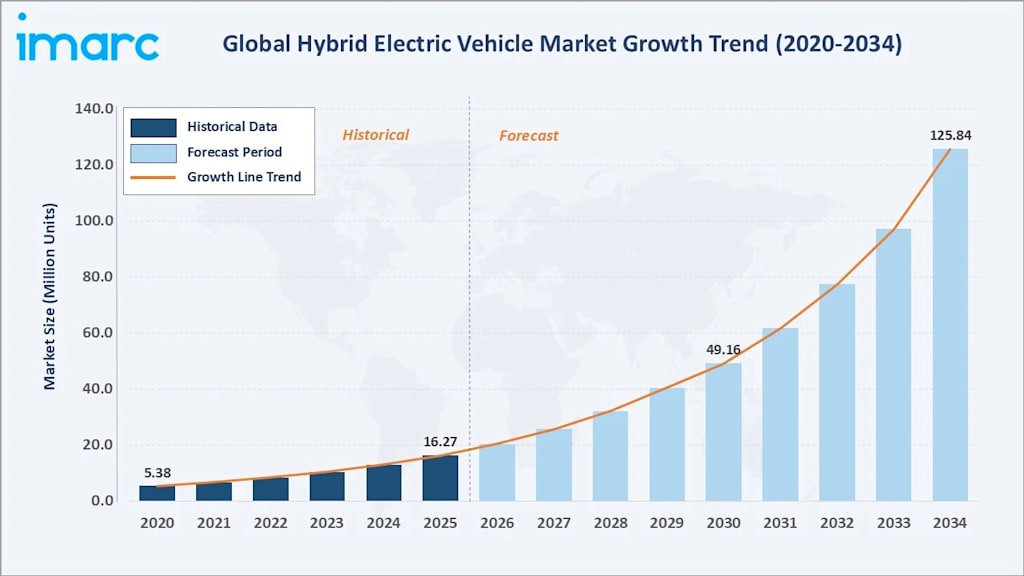
Rising environmental concerns, fluctuating fuel prices, and a growing preference for vehicles that bridge the gap between traditional engines and full electrification are driving hybrid electric vehicle demand. This is supported by significant government subsidies, advancements in battery energy density, and a massive expansion in automaker portfolios across both passenger and commercial segments. According to IMARC Group’s latest data, The global hybrid electric vehicle market size reached 16.27 Million Units in 2025. Looking forward, IMARC Group estimates the market to reach 125.84 Million Units by 2034, exhibiting a CAGR of 24.76% from 2026-2034.
The hybrid electric vehicle sector has matured into a critical pillar of the global automotive transition, representing a high-growth alternative for consumers not yet ready to commit to a pure battery-electric infrastructure. Modern hybrids now offer a seamless blend of internal combustion reliability and electric efficiency, providing a practical solution for long-range travel without "range anxiety." Market expansion is further fueled by the integration of 48V mild-hybrid systems in mainstream models and the success of full-hybrid configurations that require no external charging.
Hybrid Electric Vehicle Market Growth Drivers:
- Stringent Government Emission Standards and Incentives
Global regulatory bodies are implementing rigorous carbon reduction mandates, such as the EPA’s updated standards in the U.S. and the EU’s "Fit for 55" package, which effectively force a shift toward electrified powertrains. To ease this transition, governments are offering substantial financial lifelines; for instance, U.S. federal tax credits can reach up to $7,500, while India’s FAME-II and upcoming FAME-III schemes provide direct subsidies for electric and hybrid components. These policies reduce the initial price gap between hybrids and traditional cars by nearly 15-20%, making eco-friendly mobility accessible to a broader demographic.
- Economic Viability Amid High Fuel Costs
The inherent fuel efficiency of hybrid systems often delivering 30% to 40% better mileage in stop-and-go urban traffic serves as a powerful economic motivator for consumers. With global energy markets remaining volatile, the ability to significantly lower daily commuting costs without changing refueling habits is a decisive factor for middle-income households. Technological refinements in regenerative braking and Atkinson-cycle engines have optimized these savings further. Consequently, the market sees heavy traction in regions where petrol prices remain high, positioning hybrids as a pragmatic financial tool rather than just an environmental statement.
Grab Your Free Copy of the "Hybrid Electric Vehicle Market" Analysis Report
- Rapid Advancements in Battery and Powertrain Technology
The industry’s pivot from Nickel-Metal Hydride (NiMH) to high-performance Lithium-ion (Li-ion) batteries has revolutionized vehicle performance. Li-ion cells now offer energy densities between 150–250 Wh/kg, allowing for lighter, more compact battery packs that don't compromise cabin space or vehicle weight. Furthermore, the development of intelligent energy management systems allows for a smoother transition between electric and gasoline modes. These innovations have increased real-world range and reliability, with modern hybrid batteries often retaining over 90% of their capacity after several years of use, boosting consumer confidence in long-term ownership.
Hybrid Electric Vehicle Market Trends:
- The Rise of 48V Mild-Hybrid Integration
Automakers are increasingly adopting 48V mild-hybrid architectures as a cost-effective strategy to electrify their existing Internal Combustion Engine (ICE) lineups. This trend is particularly dominant among European and Asian manufacturers who use belt-integrated starter-generators to provide a torque boost and improve fuel economy by roughly 10-15%. Because these systems require minimal changes to traditional vehicle designs, they allow brands to scale production rapidly across high-volume models. This "democratization of hybridization" ensures that even entry-level vehicles contribute to fleet-wide emission reductions while remaining affordable for the average buyer.
- Expansion of Hybridization into the Two-Wheeler Segment
A significant shift is occurring in emerging economies like India and Southeast Asia, where the hybridization of scooters and motorcycles is gaining momentum. Driven by urban mobility challenges, manufacturers are introducing hybrid two-wheelers that offer enhanced pickup and superior fuel mileage for delivery fleets and daily commuters. This segment is projected to be one of the fastest-growing sub-categories, as it addresses the need for sustainable transport in densely populated cities where charging infrastructure for pure EVs is still under development. The blend of affordability and improved performance makes hybrid two-wheelers a key urban transit solution.
- Focus on Lifestyle-Oriented Hybrid SUVs and Trucks
Consumer preference has shifted decisively toward larger vehicle formats, leading to a wave of hybrid SUVs, crossovers, and pickup trucks. Brands are no longer restricting hybrid tech to small hatchbacks; instead, they are launching rugged, high-utility vehicles that offer the towing capacity and cabin space consumers expect, combined with the efficiency of an electric motor. This trend aligns with the global "premiumization" of the automotive market, where buyers are willing to pay a premium for vehicles that reflect an active, eco-conscious lifestyle without sacrificing the versatility and power needed for family trips or off-road use.
Recent News and Developments in Hybrid Electric Vehicle Market
- April 2026: Honda Motor Co., Ltd. announced a major update to its e:HEV hybrid system, introducing a new 2.0-liter direct-injection engine designed to boost thermal efficiency by 12% to support its goal of 1.3 million annual hybrid sales.
- February 2026: The Japanese government finalized a revised climate plan aiming to cut greenhouse gas emissions by 60% by 2035, specifically earmarking fresh subsidies for "next-generation" full-hybrid and plug-in hybrid platforms.
- January 2026: Toyota Motor Corporation revealed a breakthrough in solid-state battery integration for its hybrid prototypes, promising a 20% reduction in battery weight which could significantly enhance the fuel economy of its future SUV lineup.
Note: If you require specific details, data, or insights that are not currently included in the scope of this report, we are happy to accommodate your request. As part of our customization service, we will gather and provide the additional information you need, tailored to your specific requirements. Please let us know your exact needs, and we will ensure the report is updated accordingly to meet your expectations.
About the Creator
Andrew Sullivan
Hello, I’m Andrew Sullivan. I have over 9+ years of experience as a market research specialist.
Enjoyed the story? Support the Creator.
Subscribe for free to receive all their stories in your feed.
Comments
There are no comments for this story
Be the first to respond and start the conversation.