
How "Vibe Coding" Allowed Me to Build an App Without Writing a Single Line of Code
The era of the "Syntax Barrier" is over. Here is how I went from an idea to a functional application using nothing but natural language.

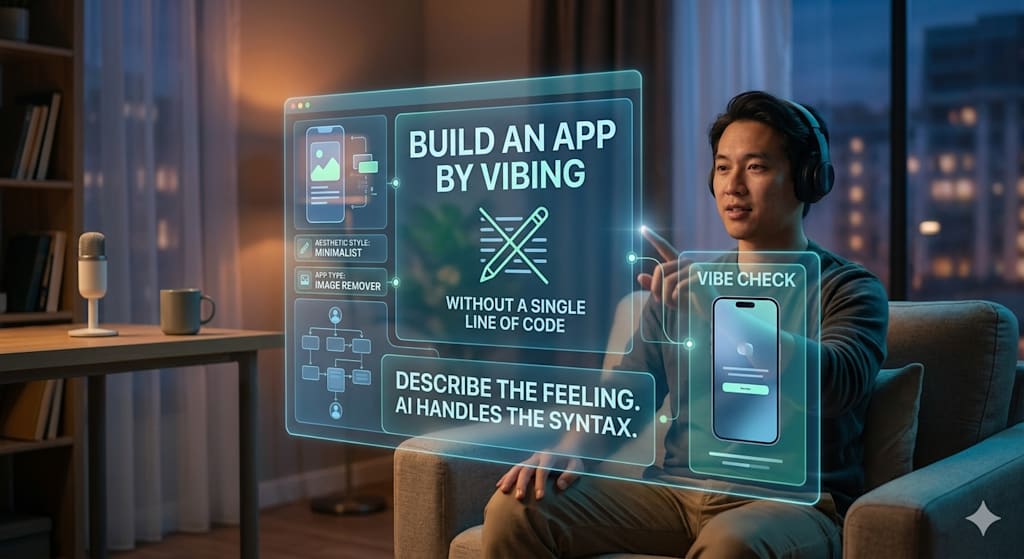
The traditional image of a programmer involves a dark room, glowing monitors, and thousands of lines of cryptic code. For years, this was the "entry fee" for innovation. If you couldn't speak Python or JavaScript, your ideas stayed trapped in your head.
But in 2026, the barrier has crumbled. Enter Vibe Coding.
I recently built a fully functional web application without typing a single bracket or semicolon. I didn't "program" it in the traditional sense; I "vibed" it into existence. Here is how the process works and why it is changing the economy for creators everywhere.
What is "Vibe Coding"?
Vibe Coding is a methodology where the human acts as the Architect and Creative Director, while the AI acts as the Lead Developer. Instead of writing code, you describe the "vibe"—the look, the feel, the logic, and the user journey.
Unlike traditional low-code tools that limit you to templates, Vibe Coding uses Agentic AI to write raw, professional-grade code in the background based on your conversational feedback.
The 3-Step Process to Building with "Vibes"
1. Conceptualizing the "Aesthetic Logic"
I started by describing the app’s purpose to my AI agent. I didn’t say "I need a DIV with a 20px padding." Instead, I said: "I want a minimalist, brutalist-style tool that removes backgrounds from images. It should feel industrial, fast, and have no unnecessary buttons."
The AI immediately generated a mockup and the underlying React code. It understood the "vibe" before I even mentioned technical specs.
2. The Iterative Refinement (The "Vibe Check")
This is where the magic happens. When something didn't look right, I didn't debug. I gave feedback:
- "The upload button feels too heavy. Make it float and give it a neon glow when hovered."
- "The processing speed is great, but show a retro-style loading bar to match the aesthetic."
With every "vibe check," the AI refactored the code in seconds. I was shaping the software like clay, not building it like a brick wall.
3. Deploying via Natural Language
Once the app was ready, I didn't touch a server terminal. I told the AI: "Deploy this to Firebase and give me a URL." It handled the API keys, the environment variables, and the hosting configuration.
Why This Matters for Non-Technical Creators
The democratization of software means that creativity is now the only bottleneck. * Speed: What used to take a month of development now takes an afternoon.
- Cost: You no longer need to hire a dev team for a Minimum Viable Product (MVP).
- Focus: You spend 100% of your energy on the User Experience (UX) rather than fixing syntax errors.
Final Thoughts: My "Aha!" Moment
Before I discovered Vibe Coding, I always felt like a spectator in the tech world. I had the ideas, but I didn't have the "language."
Last month, when I shared my first AI-built tool with a friend, they asked, "Who coded this for you?" When I replied, "I just talked to it until it looked right," I realized we have entered a new era. We are no longer limited by what we can write; we are only limited by what we can imagine.
If you have an idea sitting in a notebook because you "don't know how to code," your excuse just expired. Pick up an AI agent, start describing the vibe, and watch your vision come to life.
About the Creator
AI Lens
Exploring the profound intersection of human nature, philosophy, and the future of artificial intelligence. Writing about our evolving digital world.
Enjoyed the story? Support the Creator.
Subscribe for free to receive all their stories in your feed.
Comments
There are no comments for this story
Be the first to respond and start the conversation.